



01. Edit your form online
Type text, add images, blackout confidential details, add comments, highlights and more.

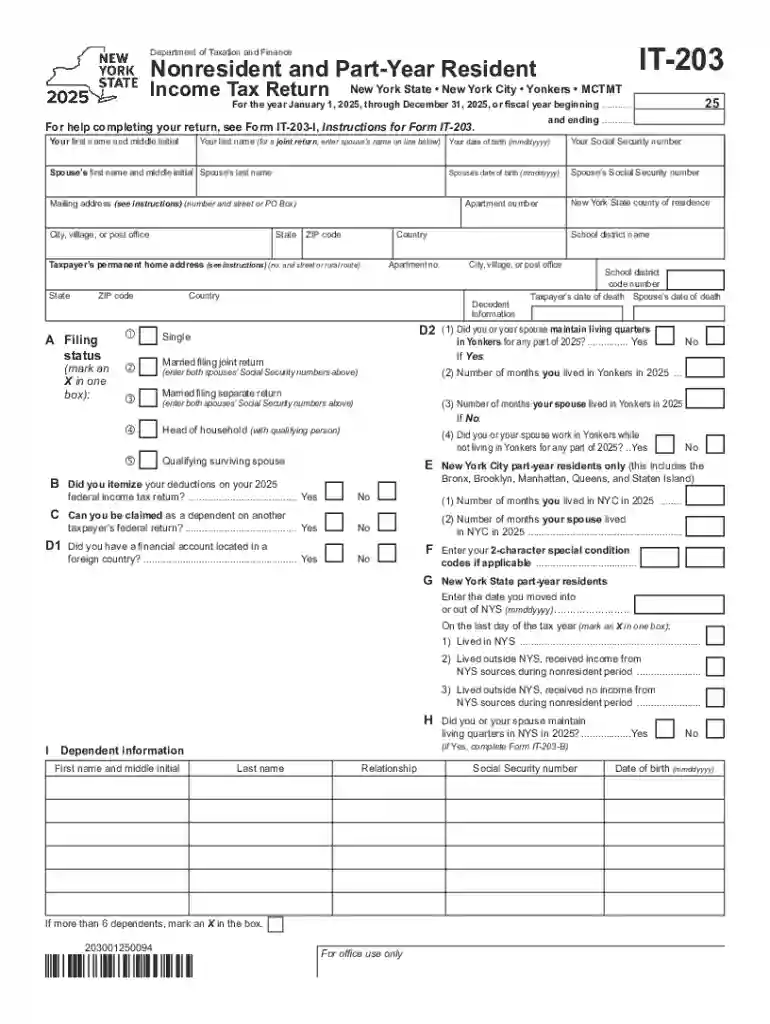
Type text, add images, blackout confidential details, add comments, highlights and more.

Draw your signature, type it, upload its image, or use your mobile device as a signature pad.

Send it via email, link, or fax. You can also download it, export it or print it out.
Form IT-203 is the New York State Department of Taxation and Finance's designated nonresident and part-year resident income tax return form. This document is mandatory for individuals who do not reside in New York but earn an income from New York sources. The primary function of this form is to determine the appropriate amount of state taxes owed based on income generated within New York. It includes sections for reporting wages, business income, rental income, and any other earnings specific to the state.
To determine whether you should file Form IT-203, consider the following criteria:


Completing Form IT-203 involves several detailed steps to ensure accuracy and compliance. The following outlines the process:
Understanding essential terminology is vital when dealing with Form IT-203:
These terms ensure accurate completion of the form, as different rules may apply for nonresidents and part-year residents regarding the income reported and tax liabilities calculated.
Form IT-203 is applicable in numerous situations. Here are several practical examples:
Consider the scenario of an IT consultant living in California who provides services to a New York-based company. They would file Form IT-203 to disclose this New York-source income and ascertain the correct tax obligations.
New York State ensures compliance by requiring nonresidents and part-year residents with New York-source income to file Form IT-203. The legal framework mandates accurate reporting to prevent underpayment or evasion of taxes owed. Understanding the implications of underreporting or neglecting to file is crucial, as penalties can involve fines or additional fees.
Failure to file or incorrectly filing Form IT-203 can result in several penalties, such as late fees, interest on unpaid taxes, and additional charges for discrepancies discovered during audits.
Mastering these key elements is vital to achieving an accurate and compliant tax filing. Each section of the form plays a critical role in determining overall tax obligations.
Form IT-203 is due by April 15 of the year following the tax year being reported. If April 15 falls on a weekend or public holiday, the deadline extends to the next business day.
Taxpayers can request an automatic extension by filing Form IT-370, allowing additional time, typically extending to October 15. However, interest will accrue on any taxes not paid by the original due date.
Form IT-203 can be submitted either digitally through approved software or as a paper form mailed to the New York State Department of Taxation and Finance. Digital filing offers the advantage of faster processing and instant confirmation of receipt.
Understanding these options and strategic filing choices is essential for optimizing your tax reporting process.
We've got more versions of the How to file New York Form IT-203 for a Nonresident form. Select the right How to file New York Form IT-203 for a Nonresident version from the list and start editing it straight away!
| Versions | Form popularity | Fillable & printable |
|---|---|---|
| 2025 | 4.6 Satisfied (39 Votes) | |
| 2024 | 4.6 Satisfied (43 Votes) | |
| 2023 | 4.1 Satisfied (44 Votes) | |
| 2022 | 4.9 Satisfied (24 Votes) | |
| 2021 | 4.8 Satisfied (81 Votes) | |
| 2020 | 4.4 Satisfied (264 Votes) | |
| 2019 | 4.4 Satisfied (214 Votes) | |
| 2018 | 4.3 Satisfied (118 Votes) | |
| 2017 | 4.2 Satisfied (66 Votes) | |
| 2015 | 4.5 Satisfied (49 Votes) | |
| 2011 | 4.3 Satisfied (74 Votes) | |
| 2010 | 4 Satisfied (51 Votes) | |
| 2002 | 4 Satisfied (26 Votes) |
At DocHub, your data security is our priority. We follow HIPAA, SOC2, GDPR, and other standards, so you can work on your documents with confidence.


If I am a nonresident , do I need to file a. NYS income tax return? Yes, if you meet any of the following conditions:: ▫ You had New York-source income and yourRead more
Indicate the number of outstanding shares of each of the issuers classes of capital or common stock as of the close of the period covered by the annual.Read more


