




01. Edit your form online
Type text, add images, blackout confidential details, add comments, highlights and more.

Type text, add images, blackout confidential details, add comments, highlights and more.

Draw your signature, type it, upload its image, or use your mobile device as a signature pad.

Send it via email, link, or fax. You can also download it, export it or print it out.
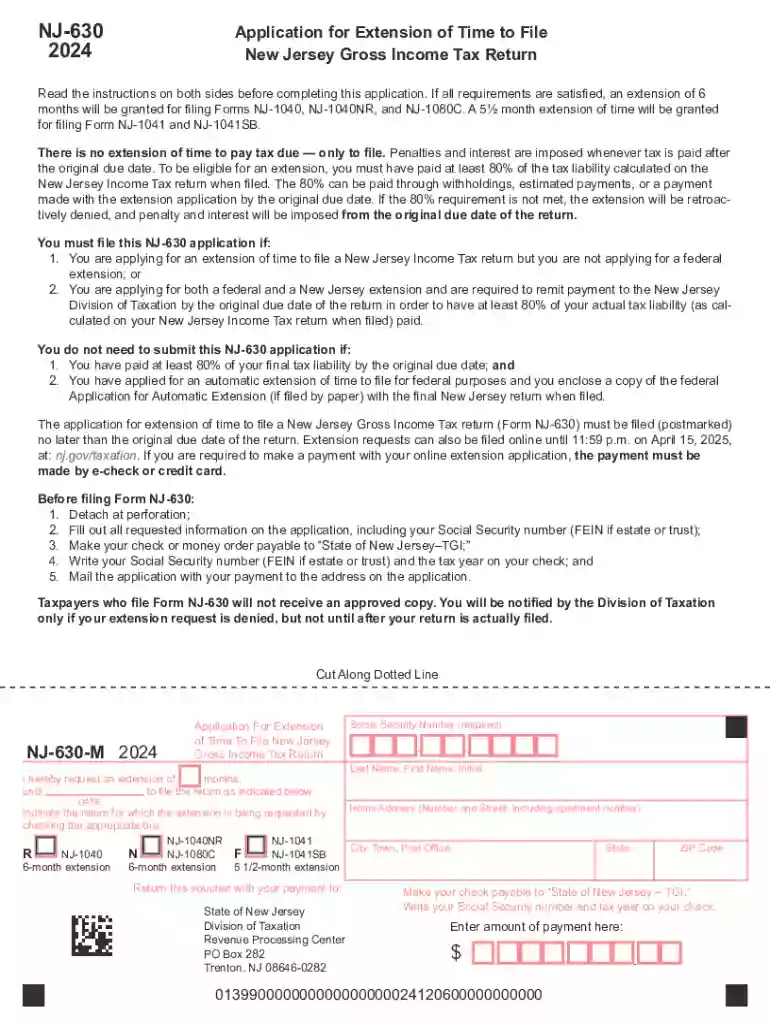
Form NJ-630, officially titled the "Application for Extension of Time to File," is a critical document for taxpayers in New Jersey. This form enables individuals to request additional time for filing their New Jersey Gross Income Tax returns. The main purpose of the form is to provide taxpayers with a six-month extension to file their returns under specific circumstances. However, it is crucial to note that while this extension applies to the filing of the return, it does not extend the time for paying any taxes due. Taxpayers must settle at least 80% of their total tax liability by the original due date to qualify for this extension.
To qualify for the extension provided by Form NJ-630, taxpayers must meet several criteria. Primarily, they must ensure that at least 80% of the anticipated New Jersey Gross Income Tax liability is paid by the original due date, which is generally April 15. Failure to meet this criterion may result in penalties and interest on any outstanding tax amount. Additionally, taxpayers must not have any outstanding balances or prior issues with the New Jersey Division of Taxation that could affect their eligibility for the extension.


Filing Form NJ-630 requires careful attention to detail to ensure accuracy and completeness. Below is a step-by-step guide to completing the form:
Personal Information: Start by entering your full name, address, and Social Security Number. Ensure that this information matches what is filed with the New Jersey Division of Taxation.
Tax Year Information: Clearly indicate the tax year for which you are seeking an extension. For the 2024 application, ensure that the year '2024' is correctly filled in the designated section.
Tax Payment Details: Calculate and enter the tax payment amount you have made or intend to make by the original filing deadline. This should reflect at least 80% of your liability.
Signature: The form requires your signature to validate and authorize the request for an extension. Ensure the form is signed and dated properly.
Submission: Submit the completed form along with the required payment amount. Methods of submission are detailed further below.
Form NJ-630 offers multiple submission options to accommodate various taxpayer preferences. Understanding these methods ensures compliance and timely processing of your extension request.
Online Submission: E-filing through the New Jersey Division of Taxation's official website can be a quick and secure method. Digital submissions often offer immediate confirmation.
Mail: Physical copies of the form can be mailed. When mailing, ensure that it is postmarked by the due date to avoid any penalties.
In-Person: In some cases, delivering the form at designated centers is an option, providing an opportunity for personal verification.
The deadline to file Form NJ-630 for the tax year 2024 aligns with the federal tax filing deadline, typically April 15. However, when this date falls on a weekend or public holiday, the deadline is extended to the next business day. It is crucial that the application, along with any necessary payments, is submitted by this date to avoid penalties.
There are specific consequences for taxpayers who fail to comply with the extension terms or miss the deadlines:
Late Payment Penalties: If the required 80% payment is not made by the original due date, interest and penalties may accrue on the unpaid amount.
Late Filing Penalties: While Form NJ-630 provides an extension for filing, missing the new deadline can result in additional fines.
Form NJ-630 is particularly ideal for individuals who foresee challenges in meeting the initial tax filing deadline. Common users include:
Self-Employed Individuals: Those with complex income streams who need more time to organize their financial documents.
Business Owners: Small businesses and partnerships requiring extensions on their state income tax obligations.
Expats: U.S. citizens or residents temporarily living overseas who might face delays in preparing their returns.
Consider a small business owner who needs additional time to finalize his financial statements to ensure accuracy in reporting. Submitting Form NJ-630 grants the necessary time without facing penalties for late filing, provided conditions are met.
For seamless and effective management of Form NJ-630, integrating it with platforms like DocHub can streamline document workflows. Digital tools enhance the completion, signing, and submission process, providing a user-friendly interface to manage tax documentation.
Leveraging software like TurboTax or QuickBooks in conjunction with DocHub can further simplify filing, enabling users to maintain accurate financial records and facilitate data transfer when completing Form NJ-630.
Timeliness: Ensuring all payments are made by the original tax deadline is crucial to avoid penalties.
Accuracy: Double-checking entries on Form NJ-630 minimizes errors that could delay processing.
Digital Tools: Utilizing platforms like DocHub can enhance form management and improve overall efficiency.
Form NJ-630 serves as a valuable resource for New Jersey taxpayers needing additional time to file their income tax returns. Proper understanding and application of this form can provide significant relief, permitting focused and orderly tax preparation.
We've got more versions of the 2024 Application for Extension of Time to File, form NJ-630 form. Select the right 2024 Application for Extension of Time to File, form NJ-630 version from the list and start editing it straight away!
| Versions | Form popularity | Fillable & printable |
|---|---|---|
| 2025 | 4.7 Satisfied (24 Votes) | |
| 2024 | 4.6 Satisfied (59 Votes) | |
| 2023 | 4.9 Satisfied (39 Votes) | |
| 2022 | 4.8 Satisfied (51 Votes) | |
| 2021 | 4.8 Satisfied (85 Votes) | |
| 2020 | 4.4 Satisfied (158 Votes) | |
| 2019 | 4.3 Satisfied (53 Votes) | |
| 2018 | 4.4 Satisfied (97 Votes) | |
| 2017 | 4.2 Satisfied (58 Votes) | |
| 2016 | 4.4 Satisfied (31 Votes) | |
| 2015 | 4.4 Satisfied (510 Votes) | |
| 2014 | 3.9 Satisfied (28 Votes) | |
| 2013 | 4 Satisfied (50 Votes) | |
| 2012 | 4.4 Satisfied (279 Votes) |
At DocHub, your data security is our priority. We follow HIPAA, SOC2, GDPR, and other standards, so you can work on your documents with confidence.

Jun 18, 2026 Chapter 3 provides a comprehensive literature review on the topic of organizational incentives for sustainability.
Mar 28, 2024 The State University of New Jersey: February 9, 2024 ) provides a comprehensive overview of the financial position of Rutgers, The State
Mar 24, 2026 You can file your request for extension online or by printing and mailing Form NJ-630 . You Must Pay At Least 80% of Your Tax Liability.Read more


