




01. Edit your w4 form 2016 online
Type text, add images, blackout confidential details, add comments, highlights and more.

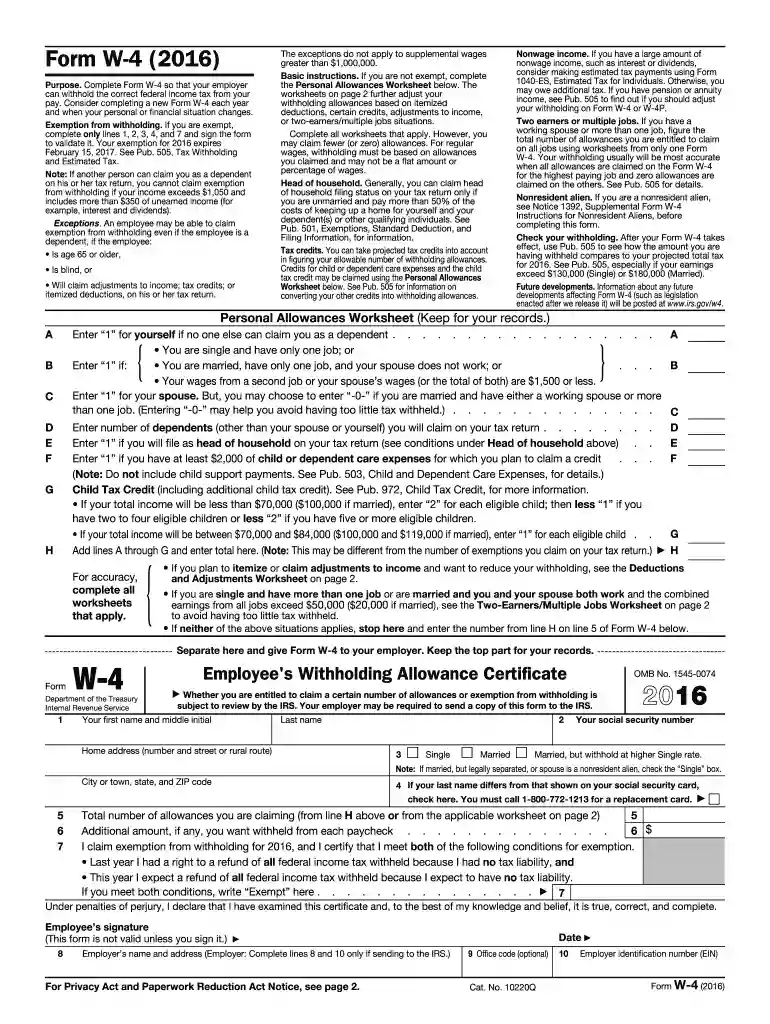
Type text, add images, blackout confidential details, add comments, highlights and more.

Draw your signature, type it, upload its image, or use your mobile device as a signature pad.

Send w 4 form 2016 via email, link, or fax. You can also download it, export it or print it out.
The 2016 W-4 Form, also known as the Employee's Withholding Allowance Certificate, is used in the United States by employees to inform their employers of the appropriate amount of federal income tax to withhold from their paychecks. This form is crucial for ensuring that the correct tax amount is deducted, preventing employees from owing a significant amount of tax during filing season or overpaying throughout the year. Adjusting the withholding based on personal circumstances, such as changes in marital status, number of dependents, or multiple jobs, is an essential feature of the form.
To effectively use the 2016 W-4 Form, employees must assess their personal tax situations and claim allowances accordingly. Here's a step-by-step approach to utilizing the form appropriately:
Determine Filing Status:
Calculate Allowances:
Adjust Withholdings for Specific Situations:
Submit the Form to Your Employer:
Completing the 2016 W-4 Form involves several key steps to ensure accuracy. Follow this detailed procedure:
Filling Out Personal Information:
Completing Allowances Worksheet:
Indicating Additional Withholding:
Adjusting for Higher Income:
Sign and Date the Form:
Understanding the key elements of the 2016 W-4 Form is essential for correct and efficient filing:
Abiding by legal guidelines when using the 2016 W-4 Form is imperative for both employees and employers. Several critical legal considerations include:
Real-world scenarios can illustrate common use cases of the 2016 W-4 Form:
The IRS provides specific guidelines that must be adhered to when dealing with the 2016 W-4 Form, ensuring employees correctly calculate withholding:
Understanding submission options and critical deadlines is essential for timely processing:
Submission Methods:
Relevant Deadlines:
We've got more versions of the w4 form 2016 form. Select the right w4 form 2016 version from the list and start editing it straight away!
| Versions | Form popularity | Fillable & printable |
|---|---|---|
| 2025 | 4.5 Satisfied (26 Votes) | |
| 2024 | 4.2 Satisfied (40 Votes) | |
| 2023 | 4.3 Satisfied (21 Votes) | |
| 2022 | 4 Satisfied (53 Votes) | |
| 2021 | 4.9 Satisfied (53 Votes) | |
| 2020 | 4.2 Satisfied (93 Votes) | |
| 2019 | 4.4 Satisfied (617 Votes) | |
| 2018 | 4.4 Satisfied (332 Votes) | |
| 2017 | 4 Satisfied (47 Votes) | |
| 2017 | 4.4 Satisfied (334 Votes) | |
| 2016 | 4.4 Satisfied (484 Votes) | |
| 2015 | 4 Satisfied (51 Votes) | |
| 2014 | 4.2 Satisfied (41 Votes) | |
| 2013 | 4 Satisfied (29 Votes) | |
| 2012 | 4.4 Satisfied (38 Votes) |
At DocHub, your data security is our priority. We follow HIPAA, SOC2, GDPR, and other standards, so you can work on your documents with confidence.



Purpose. Complete Form W-4 so that your employer can withhold the correct federal income tax from your pay. Consider completing a new Form W-4 each year.Read more
Mar 1, 2017 Form W-4 (given to your employer) and your. Form W-4 or W-4P (on file with your pension plan) must work together to determine the cor- rectRead more


