




01. Edit your form w 4 2013 online
Type text, add images, blackout confidential details, add comments, highlights and more.

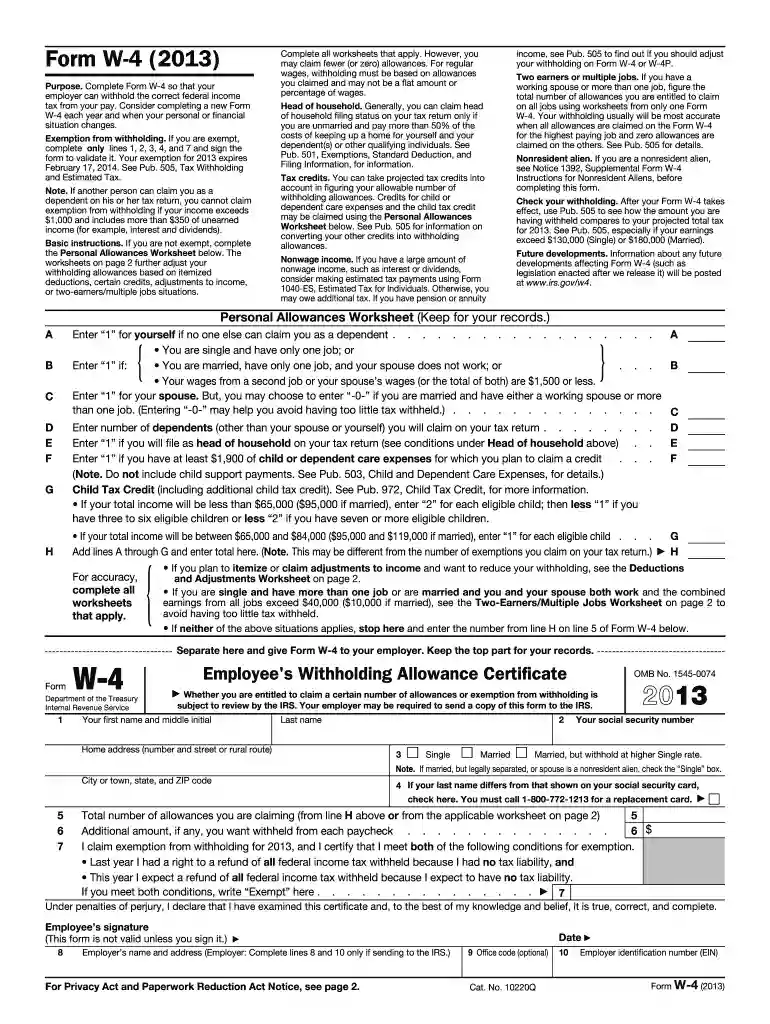
Type text, add images, blackout confidential details, add comments, highlights and more.

Draw your signature, type it, upload its image, or use your mobile device as a signature pad.

Send 2013 w4 via email, link, or fax. You can also download it, export it or print it out.
The "2013 form" refers to a specific document used for tax reporting or legal purposes, often in a financial or business context. These forms are typically used to communicate vital information to government entities, like the Internal Revenue Service (IRS), or other governing bodies. Comprehending the details and purpose of these forms is critical, as they ensure compliance with applicable regulations and laws. The 2013 form may include sections to capture personal or business information, financial details, or relevant declarations. It is essential to explore the unique characteristics and functions of each form type to fully grasp its implications.
To effectively use a 2013 form, follow these steps for accurate completion:
Pay close attention to detail, as accuracy in filling out these forms is crucial for proper processing and compliance with federal and state regulations.
Obtaining a 2013 form can be done through various channels:
Having timely access to the necessary forms enables a smoother submission process, ensuring you remain compliant with necessary legal requirements.
Completing a 2013 form requires meticulous attention. Here’s a step-by-step process:
Completing these steps thoroughly supports a hassle-free filing process.
Several important terms often emerge when dealing with the 2013 form:
Familiarity with these terms enhances understanding and ensures accurate form completion.
The legal framework for using a 2013 form involves strict adherence to laws and regulations to maintain compliance. Utilizing the form:
Understanding the legal implications of these forms avoids potential penalties and supports lawful financial practices.
Adhering to the filing deadlines associated with the 2013 form is crucial to avoid penalties. Key considerations include:
Observance of these timelines helps ensure compliance and reduces the chance of incurring late fees or other sanctions.
Filing a 2013 form often necessitates accompanying documentation, such as:
Having these records on hand when completing the form ensures that all reported information is verifiable and correct.
Each section of this guide offers comprehensive insights into navigating and managing your 2013 form effectively, highlighting the importance of meticulous attention to detail and compliance with prescribed guidelines for smooth processing.
We've got more versions of the form w 4 2013 form. Select the right form w 4 2013 version from the list and start editing it straight away!
| Versions | Form popularity | Fillable & printable |
|---|---|---|
| 2025 | 4.5 Satisfied (26 Votes) | |
| 2024 | 4.2 Satisfied (40 Votes) | |
| 2023 | 4.3 Satisfied (21 Votes) | |
| 2022 | 4 Satisfied (53 Votes) | |
| 2021 | 4.9 Satisfied (53 Votes) | |
| 2020 | 4.2 Satisfied (93 Votes) | |
| 2019 | 4.4 Satisfied (617 Votes) | |
| 2018 | 4.4 Satisfied (332 Votes) | |
| 2017 | 4 Satisfied (47 Votes) | |
| 2017 | 4.4 Satisfied (334 Votes) | |
| 2016 | 4.4 Satisfied (484 Votes) | |
| 2015 | 4 Satisfied (51 Votes) | |
| 2014 | 4.2 Satisfied (41 Votes) | |
| 2013 | 4 Satisfied (29 Votes) | |
| 2012 | 4.4 Satisfied (38 Votes) |
At DocHub, your data security is our priority. We follow HIPAA, SOC2, GDPR, and other standards, so you can work on your documents with confidence.
Check the box for the return for which you are using this Form 8879-EO and enter the applicable amount, if any, from the return. If you check the box on line 1aRead more
Form 1040A (2013). Page 2. Tax, credits, and payments. 22. Enter the amount from Firms name ▷. Firms address ▷. Firms EIN ▷. Phone no. Form 1040A (2013)Read more
Attach this form and a copy of federal Form 4562 to your New York State corporation franchise tax return.Read more


