




01. Edit your fillable w4 2023 online
Type text, add images, blackout confidential details, add comments, highlights and more.

Type text, add images, blackout confidential details, add comments, highlights and more.

Draw your signature, type it, upload its image, or use your mobile device as a signature pad.

Send w4 2023 form via email, link, or fax. You can also download it, export it or print it out.
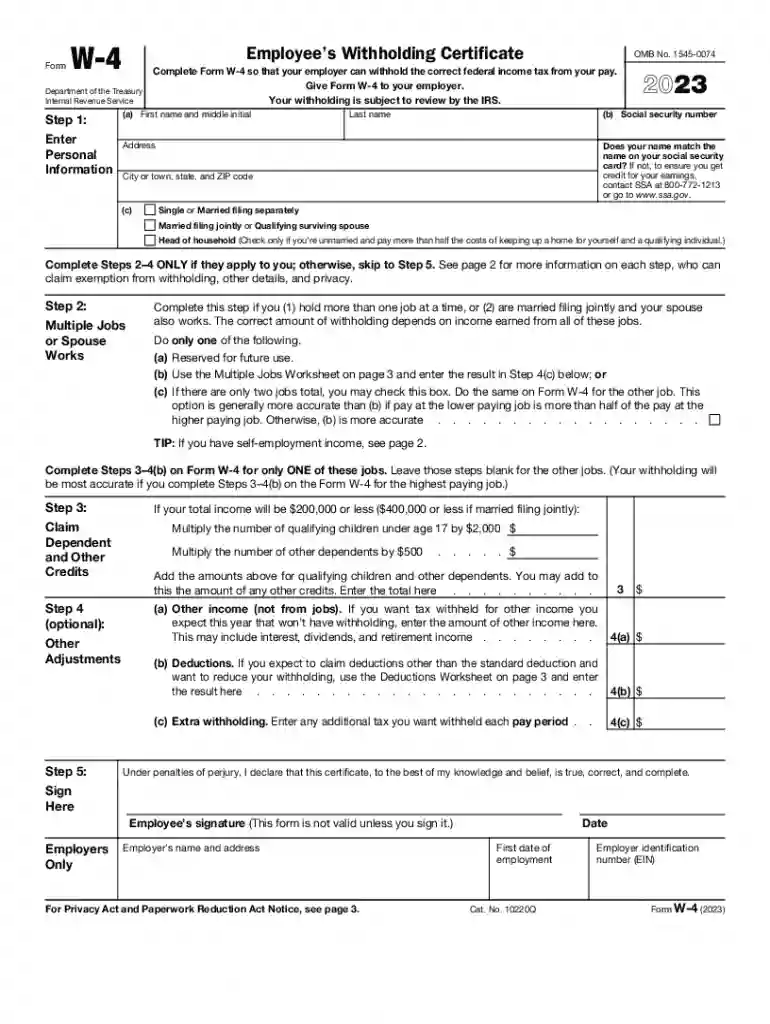
The 2023 Form W-4, known as the Employee's Withholding Certificate, is a vital document issued by the IRS. It is designed for employees to communicate their personal information and tax withholding preferences to their employers. This ensures that the correct amount of federal income tax is withheld from their paychecks, aligning with their financial situation to avoid underpayment or overpayment of taxes. This form is crucial for maintaining accurate tax withholding, which helps in preventing large tax payments or refunds during the annual tax filing process.
Employees can easily access the 2023 Form W-4 through various methods. It is freely available on the IRS website, where it can be downloaded and printed. Employers typically provide this form to new employees during the onboarding process. Additionally, many tax software applications and payroll services include the capacity to fill out this form digitally. Obtaining the form through these channels ensures that employees can promptly update their withholding information as needed.
Filling out the 2023 Form W-4 requires careful attention to detail. Follow these steps to ensure accuracy:
Enter Personal Information:
Multiple Jobs or Spouse Works:
Claim Dependents:
Other Adjustments:
Signing and Dating:
The 2023 Form W-4 plays a critical role in an employee's tax planning strategy. Accurate withholding helps maintain financial stability by avoiding unexpected tax bills or unwanted large refunds. With updated information, employees can ensure that their withholdings match their actual tax obligation, considering changes in income, dependents, and employment status.
Understanding the essential sections of the W-4 form is important for accurate completion:
These components collectively ensure precise withholding aligning with individual financial circumstances.
The IRS provides comprehensive guidelines for the effective use of the Form W-4. Employees should review and update the form whenever significant life changes occur, such as marriage, divorce, birth of a child, or a change in employment. The guidelines also clarify when recalibrating withholding might be necessary, especially in response to tax law changes or variations in income levels across different tax years.
The IRS and employers accommodate several methods to submit the 2023 Form W-4:
These methods ensure that the employee's tax withholding preferences are documented and implemented accurately.
Failure to accurately complete and submit the Form W-4 can lead to inadequate withholding, resulting in potential penalties. Underwithholding might cause a substantial tax bill and interest penalties during tax filing, while overwithholding could lead to reduced paycheck cash flow. Non-compliance may also trigger scrutiny from the IRS, emphasizing the importance of maintaining updated and precise records on this form to avoid any legal or financial consequences.
We've got more versions of the fillable w4 2023 form. Select the right fillable w4 2023 version from the list and start editing it straight away!
| Versions | Form popularity | Fillable & printable |
|---|---|---|
| 2025 | 4.5 Satisfied (26 Votes) | |
| 2024 | 4.2 Satisfied (40 Votes) | |
| 2023 | 4.3 Satisfied (21 Votes) | |
| 2022 | 4 Satisfied (53 Votes) | |
| 2021 | 4.9 Satisfied (53 Votes) | |
| 2020 | 4.2 Satisfied (93 Votes) | |
| 2019 | 4.4 Satisfied (617 Votes) | |
| 2018 | 4.4 Satisfied (332 Votes) | |
| 2017 | 4 Satisfied (47 Votes) | |
| 2017 | 4.4 Satisfied (334 Votes) | |
| 2016 | 4.4 Satisfied (484 Votes) | |
| 2015 | 4 Satisfied (51 Votes) | |
| 2014 | 4.2 Satisfied (41 Votes) | |
| 2013 | 4 Satisfied (29 Votes) | |
| 2012 | 4.4 Satisfied (38 Votes) |
At DocHub, your data security is our priority. We follow HIPAA, SOC2, GDPR, and other standards, so you can work on your documents with confidence.
Complete Form W-4 so that your employer can withhold the correct federal income tax from your pay. If too little is withheld, you will generally owe tax whenRead more
Apr 15, 1976 Employees Withholding Allowance Certificate. W-4. Employers Annual Federal Unemployment. (FUTA) Tax Return. 940. U.S. Individual Income TaxRead more


