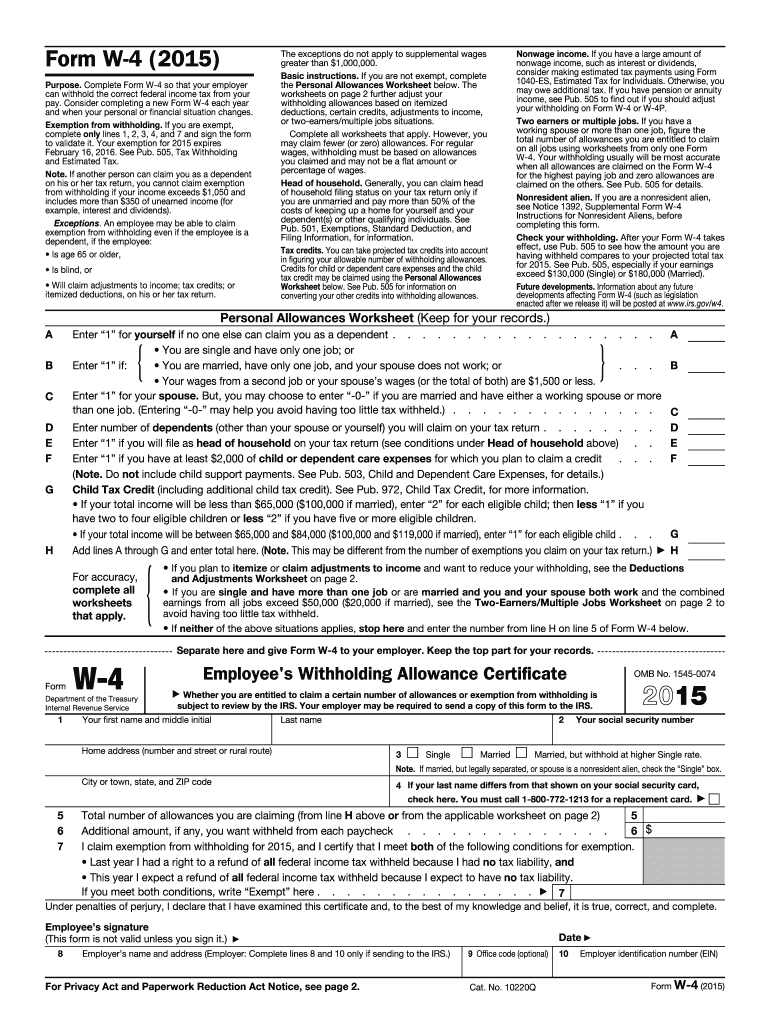







Definition and Meaning of Form W-4 (2015)
Form W-4 (2015) is essential for employees to communicate to their employers how much federal income tax should be withheld from their paychecks. This form facilitates the employer's calculation of withholding tax based on the employee's personal financial situation, such as marital status, number of dependents, and other income or deductions. It helps in preventing over- or under-withholding throughout the tax year.
How to Use the W-4 2015 Form
To effectively use the Form W-4 (2015), employees must accurately complete the worksheets provided within the form. These worksheets assist in determining the correct number of allowances and any additional withholding amount required. Employees must submit the completed form to their employer, who will then adjust the withholding accordingly. It's important to review and update the W-4 in response to life changes such as marriage, having children, or changes in income.
How to Obtain the W-4 2015 Form
The W-4 2015 form can be obtained directly from the IRS website. Employers typically provide the form to new hires as part of the onboarding process. Additionally, many human resource departments maintain copies of the form and can assist employees in accessing it. The form can also be filled out and printed from various tax preparation software.
Steps to Complete the W-4 2015 Form
- Personal Information: Fill in your name, address, Social Security number, and filing status.
- Withholding Allowances: Complete the necessary worksheets to determine the number of allowances.
- Additional Withholding: Specify any additional withholding amount, if needed.
- Sign and Date: Ensure the form is signed and dated before submitting it to your employer.
Detailed Worksheet Instructions
- Worksheet A: This helps calculate allowances for the employee, spouse, and other dependents.
- Worksheet B: Use this for adjusting your withholdings if you have multiple jobs or your spouse also works.
Key Elements of the W-4 2015 Form
- Personal Allowances Worksheet: Assists in calculating the number of allowances.
- Deductions, Adjustments, and Additional Income Worksheet: Allows taxpayers to account for deductions and additional income.
- Two-Earners/Multiple Jobs Worksheet: Helps adjust withholding when household income comes from multiple sources.
- Signature and Filing Status: Confirms the validity of the information provided and indicates the taxpayer's filing status.
IRS Guidelines for W-4 2015 Form
The IRS provides comprehensive guidance on how to complete Form W-4 (2015). The guidelines detail how employees should assess their financial situation and complete the form accurately. It advises revisiting the form annually or upon significant life changes. IRS publications related to withholding and tax credits can provide additional details and instructions.
Examples of Using the W-4 2015 Form
Consider an employee who recently got married and bought a home:
- Marital Status Change: Update W-4 to reflect the new filing status, potentially changing allowances.
- Itemized Deductions: Use the deductions worksheet to adjust withholding for mortgage interest and property taxes.
In these scenarios, updating the form ensures the appropriate amount of tax is withheld, avoiding a large tax bill or refund at the end of the year.
Filing Deadlines and Important Dates
Form W-4 (2015) does not have a filing deadline in the traditional sense, as it is not filed with the IRS but rather kept on file with the employer. However, it's crucial to submit it as soon as changes in your financial situation occur to ensure accurate withholding. Regular reviews and updates provide the best tax management throughout the year.
Important Terms Related to the W-4 2015 Form
- Withholding: The portion of an employee's paycheck that is sent directly to the federal government as partial payment of income tax.
- Allowances: Provisions that reduce the amount of tax withheld from each paycheck.
- Filing Status: Status selected (e.g., single, married, head of household) that affects tax calculations.
Understanding these terms helps employees appreciate the impact of Form W-4 on their annual tax experience and financial planning.