Definition & Meaning
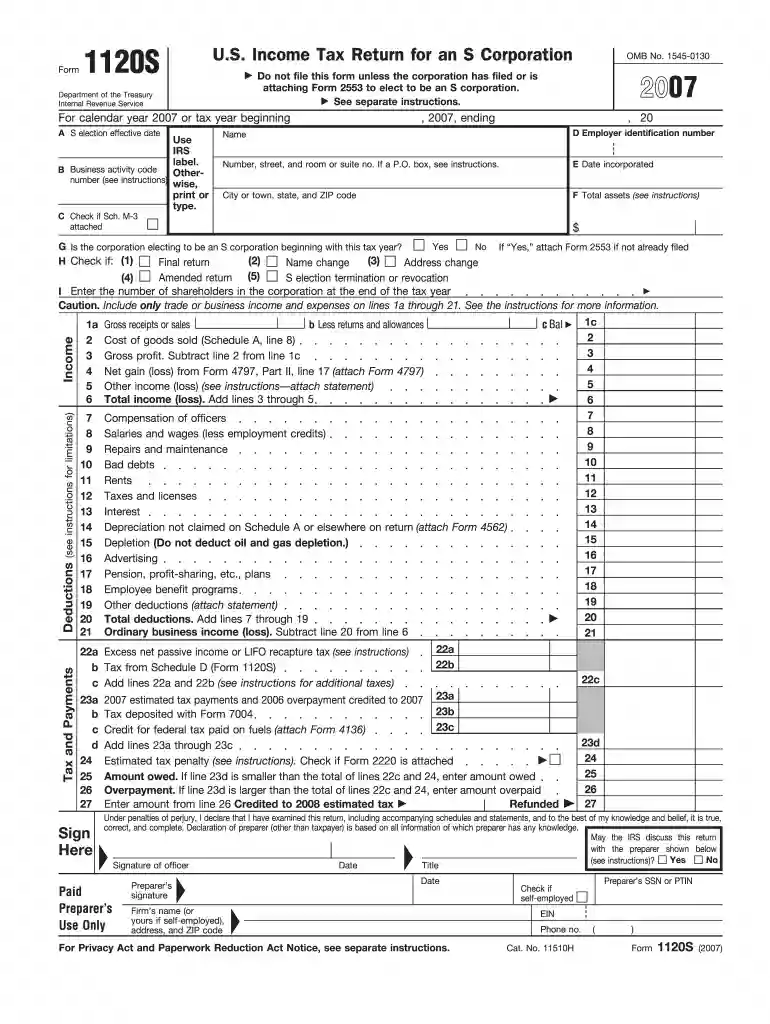
Form 1120S for the tax year 2007 is the U.S. federal income tax return used by S Corporations to report their financial activity. This tax document is pivotal for companies that have elected to be taxed under Subchapter S of the Internal Revenue Code, a status that allows income, losses, deductions, and credits to pass directly to shareholders, avoiding double taxation at the corporate level.
Characteristics of an S Corporation
- Pass-Through Taxation: Profits and losses pass through to shareholders, who report them on personal tax returns.
- Limited Liability: Shareholders have protection from business debts beyond their investment.
- Compliance Requirements: Must file Form 2553 to elect S corporation status with the IRS.
Essential Sections of Form 1120S
- Income Reporting: Sections to declare income from sales, products, and services.
- Deductions and Credits: Offers a comprehensive outline of allowable deductions, including operating expenses, salaries, and other corporate deductions.
How to Use the Form 1120S 2007
Guidance for Effective Filing
- Prepare Required Documents: Gather financial statements, proof of income, expense records, and previous tax returns.
- Fill Accurate Information: Precise income and deduction details are crucial. Include shareholder data and corporate ID numbers.
- Utilize Professional Help: Consult with a tax professional or accountant familiar with corporate filings.
Detailed Income and Deductions
- Revenue Streams: Includes line sections for gross receipts and sales. Accurate allocation between ordinary income and other income streams is necessary.
- Deductions Specificity: Accurately calculate salaries, wages, and any employment benefits granted.
Steps to Complete the Form 1120S 2007
- Start with Company Identification: Fill in the company's name, address, and unique EIN.
- Enter Shareholder Information: Precise entries for shareholder names, addresses, and share percentage.
- Complete Income Sections: Detail all income sources and any applicable credits.
- Calculate and Enter Deductions: Include expenses such as rent, wages, and utilities.
- Validate Balance Sheet Entries: Ensure that balance sheets reconcile with books.
Cross-Check with Form Instructions
- Ensure all figures align with accompanying instructions provided by the IRS.
- Double-check for any updates or nuances specific to the 2007 tax year.
Key Elements of the Form 1120S 2007
Main Components
- Page 1 - Income and Deductions: Captures the core financial details such as total income and applicable deductions.
- Schedule K: Lists income, credits, and other shareholder insights.
- Schedule M-1 and M-2: Reconciliation of income (loss) per books with income (loss) per return and analysis of unappropriated retained earnings.
Important Considerations
- Balance Sheet on Schedule L: Reflects the end-of-year financial positions.
- Distribution Details: Ensure post-filing shareholder distributions are accurately reported.
Compliance Requirements
- Filing with the IRS: Submit Form 1120S to the IRS by the 15th day of the third month after the tax year ends, typically March 15.
- Record Keeping: Maintain comprehensive records to support entries.
Amendments and Corrections
- Procedure for Amendments: Use Form 1120X to amend or correct any filed return mistakes.
- Documentation Support: Keep copies of all supporting documents for possible future audits.
Filing Deadlines / Important Dates
- Regular Submission Deadline: March 15, 2008, for calendar year filers.
- Extension Requests: Possible extensions with Form 7004, granting an additional six months.
Considerations for Timely Filing
- File early to avoid penalties.
- Arrange electronic filing to expedite the process.
Eligible Business Entities
- S Corporations Exclusively: Businesses that have filed Form 2553 for S Corporation status.
- Corporations Seeking Pass-Through Benefits: Businesses preferring income to be taxed at individual rather than corporate rates.
Typical Company Profiles
- Small to medium-sized enterprises (SMEs) utilizing pass-through benefits.
- Real estate businesses and service-based companies often find the structure advantageous.
Penalties for Non-Compliance
Understanding Consequences
- Late Filing Penalties: Calculated per month based on the number of shareholders.
- Underreporting Penalties: Imposed for significant discrepancies between true financial status and tax return content.
Avoiding Penalties
- Adhere to all deadlines.
- Assure accurate and complete information submission.
Digital vs. Paper Version
Comparing Filing Methods
- Digital Filing: Efficient and expedient, allowing autofill features and error checks.
- Paper Filing: Traditional approach with potential for manual entry errors.
Advantages of Electronic Filings
- Saves time and reduces error potential.
- IRS acknowledges receipt promptly, streamlining the process.
Essential Documentation
- Shareholder Agreements: Statements supporting income division.
- Financial Records: Income statements, balance sheets, and expense logs.
- Previous Tax Returns: To guide accurate current-year reporting.
Setting Up for Success
- Assemble documents before beginning to ensure an efficient filing process.
- Confirm each document's relevance to the form's sections.