







Definition & Meaning
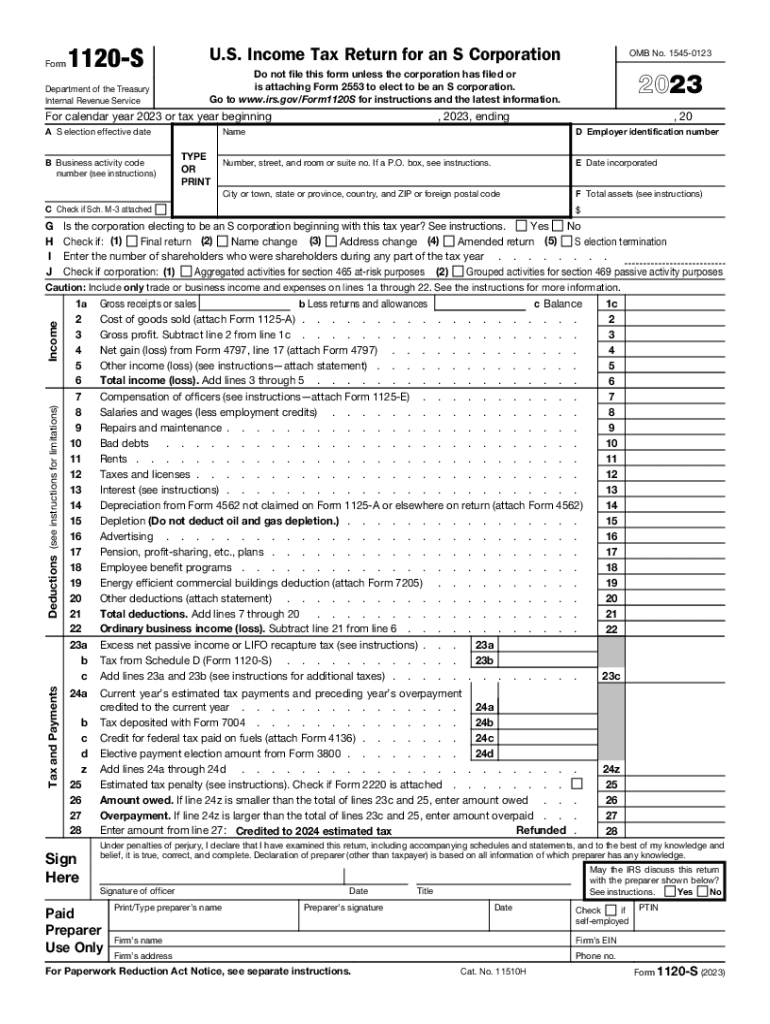
Form 1120-S, often referred to as F1120s, is the U.S. tax document filed by corporations that elect to be taxed as S corporations. Unlike traditional corporations that pay corporate income tax, S corporations pass corporate income, losses, deductions, and credits through to shareholders, who report these on their personal tax returns. This form is critical for ensuring the correct allocation of tax responsibilities within an S corporation and involves detailed reporting of the company's financial and operational data.
Steps to Complete the F1120s
Completing Form 1120-S involves several detailed steps, ensuring accurate reporting:
-
Identify General Information: Start by providing corporate details, including the name, address, and Employer Identification Number (EIN). This section also requires the date of incorporation and the type of business operations.
-
Report Income: All gross receipts or sales need to be detailed. This involves calculating total sales and subtracting returns and allowances to arrive at net sales.
-
Deduct Expenses: Here, businesses list their allowable deductions such as salaries, wages, rents, and advertising expenses. This step is essential for identifying the net profit or loss.
-
Shareholder Information: List each shareholder's information, including their ownership percentage. This ensures accurate allocation of income or loss.
-
Calculate Total Taxes: Determine any tax liabilities, including built-in gains tax or excess net passive income tax.
Following each step meticulously ensures compliance and accurate financial reporting for the corporation and its shareholders.
Examples and Detailed Guidance
-
Gross Receipts: If your business generated $500,000, include this in the gross receipts section. Account for any returns or discounts separately.
-
Wage Deductions: If your corporation paid $200,000 in employee wages, this figure should appear in the deductions section.
-
Shareholder Allocation: In an S corporation with three equal shareholders, each must report one-third of the corporation's income or loss on their personal tax returns.
Filing Deadlines / Important Dates
The filing deadline for Form 1120-S generally falls on the 15th day of the third month following the end of the corporation's tax year. For corporations using a calendar year, this means the form is due by March 15. If additional time is needed, businesses can file for a six-month extension using Form 7004. However, this extension does not delay any tax payments owed.
Critical Considerations
- Mark March 15 as the due date for calendar year corporations.
- Penalties can arise if the form is late, leading to daily charges for each month or part of a month past the deadline.
- Extensions granted by filing Form 7004 only postpone the filing requirement, not the payment due date.
Required Documents
To accurately complete Form 1120-S, several supporting documents are necessary:
-
Financial Statements: Balance sheet, profit and loss statement, and other relevant documents showing the corporation's financial position.
-
S Corporation Election Form (Form 2553): This is crucial for corporations initially electing S status and must have been previously filed and approved.
-
Shareholder Agreements: Documents detailing the structure of shareholder arrangements and income distribution methods.
Having these documents ensures a streamlined process for preparing and submitting the 1120-S.
Who Typically Uses the F1120s
Form 1120-S is utilized by S corporations in the United States, which are often small to medium-sized businesses that choose to pass income directly to shareholders to avoid double taxation. This form caters primarily to companies with shareholders who want income taxed at their individual rates rather than at corporate tax rates. These entities range from family-owned businesses to diverse business ventures with multiple shareholders.


Eligible Business Types
- Family-Owned Corporations: Often elect S corporation status to benefit from pass-through taxation.
- Start-Ups and Small Businesses: These entities may prefer the single level of taxation available through S corporation status.
- Professional Corporations: Such as those owned by lawyers or doctors, which can benefit from specific tax structures provided by an S corporation.
IRS Guidelines
The Internal Revenue Service provides extensive guidelines for completing Form 1120-S, ensuring compliance and accurate reporting:
-
Income and Deductions Reporting: IRS instructions detail what constitutes taxable income and allowable business deductions, vital for maintaining compliance.
-
Record-Keeping Requirements: The IRS mandates thorough record maintenance to substantiate entries on both the corporate form and shareholders’ individual tax returns.
-
Shareholder Basis Requirements: Guidelines explain how to manage the basis of shares in S corporations, essential for determining loss deduction limits by shareholders.
Key Elements of the F1120s
Form 1120-S includes several essential components that capture the financial and operational status of an S corporation:
- Income Section: This records all gross income, including sales, interest, dividends, and rental income.
- Deductions Section: Corporations disclose ordinary business expenses, leading to taxable income calculation.
- K-1 Forms: Used to report each shareholder's share of income, deductions, and credits. This element ensures accurate coalition between the corporation's finances and the shareholders’ individual tax situations.
Legal Use of the F1120s
Form 1120-S must be used according to U.S. tax laws governing S corporations. Filing correctly ensures corporations fulfill legal obligations and avoid potential penalties for misreporting. Correct use of the form includes accurate income and expenditure declaration, adherence to shareholder tax responsibilities, and compliance with all IRS reporting standards, maintaining the legitimacy and transparency of the corporation’s financial activities.
Compliance Tips and Pitfalls
- Regularly consult with a tax professional to ensure adherence to IRS changes and updates regarding S corporation regulations and requirements.
- Avoid common filing errors, such as incorrect shareholder percentages or misreported deductions, which could trigger audits or fines.
- Review IRS publications and resources for updates on legal adjustments affecting S corporations and their shareholders.




