




01. Edit your form online
Type text, add images, blackout confidential details, add comments, highlights and more.

Type text, add images, blackout confidential details, add comments, highlights and more.

Draw your signature, type it, upload its image, or use your mobile device as a signature pad.

Send it via email, link, or fax. You can also download it, export it or print it out.
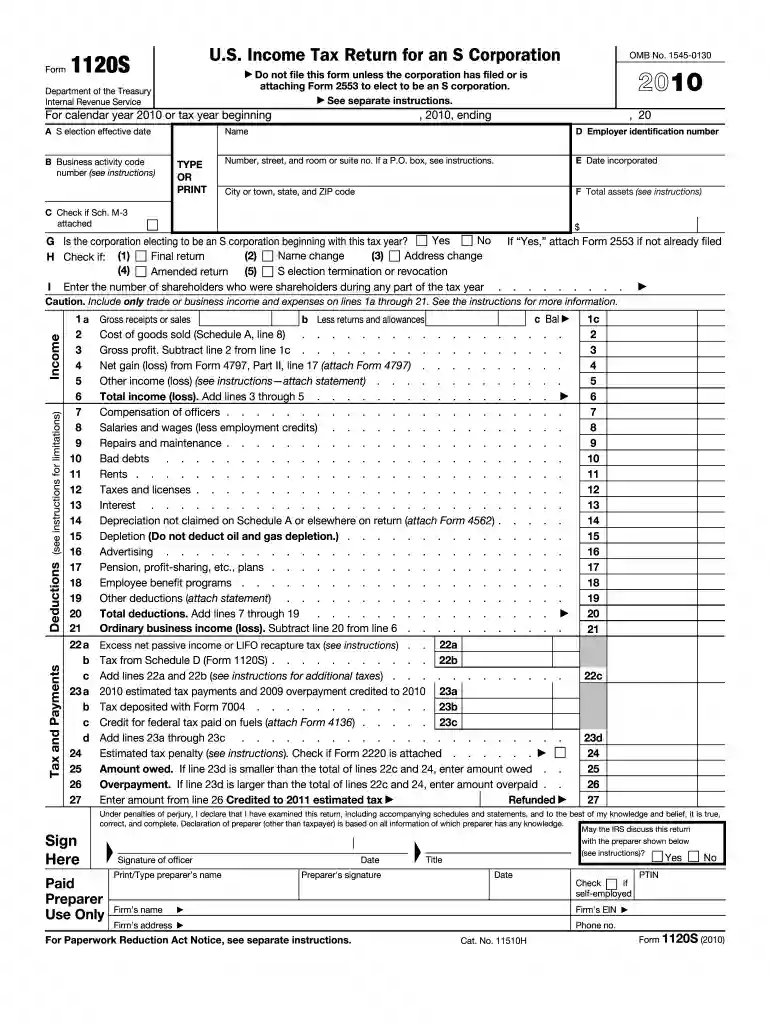
The 2010 Form 1120S is the U.S. Income Tax Return form specifically for S Corporations for the tax year 2010. S Corporations are distinct in that they pass income, losses, deductions, and credits through to their shareholders for federal tax purposes, allowing them to report income on personal tax returns, thus avoiding double taxation on the corporate income. This form is crucial for documenting these financial activities accurately.
The form ensures compliance with federal tax laws and helps determine the correct tax liability for both the corporation and its shareholders.
The 2S form is used by S Corporations to report financial data for the tax year. Proper completion is essential for accurate tax reporting and compliance.
Following these steps ensures that the 1120S form accurately represents the corporation's financial activities.
Completing the 2S form can be systematic if approached methodically.
Following these steps helps in accurate filing and compliance with IRS regulations.
S Corporations in the United States are mandated to use the 2010 Form 1120S to report their financials for that specific tax year. Typically, businesses structured as S Corporations, which may include certain small businesses, family-owned companies, and domestic corporations, utilize this form.


Understanding the following terms is critical when dealing with Form 1120S:
These terms ensure clarity in filing and comprehension of the form's requirements.
The IRS provides specific guidelines to ensure proper completion and submission of the 2S form:
Adhering to IRS guidelines is crucial to avoid errors and potential penalties.
For the tax year 2010, the 1120S form had a filing deadline typically set for March 15, 2011. However, extensions were available upon request through Form 7004, extending the deadline by six months.
Timely filing prevents late fees and interest charges.
Non-compliance with the filing requirements of the 2010 Form 1120S can lead to significant penalties:
Understanding these penalties motivates accurate and timely completion of the form.
We've got more versions of the 2010 1120 s form form. Select the right 2010 1120 s form version from the list and start editing it straight away!
| Versions | Form popularity | Fillable & printable |
|---|---|---|
| 2024 | 4.8 Satisfied (41 Votes) | |
| 2023 | 4.6 Satisfied (60 Votes) | |
| 2022 | 4.1 Satisfied (39 Votes) | |
| 2021 | 4.9 Satisfied (39 Votes) | |
| 2020 | 4.3 Satisfied (174 Votes) | |
| 2019 | 4.2 Satisfied (47 Votes) | |
| 2018 | 4.3 Satisfied (81 Votes) | |
| 2017 | 4.2 Satisfied (110 Votes) | |
| 2016 | 4.4 Satisfied (321 Votes) | |
| 2015 | 4.2 Satisfied (41 Votes) | |
| 2014 | 4 Satisfied (46 Votes) | |
| 2013 | 4.1 Satisfied (47 Votes) | |
| 2012 | 3.7 Satisfied (31 Votes) | |
| 2011 | 4.4 Satisfied (38 Votes) | |
| 2010 | 4 Satisfied (23 Votes) |
At DocHub, your data security is our priority. We follow HIPAA, SOC2, GDPR, and other standards, so you can work on your documents with confidence.




An electing small business corporation, whether or not subject to the tax imposed by section 1378, shall make a return on Form 1120-S. See also section 6037Read more
For Paperwork Reduction Act Notice, see separate instructions. Cat. No. 11510H. Form 1120S (2010). Page 2. Form 1120S (2010). Page 2. Schedule A. Cost of GoodsRead more
Jan 19, 2017 This publication discusses common business expenses and explains what is and is not de ductible. The general rules for deducting busi.Read more


