




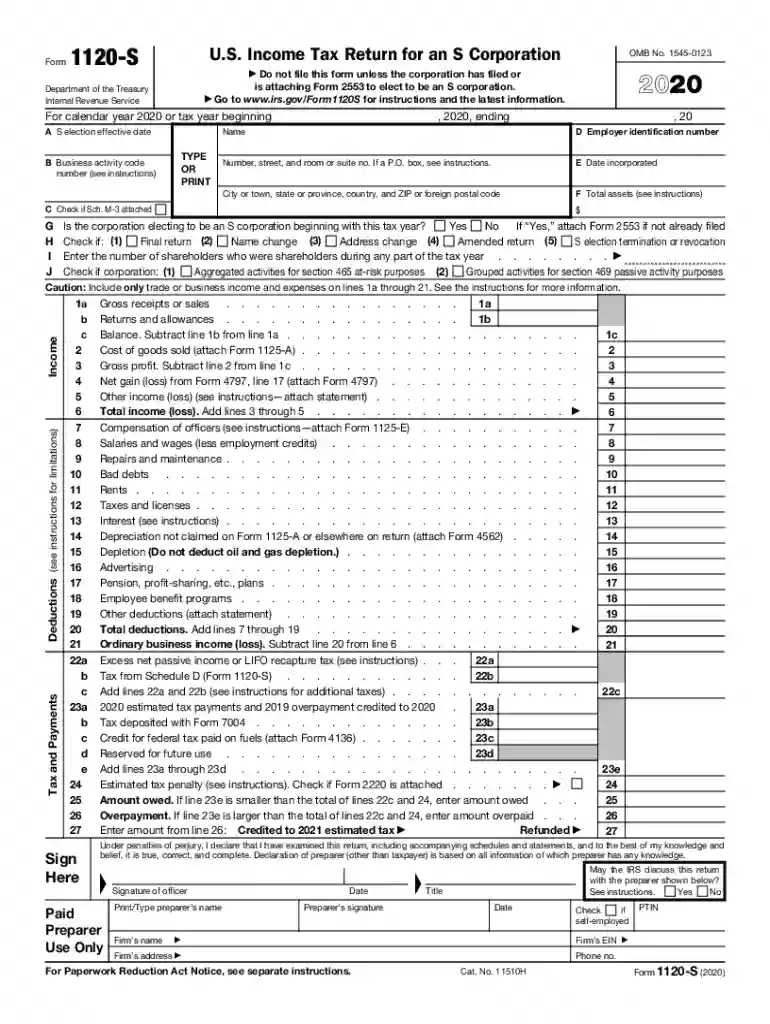
01. Edit your 2020 irs form 1120s online
Type text, add images, blackout confidential details, add comments, highlights and more.

Type text, add images, blackout confidential details, add comments, highlights and more.

Draw your signature, type it, upload its image, or use your mobile device as a signature pad.

Send form 1120s 2020 via email, link, or fax. You can also download it, export it or print it out.
Form 1120-S is a U.S. income tax return used by S corporations. It serves as a detailed report to the Internal Revenue Service (IRS) concerning the corporation's earnings, deductions, and other financial information. An S corporation must have previously filed Form 2553, which elects its status as an S corporation for tax purposes. The form simplifies taxation by allowing profits, and some losses, to be passed through directly to shareholders, avoiding double taxation.
Completing Form 1120-S involves several key steps:
Gather Required Information: Assemble all necessary financial documents, including income statements, balance sheets, and records of deductible expenses and credits.
Fill Out General Information: Include the corporation's name, address, Employer Identification Number (EIN), and the date of incorporation.
Report Income and Deductions: Calculate the corporation's total income and itemize all eligible deductions to determine taxable income.
Complete Schedules: Fill out Schedule K (Shareholders' Pro Rata Share Items) and Schedule L (Balance Sheets per Books).
Shareholder Information: Provide detailed information about each shareholder, including their percentage of ownership and any distributions received.
Review and Sign: Ensure accuracy and completeness before signing the form.
Attach Required Schedules: Append all necessary schedules and statements.
The deadline for filing Form 1120-S is the 15th day of the third month after the end of the corporation's tax year. For a typical calendar year corporation, this deadline falls on March 15. An extension can be requested using Form 7004, extending the deadline up to six months.
To qualify as an S corporation and use Form 1120-S, a corporation must meet specific requirements:


Form 1120-S is compatible with various tax preparation software, including TurboTax and QuickBooks, which aid in accurately preparing and filing the form. These tools can streamline the process, offer automatic calculations, and provide integrated error-checking.
Failing to timely file Form 1120-S or provide accurate information can result in significant penalties. Late filing incurs a penalty calculated per month or part of a month the return is late, multiplied by the number of shareholders. Inaccurate or fraudulent information can lead to additional fines and penalties, emphasizing the importance of accuracy.
Some states require separate filings or additional schedules alongside the federal Form 1120-S. Corporations must comply with both federal and state tax obligations, which can vary significantly. For example, certain states impose franchise taxes that S corporations must report separately.
S corporations can submit Form 1120-S by mail or electronically. Electronic filing is encouraged by the IRS for its efficiency and reduction of processing errors. Various tax preparation software facilitates e-filing, helping corporations ensure compliance and streamline record-keeping.
We've got more versions of the 2020 irs form 1120s form. Select the right 2020 irs form 1120s version from the list and start editing it straight away!
| Versions | Form popularity | Fillable & printable |
|---|---|---|
| 2024 | 4.8 Satisfied (41 Votes) | |
| 2023 | 4.6 Satisfied (60 Votes) | |
| 2022 | 4.1 Satisfied (39 Votes) | |
| 2021 | 4.9 Satisfied (39 Votes) | |
| 2020 | 4.3 Satisfied (174 Votes) | |
| 2019 | 4.2 Satisfied (47 Votes) | |
| 2018 | 4.3 Satisfied (81 Votes) | |
| 2017 | 4.2 Satisfied (110 Votes) | |
| 2016 | 4.4 Satisfied (321 Votes) | |
| 2015 | 4.2 Satisfied (41 Votes) | |
| 2014 | 4 Satisfied (46 Votes) | |
| 2013 | 4.1 Satisfied (47 Votes) | |
| 2012 | 3.7 Satisfied (31 Votes) | |
| 2011 | 4.4 Satisfied (38 Votes) | |
| 2010 | 4 Satisfied (23 Votes) |
At DocHub, your data security is our priority. We follow HIPAA, SOC2, GDPR, and other standards, so you can work on your documents with confidence.




Use Form 1120-S to report the income, gains, losses, deductions, credits, etc., of a domestic corporation or other entity for any tax year covered by anRead more
Caution: Include only trade or business income and expenses on lines 1a through 21. See the instructions for more information. 1c. Gross receipts or sales. 1a bRead more
Dec 21, 2011 Instructions for. Form 1120S. The following are some of the tax changes for 2011. For information on other changes, go to IRS.gov. What youRead more


