
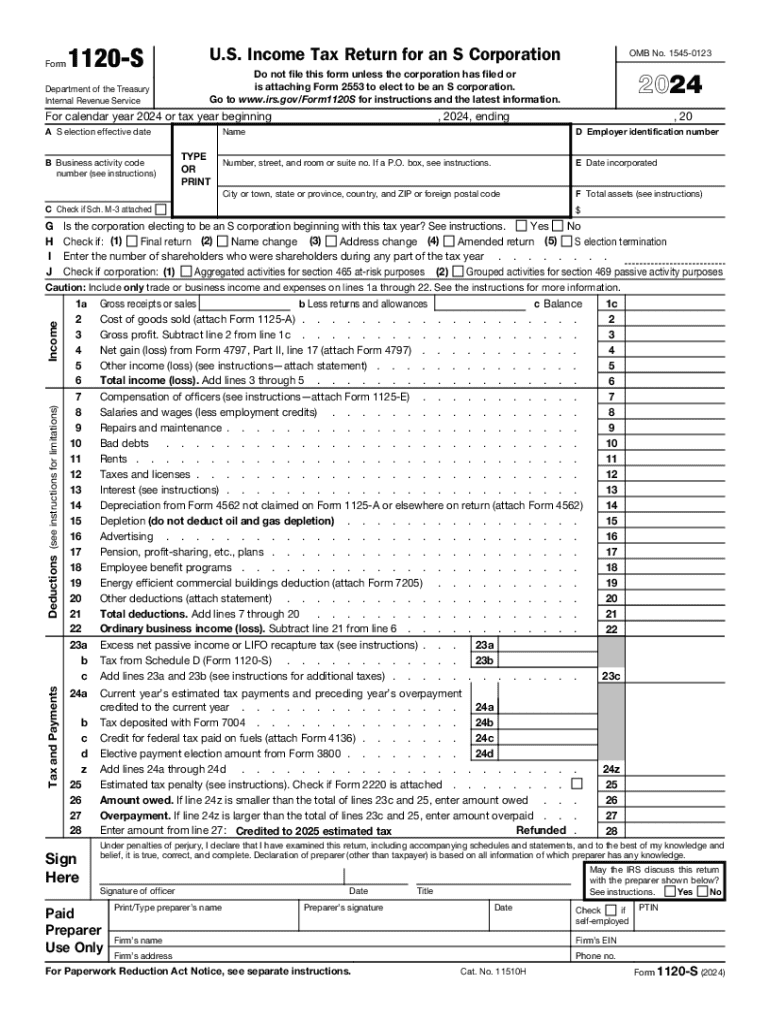







Definition and Purpose of the 2024 Form 1120-S
The 2024 Form 1120-S, known as the U.S. Income Tax Return for an S Corporation, is a critical document for businesses that choose S corporation status. This form allows these corporations to report income, deductions, and tax liabilities. By preparing this form, businesses ensure that income is passed through to shareholders and taxed only at the individual level, avoiding double taxation. Essential to tax compliance, the Form 1120-S includes various schedules that require accurate financial reporting.
Steps to Complete the 2024 Form 1120-S
- Gather Required Information: Collect financial statements, shareholder details, and previous tax documents.
- Fill in Identification Details: Include the S corporation's name, address, and EIN.
- Report Income: Under Schedule K, document total income and allocations to shareholders.
- Deductions and Credits: List operating deductions and any applicable tax credits accurately.
- Calculate Shareholder Allocations: Distribute income and deductions according to shareholder agreements.
- Complete Schedules: Ensure all applicable schedules and forms like Schedule K-1 are filled.
- Review and Submit: Verify the form for accuracy and completeness before submission.
Important Terms Related to Form 1120-S
- S Corporation: A special designation that allows a corporation's income, losses, and other tax attributes to pass through to shareholders.
- Schedule K-1: A document issued to each shareholder, detailing their share of the S corporation's income, deductions, and credits.
- Pass-Through Entity: A business entity that does not pay corporate income tax, with income passed directly to owners for taxation.
Filing Deadlines and Important Dates
- Standard Deadline: Typically due March 15 following the end of the tax year.
- Extensions: An automatic six-month extension may be requested using Form 7004.
- Shareholder Reporting Deadline: Shareholders should receive their Schedule K-1 by the individual tax filing deadline, usually April 15.
Who Typically Uses the 2024 Form 1120-S
S corporations and their shareholders use this form. Businesses that desire pass-through taxation and meet eligibility criteria choose the S corporation structure. These include small to medium-sized enterprises looking to mitigate double taxation while benefiting from incorporation advantages. Shareholders, often limited to 100, must be individuals, specific trusts, or estates.


Required Documents for Filing
- Financial Statements: Balance sheets, income statements, and cash flow statements.
- Shareholder Information: Names, addresses, and social security numbers.
- Previous Tax Returns: Copies of prior years’ Form 1120-S for reference.
- Supporting Schedules and Forms: Including Schedule K-1 and potentially Schedule D for capital gains.
Penalties for Non-Compliance
- Late Filing Penalties: The IRS imposes a penalty for late filing equal to $210 per month, per shareholder, up to twelve months.
- Inaccurate Information Penalties: Accurate reporting is essential, as providing false information can result in severe penalties and interest.
IRS Guidelines for Form 1120-S
The IRS provides detailed instructions on completing Form 1120-S, emphasizing compliance with the Subchapter S provisions of the Internal Revenue Code. Key points include eligibility criteria, responsibility for accurate income allocation, and necessary supplements like Schedule M-1 and M-2 to reconcile books with the tax return.
Business Types That Benefit Most from Form 1120-S
- Small Businesses: Who want to avoid double taxation while benefiting from an entity that provides liability protection.
- Family-Owned Businesses: Typically favor S corporations due to flexible income distribution to shareholders.
- Start-Ups and Ventures: That have a predictable number of shareholders and seek tax efficiency.


