




01. Edit your 2014 form 1120s online
Type text, add images, blackout confidential details, add comments, highlights and more.

Type text, add images, blackout confidential details, add comments, highlights and more.

Draw your signature, type it, upload its image, or use your mobile device as a signature pad.

Send 1120s 2014 via email, link, or fax. You can also download it, export it or print it out.
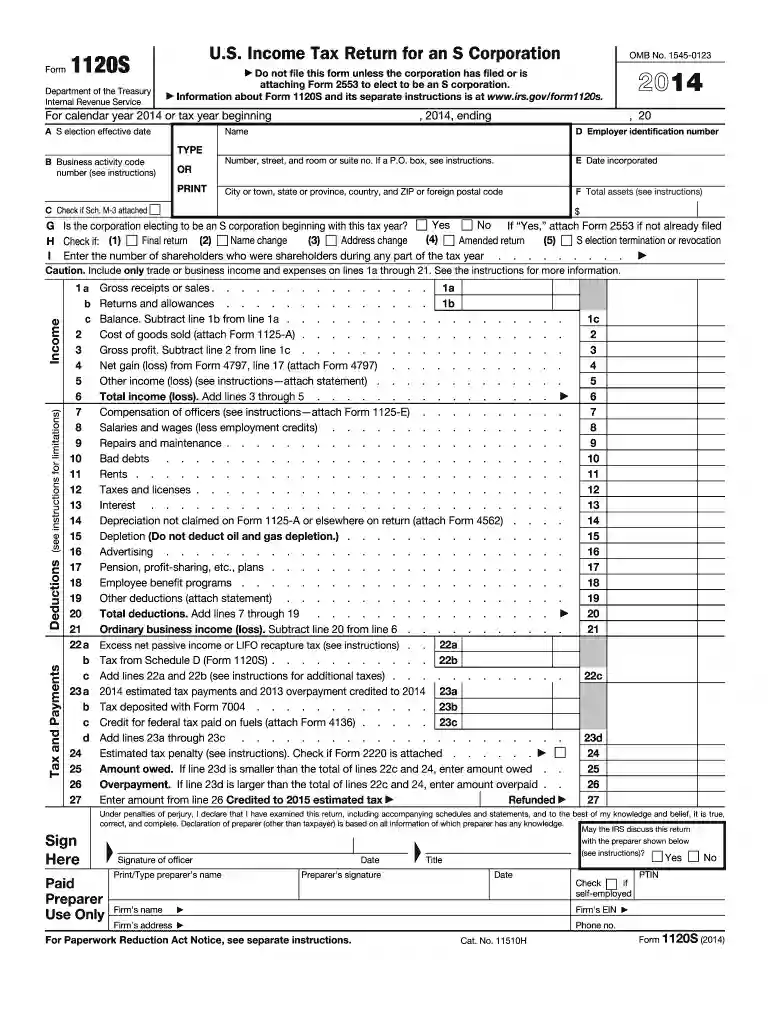
The 1120S 2014 form is the official U.S. Income Tax Return for an S Corporation, as mandated by the Internal Revenue Service (IRS). This form is used by S corporations to report their financial activities, including income, deductions, gains, losses, and credits, for the 2014 tax year. By filing the 1120S form, S corporations comply with federal tax regulations, providing transparency and accountability regarding their financial status.
To accurately use the 1120S 2014 form, S corporations need to gather pertinent financial information from the tax year 2014. Here’s a general procedure:
Completing the 1120S 2014 form involves several steps, including:
The 1120S 2014 form is primarily used by S corporations, which are corporations that elect to pass corporate income, losses, deductions, and credits through to their shareholders for federal tax purposes. These entities are typically small to medium-sized businesses structured to benefit from limited liability while avoiding double taxation. Shareholders report the income and losses on their personal tax returns, thus allowing the income to be taxed at personal tax rates.


Understanding the key components of the 1120S 2014 form is crucial for correct filing:
For the tax year 2014, the 1120S form must be filed by March 15, 2015. If the corporation operates on a fiscal year other than the calendar year, the form is due on the 15th day of the third month following the end of the fiscal year. If more time is needed, filing for an extension using the appropriate IRS form can provide an additional six months, pushing the deadline to September 15, 2015.
To prepare and file the 1120S 2014 form, S corporations need the following documents:
Failing to timely file the 1120S 2014 form or file accurately can lead to penalties. Common penalties include:
The IRS provides comprehensive guidelines that outline how to complete the 1120S 2014 form, the requirements for electing S corporation status, and the criteria to maintain that status. It also includes instructions for reporting various types of income and deductions, ensuring compliance with federal tax laws. These guidelines are essential for avoiding errors and ensuring the proper filing of the corporate tax return.
We've got more versions of the 2014 form 1120s form. Select the right 2014 form 1120s version from the list and start editing it straight away!
| Versions | Form popularity | Fillable & printable |
|---|---|---|
| 2024 | 4.8 Satisfied (41 Votes) | |
| 2023 | 4.6 Satisfied (60 Votes) | |
| 2022 | 4.1 Satisfied (39 Votes) | |
| 2021 | 4.9 Satisfied (39 Votes) | |
| 2020 | 4.3 Satisfied (174 Votes) | |
| 2019 | 4.2 Satisfied (47 Votes) | |
| 2018 | 4.3 Satisfied (81 Votes) | |
| 2017 | 4.2 Satisfied (110 Votes) | |
| 2016 | 4.4 Satisfied (321 Votes) | |
| 2015 | 4.2 Satisfied (41 Votes) | |
| 2014 | 4 Satisfied (46 Votes) | |
| 2013 | 4.1 Satisfied (47 Votes) | |
| 2012 | 3.7 Satisfied (31 Votes) | |
| 2011 | 4.4 Satisfied (38 Votes) | |
| 2010 | 4 Satisfied (23 Votes) |
At DocHub, your data security is our priority. We follow HIPAA, SOC2, GDPR, and other standards, so you can work on your documents with confidence.




IRS has released draft Instructions for Form 1120S, U.S. Income Tax Return for an S Corporation. These instructions detail some newRead more
Jan 26, 2017 For. 2016, the maximum compensation used for fig uring contributions and benefits is $265,000. This limit increases to $270,000 for 2017.Read more
Ordinary business income (loss). Determine whether the income (loss) is passive or nonpassive and enter on your return as follows: Report on. Passive loss.Read more


