




01. Edit your ftb540 online
Type text, add images, blackout confidential details, add comments, highlights and more.

Type text, add images, blackout confidential details, add comments, highlights and more.

Draw your signature, type it, upload its image, or use your mobile device as a signature pad.

Send mycitruscollege via email, link, or fax. You can also download it, export it or print it out.
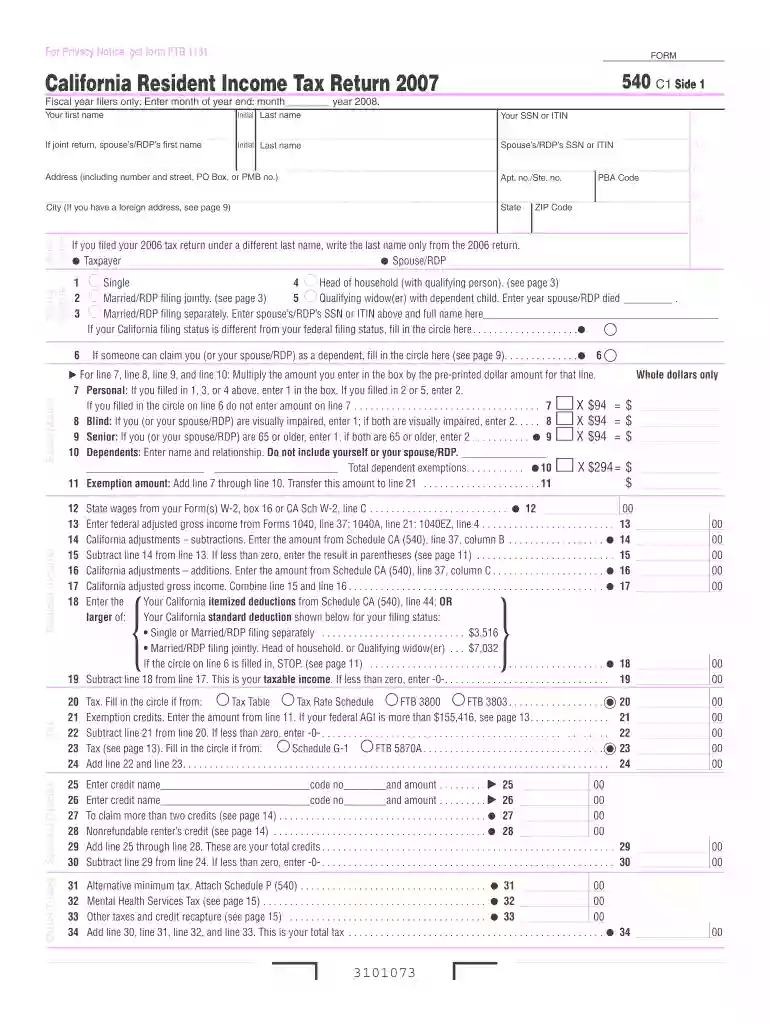
The 540 form, also known as the California Resident Income Tax Return, is essential for residents of California to report their state income tax obligations. This form is used to declare income, exemptions, deductions, and calculate the taxes owed or refunds due. The form plays a critical role in ensuring compliance with state tax laws and allows the state government to assess the taxable income of residents accurately.
To use the 540 form effectively, taxpayers should follow a series of steps that involve gathering financial documentation, accurately reporting income, and understanding the available deductions and credits. It's important to enter all required information carefully to avoid processing delays. Using online tools like DocHub can streamline the form-filling process by allowing users to input information digitally, reducing the risk of errors commonly associated with manual entries.
The 540 form is available for download on the California Franchise Tax Board’s website. Taxpayers can fill out the form directly through online platforms like DocHub, which offers the advantage of editing and signing documents without printing. Additionally, forms can be obtained through tax preparation software, ensuring users have access to the latest version.
The 540 form is primarily used by California residents, including individuals, families, and certain business owners who must report personal income. It applies to anyone who has earned income within the state or possesses other forms of taxable income. Non-residents and part-year residents use different variations of the form, specifically designed to account for income earned while residing in California.


Several critical sections must be completed in the 540 form:
California imposes unique rules for its state income tax returns that differ from federal regulations:
The 540 form is a legally binding document and must be completed accurately to comply with California tax statutes. Filing correct and truthful information is crucial, as discrepancies can trigger audits or legal repercussions. Digital platforms that offer secure completion and submission processes, such as DocHub, ensure forms are accurately filled out and safeguarded against unauthorized access or alterations.
The deadline for submitting the 540 form typically coincides with the federal tax filing deadline on April 15. However, if the 15th falls on a weekend or holiday, the deadline is extended to the next business day. Filing on time is crucial, as late submissions can result in penalties or interest charges. California taxpayers may apply for extensions if additional time is needed, provided they meet eligibility requirements and pay estimated taxes owed.
We've got more versions of the ftb540 form. Select the right ftb540 version from the list and start editing it straight away!
| Versions | Form popularity | Fillable & printable |
|---|---|---|
| 2025 | 4.9 Satisfied (32 Votes) | |
| 2024 | 4.5 Satisfied (41 Votes) | |
| 2023 | 4.8 Satisfied (57 Votes) | |
| 2022 | 4.4 Satisfied (58 Votes) | |
| 2021 | 4.8 Satisfied (196 Votes) | |
| 2020 | 4.4 Satisfied (68 Votes) | |
| 2019 | 4.3 Satisfied (176 Votes) | |
| 2018 | 4.3 Satisfied (120 Votes) | |
| 2017 | 4.3 Satisfied (127 Votes) | |
| 2016 | 4.4 Satisfied (234 Votes) | |
| 2015 | 4.3 Satisfied (243 Votes) | |
| 2014 | 4 Satisfied (31 Votes) | |
| 2013 | 4 Satisfied (47 Votes) | |
| 2012 | 4.3 Satisfied (54 Votes) | |
| 2011 | 4 Satisfied (35 Votes) |
At DocHub, your data security is our priority. We follow HIPAA, SOC2, GDPR, and other standards, so you can work on your documents with confidence.
These Bulletins serve as supplements to Ecological Risk Assessment Guidance for. Superfund: Process for Designing and Conducting Ecological Risk Assessments (Read more
If youre granted an AB 540 exemption, you will be charged in-state tuition and fees, and not the supplemental tuition charged to nonresidents.Read more
For line 7, line 8, line 9, and line 10: Multiply the number you enter in the box by the pre-printed dollar amount for that line. Whole dollars only.Read more


