




01. Edit your california 2015 online
Type text, add images, blackout confidential details, add comments, highlights and more.

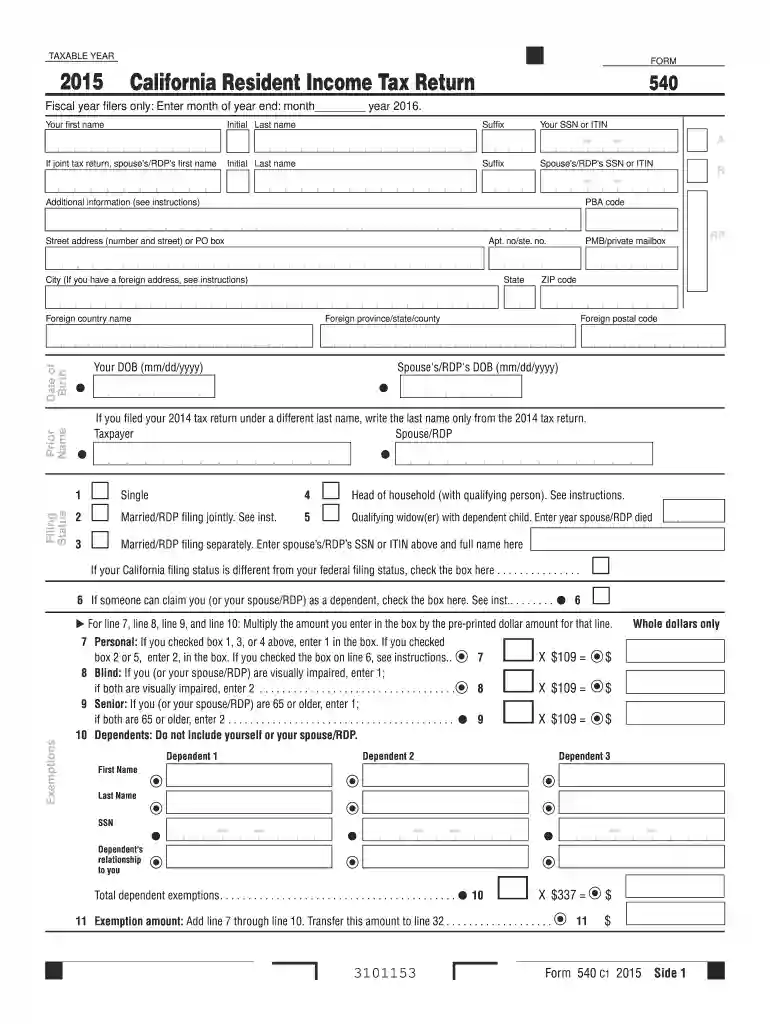
Type text, add images, blackout confidential details, add comments, highlights and more.

Draw your signature, type it, upload its image, or use your mobile device as a signature pad.

Send 2015 form 540 via email, link, or fax. You can also download it, export it or print it out.
The California 2015 Form, commonly referred to as Form 540, is a critical document used to file state income tax returns for residents of California. This form is designed to report income, calculate tax liabilities, and determine potential refunds or additional taxes owed to the state for the taxable year 2015. It is essential for ensuring compliance with California state tax laws and regulations. Form 540 includes sections related to personal information, filing status, income adjustments, tax deductions, and credits.
To effectively use the California 2015 Form, taxpayers must have a comprehensive understanding of the form’s sections and requirements. The process involves:
Completing the California 2015 Form involves a series of steps to ensure accuracy and compliance:
Understanding key terms associated with the California 2015 Form is essential for accurate completion:
The California 2015 Form must be used in accordance with federal and state tax laws. Its legal application includes:
For the 2015 tax year, the deadline for submitting the California 2015 Form was April 15, 2016. However, extensions could be requested, providing additional time to file without incurring penalties.
Preparation for filing requires various documents to support entries on the form, including:
The California 2015 Form can be submitted through different channels, providing flexibility for taxpayers:
Failing to submit the California 2015 Form or providing inaccurate information can lead to severe consequences:
These blocks provide an in-depth understanding of the California 2015 Form, guiding taxpayers in accurate and timely submission to meet state tax obligations.
We've got more versions of the california 2015 form. Select the right california 2015 version from the list and start editing it straight away!
| Versions | Form popularity | Fillable & printable |
|---|---|---|
| 2025 | 4.9 Satisfied (32 Votes) | |
| 2024 | 4.5 Satisfied (41 Votes) | |
| 2023 | 4.8 Satisfied (57 Votes) | |
| 2022 | 4.4 Satisfied (58 Votes) | |
| 2021 | 4.8 Satisfied (196 Votes) | |
| 2020 | 4.4 Satisfied (68 Votes) | |
| 2019 | 4.3 Satisfied (176 Votes) | |
| 2018 | 4.3 Satisfied (120 Votes) | |
| 2017 | 4.3 Satisfied (127 Votes) | |
| 2016 | 4.4 Satisfied (234 Votes) | |
| 2015 | 4.3 Satisfied (243 Votes) | |
| 2014 | 4 Satisfied (31 Votes) | |
| 2013 | 4 Satisfied (47 Votes) | |
| 2012 | 4.3 Satisfied (54 Votes) | |
| 2011 | 4 Satisfied (35 Votes) |
At DocHub, your data security is our priority. We follow HIPAA, SOC2, GDPR, and other standards, so you can work on your documents with confidence.
Form 540 C1 2015 Side 1. TAXABLE YEAR. 2015 California Resident Income Tax Return. FORM. 540. Fiscal year filers only: Enter month of year end: monthRead more
Arrived in California on 7/1/2015. Spent the remainder of 2015 in CA. Filing a 1040NR tax return for 2015. Single. Sandy has the following income for 2015:.Read more
Apr 22, 2015 california legislature201516 regular session. ASSEMBLY BILL. No. 888. Introduced by Assembly Member Bloom. February 26, 2015. An act to addRead more


