




01. Edit your 540 form 2016 online
Type text, add images, blackout confidential details, add comments, highlights and more.

Type text, add images, blackout confidential details, add comments, highlights and more.

Draw your signature, type it, upload its image, or use your mobile device as a signature pad.

Send schedule ca 540 2016 via email, link, or fax. You can also download it, export it or print it out.
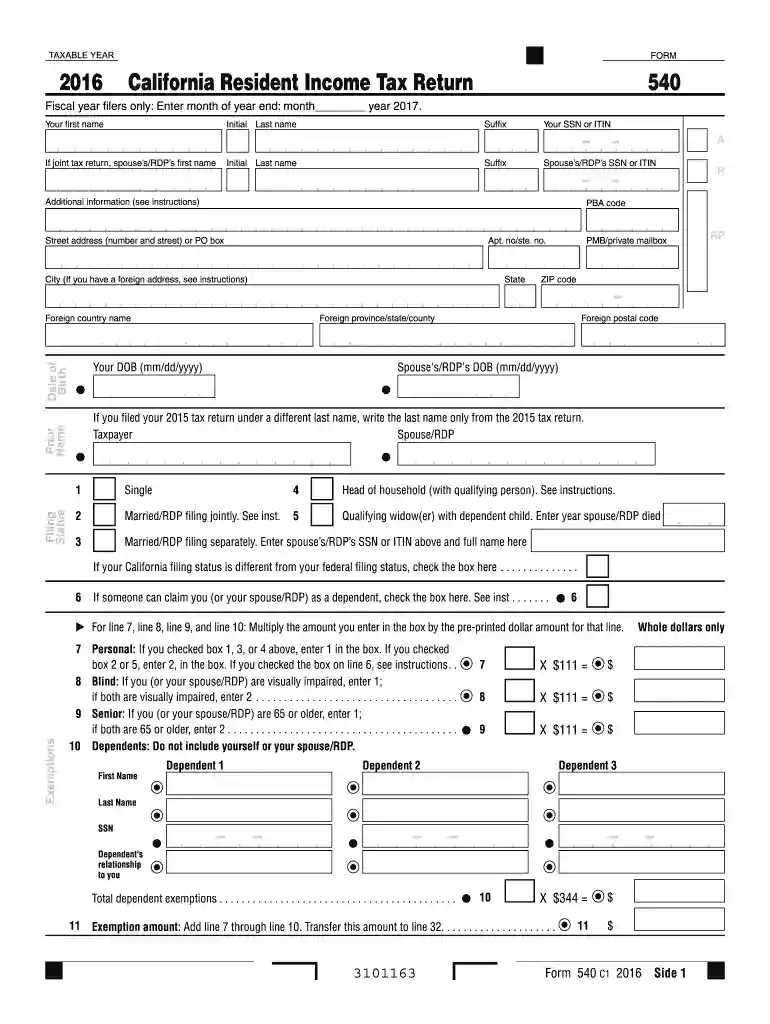
The "form california tax 2016," also known as Form 540, is the official document used by California residents to report their income for the taxable year 2016. This form is essential for calculating state tax obligations, detailing personal information, filing status, and exemptions. Residents use it to ensure compliance with state tax laws, thereby making it a vital component of the tax filing process.
To effectively use Form 540, start by gathering your financial documents from 2016, such as W-2s and 1099s. Complete each section accurately, beginning with personal information and filing status. Enter your total income and deductions, and use the provided tables on the form to calculate your estimated tax. Review and verify each entry to avoid errors. Finally, follow the form's instructions to report tax credits and calculate any owed or refundable amounts.
When filing Form 540, it is crucial to have the following documents:
For the 2016 taxable year, Form 540 was due on April 15, 2017. If the deadline falls on a weekend or holiday, the due date moves to the next business day. Filing extensions might be available but typically require a formal request before this date to avoid penalties.
The use of Form 540 complies with both state taxation laws and the California State Department of Taxation’s policies. By correctly filing this form, taxpayers report income truthfully and fulfill their fiscal responsibilities. Improper or fraudulent reporting can lead to legal repercussions, including fines or audits.
Failing to file Form 540 or providing incorrect information may result in penalties. These can include late filing fees, interest on unpaid taxes, and potential audits. To avoid repercussions, ensure accurate completion and timely submission of the form.
Although Form 540 is a state form, adherence to IRS guidelines is essential, as federal tax returns provide the basis for state filings. Ensure consistency between your federal and state income reports to avoid discrepancies that could lead to audits or penalties.
We've got more versions of the 540 form 2016 form. Select the right 540 form 2016 version from the list and start editing it straight away!
| Versions | Form popularity | Fillable & printable |
|---|---|---|
| 2025 | 4.9 Satisfied (32 Votes) | |
| 2024 | 4.5 Satisfied (41 Votes) | |
| 2023 | 4.8 Satisfied (57 Votes) | |
| 2022 | 4.4 Satisfied (58 Votes) | |
| 2021 | 4.8 Satisfied (196 Votes) | |
| 2020 | 4.4 Satisfied (68 Votes) | |
| 2019 | 4.3 Satisfied (176 Votes) | |
| 2018 | 4.3 Satisfied (120 Votes) | |
| 2017 | 4.3 Satisfied (127 Votes) | |
| 2016 | 4.4 Satisfied (234 Votes) | |
| 2015 | 4.3 Satisfied (243 Votes) | |
| 2014 | 4 Satisfied (31 Votes) | |
| 2013 | 4 Satisfied (47 Votes) | |
| 2012 | 4.3 Satisfied (54 Votes) | |
| 2011 | 4 Satisfied (35 Votes) |
At DocHub, your data security is our priority. We follow HIPAA, SOC2, GDPR, and other standards, so you can work on your documents with confidence.
TAX RETURN FILING INSTRUCTIONS. CALIFORNIA FORM 199. FOR THE YEAR ENDING. JUNE 30, 2016. PREPARED FOR: MS. LIH WU. NORTH CAMPUS - UNIVERSITY PARK DEV. CORP
Fiscal year filers only: Enter month of year end: month year 2017. Your first name. Initial Last name. Suffix. Your SSN or ITIN. If joint tax return,Read more
Dec 30, 2021 The statute of limitations has expired for tax years through 2016 for SSE Holdings. Tax Receivable Agreement. Pursuant to our election underRead more


