




01. Edit your california income tax forms online
Type text, add images, blackout confidential details, add comments, highlights and more.

Type text, add images, blackout confidential details, add comments, highlights and more.

Draw your signature, type it, upload its image, or use your mobile device as a signature pad.

Send forms 2017 pdf via email, link, or fax. You can also download it, export it or print it out.
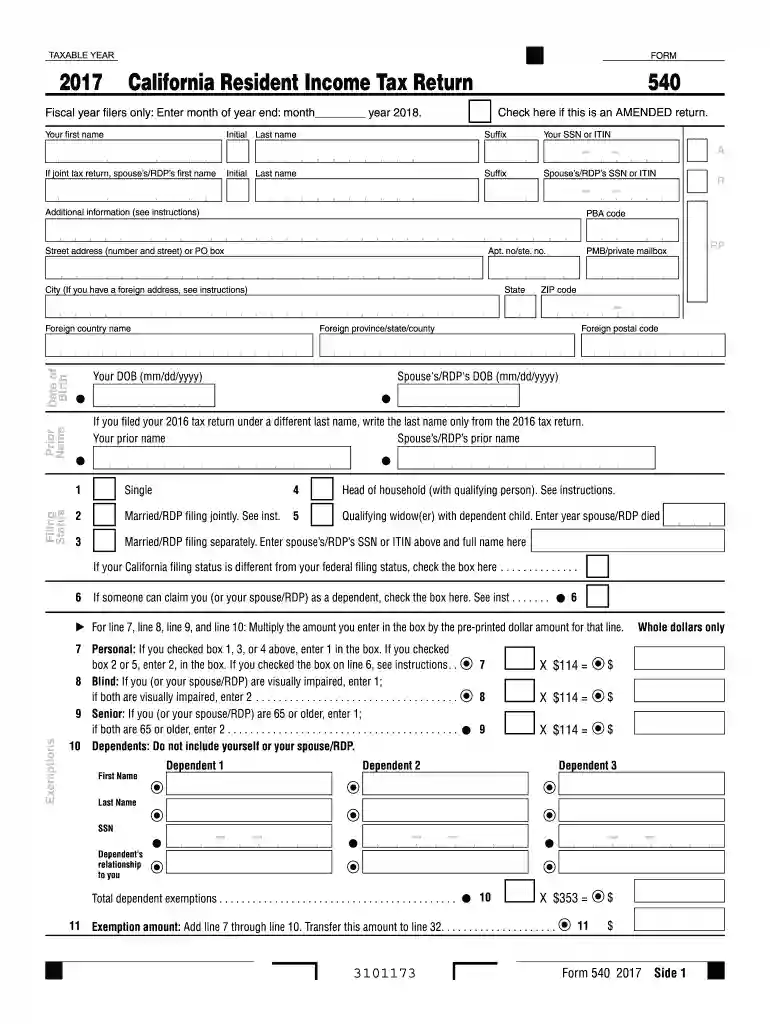
Form 540 is the California Resident Income Tax Return for the taxable year 2017. It is utilized by California residents to report their annual income and determine their state tax obligations. The form facilitates the calculation of owed taxes after accounting for allowable exemptions and deductions. It encompasses various sections such as personal information, filing status, taxable income, tax credits, and more.
Gather Required Documentation:
Determine Filing Status:
Calculate Taxable Income:
Claim Exemptions and Deductions:
Compute Tax and Credits:
Check Additional Taxes and Payments:
Sign and Submit:
Download from the Franchise Tax Board:
Request by Mail:
Visit Local Tax Offices:
The CA 540 tax form is primarily used by residents of California who need to report their state income taxes for the year 2017. This includes individuals with diverse income types, such as:
Employees:
Self-Employed:
Retirees:
Investors:


Personal Information:
Filing Status:
Income and Adjustments:
Tax and Credits:
Payments and Contributions:
Adjusted Gross Income (AGI):
Standard Deduction:
Itemized Deductions:
Tax Credits:
Regular Filing Deadline:
Extensions:
Estimated Payments:
Failing to file or pay taxes on time can result in penalties:
Late Filing Penalty:
Late Payment Penalty:
Interest Charges:
Understanding and correctly filing the CA 540 Tax Form 2017 is essential for compliant and efficient tax management for California residents, ensuring accurate reporting and preventing unnecessary penalties.
We've got more versions of the california income tax forms form. Select the right california income tax forms version from the list and start editing it straight away!
| Versions | Form popularity | Fillable & printable |
|---|---|---|
| 2025 | 4.9 Satisfied (32 Votes) | |
| 2024 | 4.5 Satisfied (41 Votes) | |
| 2023 | 4.8 Satisfied (57 Votes) | |
| 2022 | 4.4 Satisfied (58 Votes) | |
| 2021 | 4.8 Satisfied (196 Votes) | |
| 2020 | 4.4 Satisfied (68 Votes) | |
| 2019 | 4.3 Satisfied (176 Votes) | |
| 2018 | 4.3 Satisfied (120 Votes) | |
| 2017 | 4.3 Satisfied (127 Votes) | |
| 2016 | 4.4 Satisfied (234 Votes) | |
| 2015 | 4.3 Satisfied (243 Votes) | |
| 2014 | 4 Satisfied (31 Votes) | |
| 2013 | 4 Satisfied (47 Votes) | |
| 2012 | 4.3 Satisfied (54 Votes) | |
| 2011 | 4 Satisfied (35 Votes) |
At DocHub, your data security is our priority. We follow HIPAA, SOC2, GDPR, and other standards, so you can work on your documents with confidence.
If you have tax treaty you will use the Form 540 or Form 540NR; the long form is necessary to show the difference between what was reported for federal purposes.Read more
Check here if this is an AMENDED return. Your first name. Initial Last name. Suffix. Your SSN or ITIN. If joint tax return, spouses/Read more


