




01. Edit your 2014 ca 540 online
Type text, add images, blackout confidential details, add comments, highlights and more.

Type text, add images, blackout confidential details, add comments, highlights and more.

Draw your signature, type it, upload its image, or use your mobile device as a signature pad.

Send 2014 form 540 via email, link, or fax. You can also download it, export it or print it out.
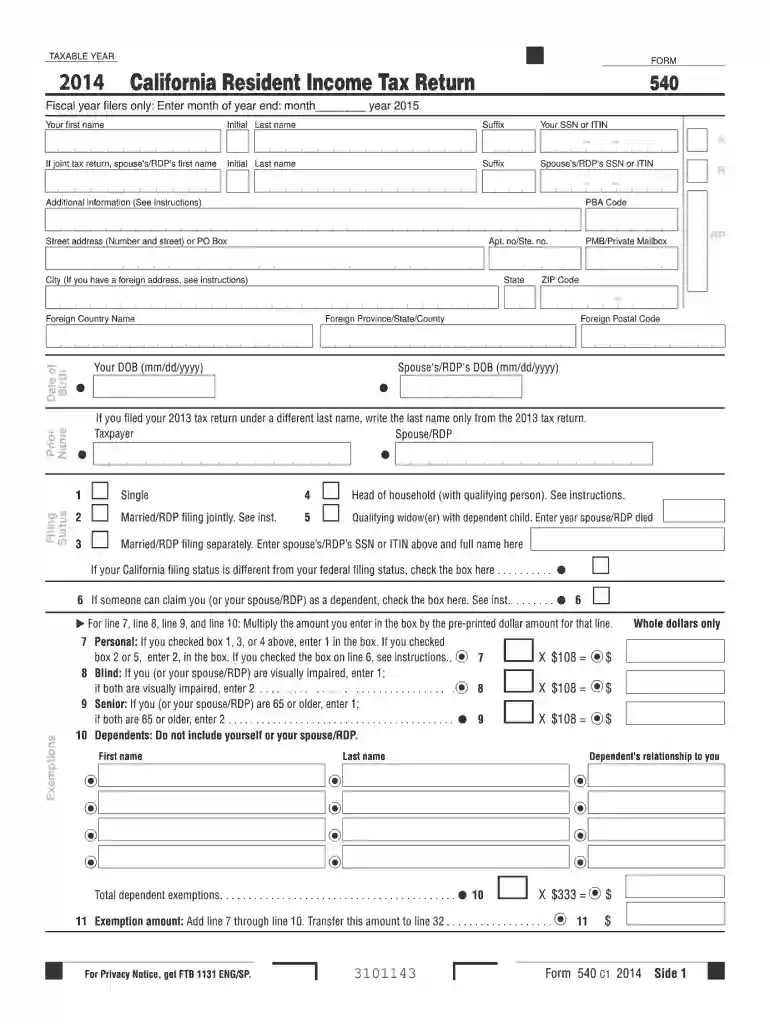
The 2014 540 Form is a California Resident Income Tax Return used by individuals who resided in California during the 2014 tax year. This form is designed to report personal income to the state, calculate state tax liabilities, and claim any deductions or credits. It's essential for Californians, as it helps determine their state tax responsibilities for the given year.
To utilize the 2014 540 Form, taxpayers must gather their financial records for the 2014 tax year, including income statements such as W-2s and 1099s. Then, they should carefully fill out each section of the form, including personal information, income details, and any applicable deductions or credits. It's crucial to follow the instructions specified on the form for accurate completion to ensure compliance with California state tax laws.
The 2014 540 Form can be obtained directly from the California Franchise Tax Board website by downloading a PDF version. Alternatively, taxpayers may acquire physical copies from local governmental offices, libraries, or post offices that have tax documents available during the tax season.
This form is primarily used by California residents who earned income within the state during the 2014 calendar year. This includes a broad range of taxpayers such as salaried employees, self-employed individuals, and retirees with income streams in the area. Non-residents and part-year residents would typically use alternative forms.


The typical deadline for filing the 2014 540 Form was April 15, 2015. However, extensions could be requested by submitting Form 3519 by this date to avoid penalties. Taxpayers should be mindful of these deadlines to prevent late filing charges and interest on outstanding taxes.
Failing to file the 2014 540 Form by the deadline can result in penalties and interest on the unpaid tax amounts. Late submission penalties are typically a percentage of the tax owed. It's crucial to comply with deadlines or file for an extension if necessary to mitigate these penalties.
To complete the 2014 540 Form, individuals must have:
California imposes specific rules that might not be applicable in other states, such as different thresholds for income tax brackets and unique state deductions. Taxpayers should pay attention to California-specific regulations, including any unique credits or exemptions relevant to residents only.
These distinct aspects require careful consideration to ensure compliant and accurate tax filing in California. It’s beneficial for taxpayers to consult with a tax professional who understands the nuances of California tax law if there are ambiguities or complex financial situations.
We've got more versions of the 2014 ca 540 form. Select the right 2014 ca 540 version from the list and start editing it straight away!
| Versions | Form popularity | Fillable & printable |
|---|---|---|
| 2025 | 4.9 Satisfied (32 Votes) | |
| 2024 | 4.5 Satisfied (41 Votes) | |
| 2023 | 4.8 Satisfied (57 Votes) | |
| 2022 | 4.4 Satisfied (58 Votes) | |
| 2021 | 4.8 Satisfied (196 Votes) | |
| 2020 | 4.4 Satisfied (68 Votes) | |
| 2019 | 4.3 Satisfied (176 Votes) | |
| 2018 | 4.3 Satisfied (120 Votes) | |
| 2017 | 4.3 Satisfied (127 Votes) | |
| 2016 | 4.4 Satisfied (234 Votes) | |
| 2015 | 4.3 Satisfied (243 Votes) | |
| 2014 | 4 Satisfied (31 Votes) | |
| 2013 | 4 Satisfied (47 Votes) | |
| 2012 | 4.3 Satisfied (54 Votes) | |
| 2011 | 4 Satisfied (35 Votes) |
At DocHub, your data security is our priority. We follow HIPAA, SOC2, GDPR, and other standards, so you can work on your documents with confidence.
On Form IT-540, Line 20 enter in the boxes designated for 5, 4, 3, or 2 the number of your qualified dependents as shown on Line 2 above for the associated starRead more
Aug 15, 2014 August 15, 2014 Prologue: Description: (Ever told) you have some form of arthritis, rheumatoid arthritis, gout, lupus, or fibromyalgia?Read more


