




01. Edit your 2015 form 709 online
Type text, add images, blackout confidential details, add comments, highlights and more.

Type text, add images, blackout confidential details, add comments, highlights and more.

Draw your signature, type it, upload its image, or use your mobile device as a signature pad.

Send 2015 gift tax return via email, link, or fax. You can also download it, export it or print it out.
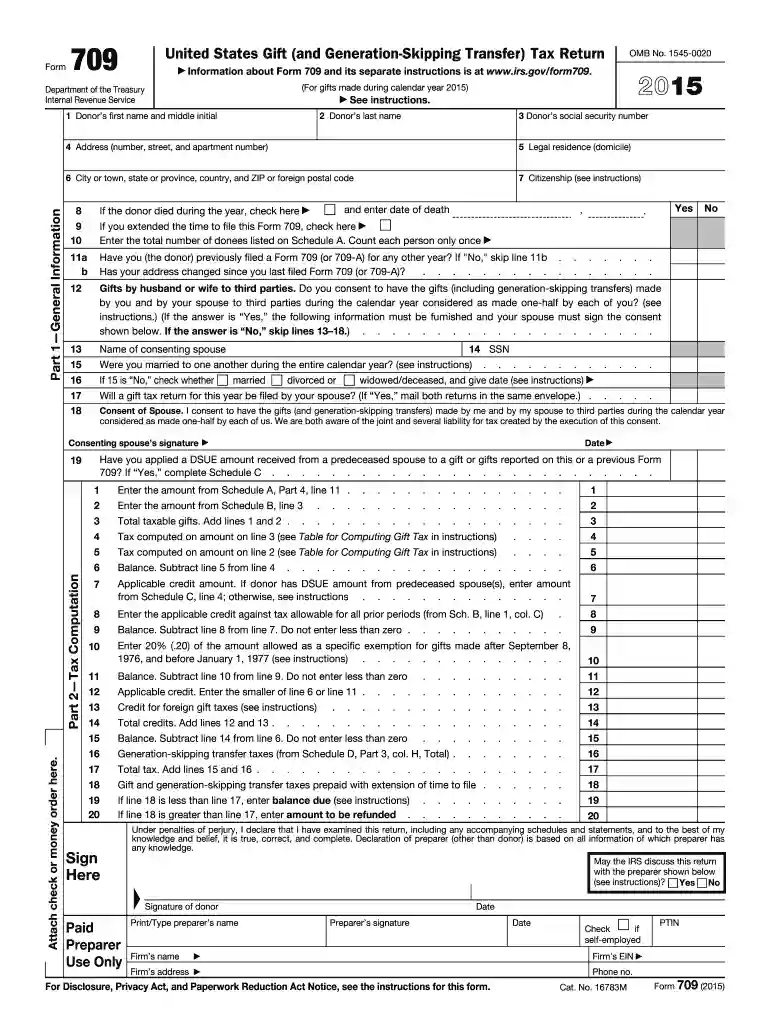
Form 709 is officially known as the "United States Gift (and Generation-Skipping Transfer) Tax Return." It is used to report gifts subject to tax during the calendar year 2015. This form ensures compliance with federal regulations regarding gift taxes and provides a structured way for individuals to detail gifts given to others, including generation-skipping transfers to grandchildren or further descendants. The documentation of these gifts helps the IRS track gift tax liability and apply any applicable credits.
Form 709 for the year 2015 can be obtained through the official IRS website, where it is available for download in PDF format. Additionally, various tax preparation software programs, such as TurboTax and QuickBooks, offer options to access the form as part of their filing services for federal taxes. Even though the form can also be requested at local IRS offices, accessing it online or via tax software provides a more streamlined and efficient process.
Forms must be filled out precisely, as inaccuracies can result in processing delays or penalties.
Each section of the form addresses different elements of gift reporting and requires detailed attention to ensure compliance.
The IRS provides extensive guidelines to assist in the completion of Form 709. These guidelines explain the intricacies of federal gift tax laws, annual exclusions, and how to appropriately calculate the value of gifts. The IRS publication on gift taxes should be reviewed in conjunction with the form to ensure a clear understanding of compliance requirements. The guidelines also highlight the necessity of using fair market value for all reported gifts and stipulate how to handle gift-splitting between spouses.
For the 2015 tax year, Form 709 was required to be filed by April 18, 2016, aligning with the federal income tax return deadline. Extensions for filing can be requested using IRS Form 8892, while payment extensions require the use of Form 4768. Missing filing deadlines can lead to penalties, so timely submission is critical.
Every form submission should be accompanied by:
Gathering and organizing these documents ahead of time ensures a accurate reporting and expedites the filing process.
Failure to properly complete or timely file Form 709 can result in significant fines and interest charges. Additionally, incorrect reporting of gift taxes can lead to increased scrutiny by the IRS, additional penalties, and potential audits. For instance, intentionally failing to disclose taxable gifts can result in a penalty up to 30% of the tax due. Taxpayers are encouraged to seek clarification or expert advice if unsure about compliance requirements.
Form 709 is legally mandated under the Internal Revenue Code for individuals who exceed the annual exclusion limit for gifts, ensuring correct tax assessments on transferred wealth. It serves as a legal record of gift-giving and tax obligations, making it essential for financial planning, estate planning, and the accurate calculation of tax liabilities tied to gifts. Taxpayers should ensure the form is completed accurately and submitted prudently to align with legal standards and IRS expectations.
We've got more versions of the 2015 form 709 form. Select the right 2015 form 709 version from the list and start editing it straight away!
| Versions | Form popularity | Fillable & printable |
|---|---|---|
| 2025 | 4.3 Satisfied (24 Votes) | |
| 2024 | 4.2 Satisfied (58 Votes) | |
| 2023 | 4.4 Satisfied (50 Votes) | |
| 2022 | 4.9 Satisfied (46 Votes) | |
| 2021 | 4.9 Satisfied (24 Votes) | |
| 2020 | 4.3 Satisfied (180 Votes) | |
| 2019 | 4.3 Satisfied (183 Votes) | |
| 2018 | 4.3 Satisfied (183 Votes) | |
| 2017 | 4.2 Satisfied (54 Votes) | |
| 2016 | 4.4 Satisfied (60 Votes) | |
| 2015 | 4 Satisfied (25 Votes) | |
| 2014 | 4 Satisfied (38 Votes) | |
| 2013 | 4.3 Satisfied (55 Votes) | |
| 2012 | 4.1 Satisfied (59 Votes) | |
| 2011 | 4 Satisfied (41 Votes) |
At DocHub, your data security is our priority. We follow HIPAA, SOC2, GDPR, and other standards, so you can work on your documents with confidence.
Oct 21, 2015 If you gave gifts to someone in 2015 totalling more than $14,000 (other than to your spouse), you probably must file Form. 709. But seeRead more
PROGNOSIS. 11. 6.1. Prognostic factors. 11. 6.2. Pre-operative factors. 11. 6.2.1 Age and gender. 11. 6.2.2 Ethnicity. 12. 6.2.3 Tobacco consumption.Read more
After completing Form 709, submit it to the appropriate IRS processing center based on your state of residence, along with supporting documentation. UseRead more


