




01. Edit your 2012 form 709 online
Type text, add images, blackout confidential details, add comments, highlights and more.

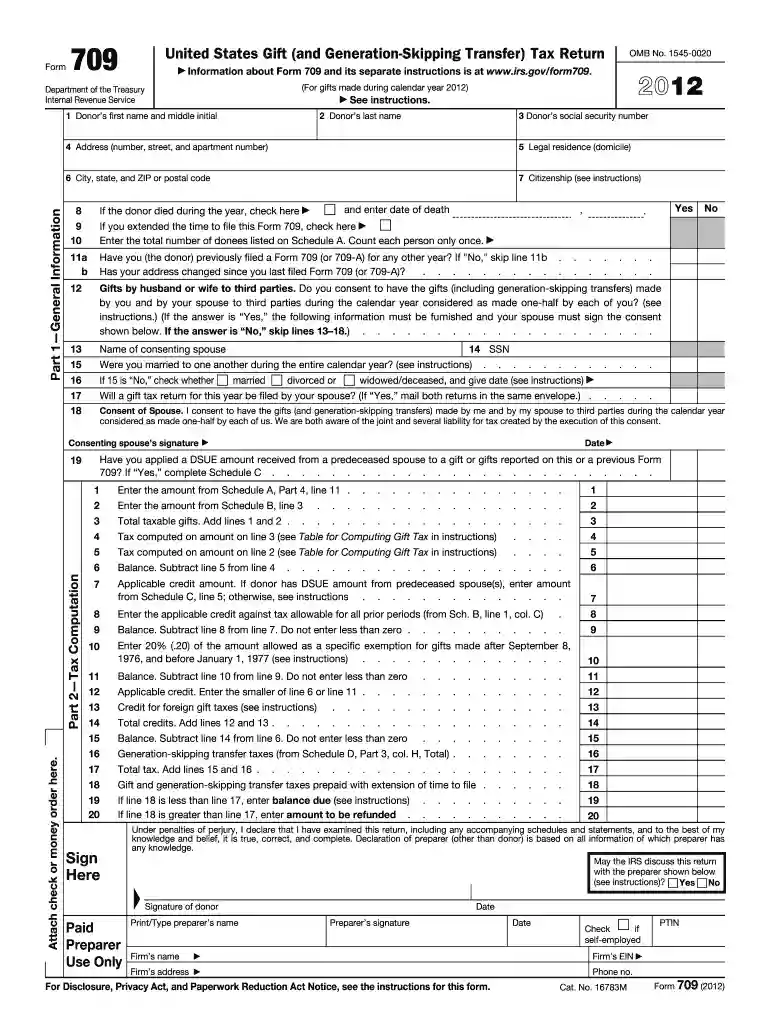
Type text, add images, blackout confidential details, add comments, highlights and more.

Draw your signature, type it, upload its image, or use your mobile device as a signature pad.

Send 709 instructions 2012 via email, link, or fax. You can also download it, export it or print it out.
The 709 form 2012 is critical for individuals in the U.S. who need to report gifts given during the calendar year under the United States Gift (and Generation-Skipping Transfer) Tax Return. Primarily used to disclose the value of gifts and ensure proper taxation, it includes sections detailing the identity of donors and donees, values of gifts, marital deductions, and applicable tax credits.
Comprehending the use of the 709 form 2012 involves understanding its different sections and requirements:
Accessing the 709 form 2012 for filing purposes can be done through several channels:
The completion of the form requires careful attention to detail to ensure all information is precise:
The form is utilized by various individuals and entities when specific conditions are met:


The IRS offers comprehensive guidelines to assist taxpayers in their reporting duties:
Publication 559: Offers insight into estate and gift tax regulations, guiding correct form use.
Instruction Manuals: Detailed instructions accompany the form for step-by-step completion assistance.
FAQs and Help Desks: Online resources provide additional support for questions arising during filing.
Example Scenario: Donating significant wealth to a relative’s education fund should be reported as per IRS gifting rules.
Understanding deadlines is crucial for timely compliance:
Annual Filing Deadline: Typically due by April 15th, aligning with the federal tax filing deadline.
Extension Forms: Utilize Form 4868 if extra time is needed to prepare the form thoroughly.
Important Exception: If April 15th falls on a weekend or holiday, the deadline may shift to the next business day.
Illustrative scenarios can help clarify form usage:
Understanding these real-world scenarios ensures the 709 form is filled accurately and comprehensively.
We've got more versions of the 2012 form 709 form. Select the right 2012 form 709 version from the list and start editing it straight away!
| Versions | Form popularity | Fillable & printable |
|---|---|---|
| 2025 | 4.3 Satisfied (24 Votes) | |
| 2024 | 4.2 Satisfied (58 Votes) | |
| 2023 | 4.4 Satisfied (50 Votes) | |
| 2022 | 4.9 Satisfied (46 Votes) | |
| 2021 | 4.9 Satisfied (24 Votes) | |
| 2020 | 4.3 Satisfied (180 Votes) | |
| 2019 | 4.3 Satisfied (183 Votes) | |
| 2018 | 4.3 Satisfied (183 Votes) | |
| 2017 | 4.2 Satisfied (54 Votes) | |
| 2016 | 4.4 Satisfied (60 Votes) | |
| 2015 | 4 Satisfied (25 Votes) | |
| 2014 | 4 Satisfied (38 Votes) | |
| 2013 | 4.3 Satisfied (55 Votes) | |
| 2012 | 4.1 Satisfied (59 Votes) | |
| 2011 | 4 Satisfied (41 Votes) |
At DocHub, your data security is our priority. We follow HIPAA, SOC2, GDPR, and other standards, so you can work on your documents with confidence.
Oct 5, 2018 Sec. 1. Short title; table of contents. DIVISION ASPORTS MEDICINE LICENSURE. Sec. 11. Short title. Sec. 12. Protections for covered sportsRead more
If you gave gifts to someone in 2012 totalling more than $13,000 (other than to your spouse), you probably must file Form. 709. But see Transfers Not Subject toRead more
by MA Goetting Cited by 5 A donor is required to file a federal gift tax return (Form. 709) to report gifts amounting to more than $13,000. (adjusted annually by the consumer price index)Read more


