2016 form 709-2025

Get Form
2016 form 709 Preview on Page 1

Here's how it works

01. Edit your 2016 form 709 online
Type text, add images, blackout confidential details, add comments, highlights and more.

02. Sign it in a few clicks
Draw your signature, type it, upload its image, or use your mobile device as a signature pad.

03. Share your form with others
Send 2016 gift tax return via email, link, or fax. You can also download it, export it or print it out.

Definition and Purpose of the 2016 Form 709

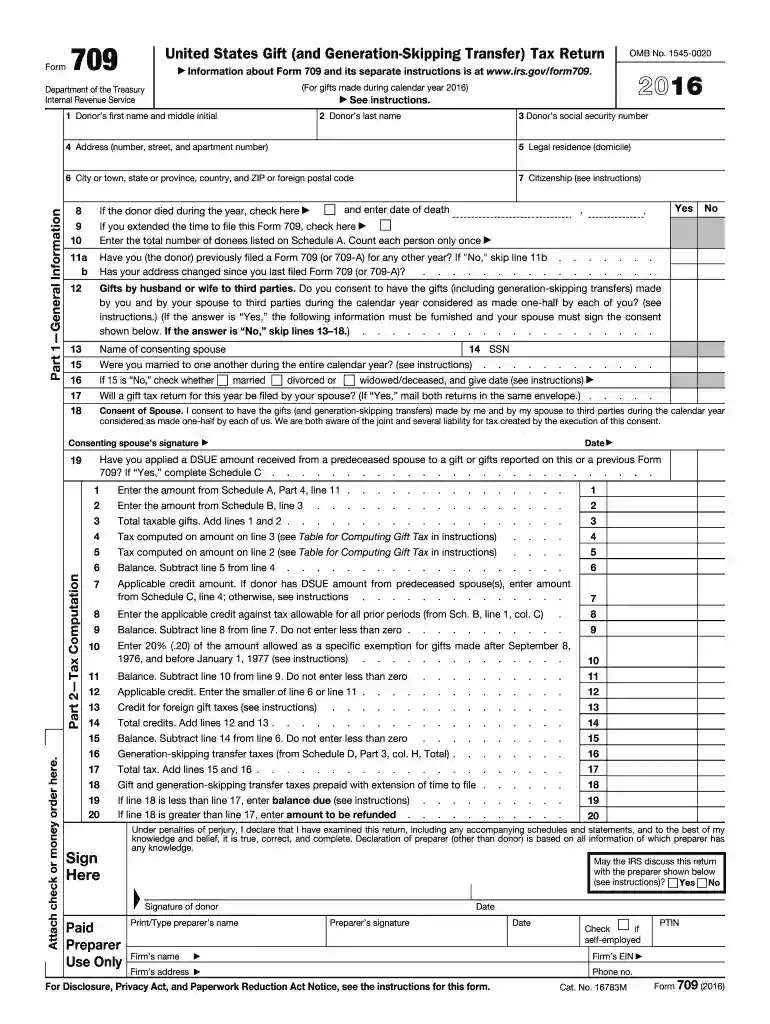
The 2016 Form 709, officially known as the United States Gift (and Generation-Skipping Transfer) Tax Return, serves a crucial role in U.S. tax law by enabling donors to report gifts made during the tax year. Gifting can significantly impact an individual's estate tax situation, and this form helps assess any potential tax liability on the gifts given. The form encompasses various donor details and the nature of the gifts, ensuring compliance with relevant tax regulations.

Important components of the form include:

  • General Information: Donor's name, address, and Social Security Number.
  • Gift Calculation: A detailed account of all gifts made, differentiating between taxable and nontaxable gifts.
  • Tax Calculation: Computation of the total gift tax owed, based on applicable rates and exemptions.
  • Schedules: Sections dedicated to specific gifts and any generation-skipping transfer needs.

Understanding the 2016 Form 709 is essential for anyone engaged in significant gifting, either during their lifetime or as part of estate planning.

How to Use the 2016 Form 709 Effectively

Effectively utilizing the 2016 Form 709 requires a thorough understanding of its structure and the information it collects. Begin by gathering all pertinent details regarding gifts made throughout the year. This includes the recipient's information and the value of each gift.

To use the form:

  • Complete Personal Information: Accurately fill out your details, ensuring your Social Security Number matches IRS records.
  • Document Each Gift: List all gifts, specifying their value and the relationship to the recipient, to establish the nature of the gift.
  • Check for Exemptions: Identify any gifts that qualify for annual exclusions or other exemptions under IRS guidelines.
  • Calculate Taxable Gifts: Determine which gifts are taxable and compute the applicable taxes, considering any cumulative gift amounts.

It is advisable to consult a tax professional or utilize software tools designed for tax filings to ensure accuracy and optimal reporting.

Steps to Complete the 2016 Form 709

Completing the 2016 Form 709 involves various steps that ensure all required information is accurately represented. Here’s a detailed breakdown of the completion process:

  1. Gather Required Information:

    • Personal details (name, Social Security Number, address).
    • A comprehensive list of gifts given during the tax year, including values and recipients.
  2. Fill Out Initial Sections:

    • Provide identifying information in the first section, ensuring accuracy to avoid processing delays.
  3. Complete Gift Schedules:

    • Use Schedule A to detail all gifts, including their fair market value and whether they qualify for annual exclusions.
  4. Calculate Tax:

    • Use the tax calculation worksheet included with the form to determine any potential gift tax owed. Consider applying applicable credits accordingly.
  5. Review and Double-Check:

    • Carefully review filled fields for any errors or omissions before submission.
  6. Sign and Date:

    • Finally, sign and date the form to validate your submission.

Following these steps meticulously is vital to ensure compliance and avoid future issues.

Important Terms Related to the 2016 Form 709

Familiarity with key terms associated with the 2016 Form 709 enhances understanding and compliance. A few important terms include:

  • Gift Tax: A federal tax applied to transfers of property by gift during the donor's lifetime.
  • Annual Exclusion: The maximum amount that one individual can gift to another without incurring gift tax, which was $14,000 for 2016.
  • Taxable Gift: Any gift that exceeds the annual exclusion amount and must be reported on Form 709.
  • Generation-Skipping Transfer (GST): A transfer of property to a beneficiary who is two or more generations younger than the donor, typically subjected to additional taxes.

Being well-versed in these terms is crucial for accurately completing the form and determining any potential tax liabilities.

Filing Deadlines for the 2016 Form 709

The timeliness of filing the 2016 Form 709 is critical to avoid penalties. The standard submission deadline is April 18, 2017, which aligns with the individual income tax return deadlines for the 2016 tax year. If an extension for filing your income tax return was requested, the deadline for Form 709 would also be extended accordingly.

Key considerations include:

  • Filing Extensions: While extensions for individual tax returns can apply, they do not automatically extend for Form 709. A separate extension request must be filed.
  • Late Penalties: Failure to file by the deadline could lead to penalties and interest on any unpaid taxes.

Ensuring deadlines are met is vital for tax compliance and minimizing potential fees.

Examples of Using the 2016 Form 709 for Estate Planning

The 2016 Form 709 can be a powerful tool in estate planning, particularly when structured gifting strategies are utilized. Below are a few scenarios that illustrate its application:

  • Transferring Wealth to Children: A donor desires to provide each child with a financial gift for education purposes. By gifting $14,000 to each child in 2016, the donor avoids the gift tax and maintains estate liquidity.
  • Gifting Real Estate: A property valued at $200,000 is gifted to a grandchild. The donor must file Form 709 to report the gift and apply the annual exclusion against it, but the excess amount is subject to the gift tax rate.
  • Charitable Donations: Donors may choose to give a portion of their estate to charity, utilizing the Form 709 to claim applicable deductions against their overall estate tax when preparing their final estate return.

Engaging in these practices ensures effective management of tax obligations while facilitating wealth transfer objectives.

IRS Guidelines for Completing Form 709

The IRS provides specific guidelines for accurately completing the 2016 Form 709. Adhering to these guidelines is imperative to ensure compliance and mitigate tax liability. Some of the crucial points highlighted in IRS documentation include:

  • Accuracy: Every gift must be precisely characterized, including details on whether the gifts were present interests or future interests.
  • Documentation: Maintain detailed records supporting the valuation of gifts, particularly for significant assets like real estate or business interests.
  • Consultation Recommended: The IRS recommends consulting tax professionals when complexities arise in valuation or if substantial gifts are involved.
  • Form Updates: Because tax law can evolve, it's crucial to confirm compliance with the most current IRS regulations related to the 2016 Form 709 and gift taxation before filing.

Following these guidelines is essential for a compliant submission and to minimize the risk of an audit or penalties.

See more 2016 form 709 versions

We've got more versions of the 2016 form 709 form. Select the right 2016 form 709 version from the list and start editing it straight away!
Versions Form popularity Fillable & printable
2023 4.4 Satisfied (50 Votes)
2022 4.9 Satisfied (46 Votes)
2021 4.9 Satisfied (24 Votes)
2020 4.3 Satisfied (180 Votes)
2019 4.3 Satisfied (183 Votes)
2018 4.3 Satisfied (183 Votes)
2017 4.2 Satisfied (54 Votes)
2016 4.4 Satisfied (60 Votes)
2015 4 Satisfied (25 Votes)
2014 4 Satisfied (38 Votes)
2013 4.3 Satisfied (55 Votes)
2012 4.1 Satisfied (59 Votes)
2011 4 Satisfied (41 Votes)
2009 4 Satisfied (27 Votes)
2008 4.2 Satisfied (24 Votes)
be ready to get more

Complete this form in 5 minutes or less

Get form

Got questions?

We have answers to the most popular questions from our customers. If you can't find an answer to your question, please contact us.
Contact us
Who Must File. In general. If you are a citizen or resident of the United States, you must file a gift tax return (whether or not any tax is ultimately due) in the following situations. If you gave gifts to someone in 2024 totaling more than $18,000 (other than to your spouse), you probably must file Form 709.
The annual gift exclusion remains the same at $14,000. The federal estate and gift tax exemptions rise with inflation, and the IRS announced the new numbers. We cover the 2016 retirement plan contribution limits here and the new numbers for individual income tax provisions for 2016 here.
For the 2025 tax year, you can give up to $19,000 per recipient without needing to file Form 709. This is called the annual gift tax exclusion. For married couples, this exclusion doubles to $38,000 if both spouses agree to split the gift.
Generally, you must file the Form 709 no earlier than January 1, but not later than April 15, of the year after the gift was made. If April 15 falls on a Saturday, Sunday, or legal holiday, Form 709 is due on the next business day.
What happens if I dont declare the gifts? As an Executor is personally liable, it is vital that they make the necessary enquiries into lifetime gifts. HMRC can impose financial penalties when gifts are not declared correctly and the Executors may be liable to pay these penalties themselves.
be ready to get more

Complete this form in 5 minutes or less

Get form

People also ask

0:12 2:51 Amount you need to report it to the IRS. Under certain conditions for the tax year 2025. You canMoreAmount you need to report it to the IRS. Under certain conditions for the tax year 2025. You can give up to $19,000 to any one person without having to report. It.
Modernized e-File (MeF) for gift taxes now offers a secure and accurate way to file the Form 709, United States Gift (and Generation-Skipping Transfer) Tax Return and Form 709-NA, United States Gift (and Generation-Skipping Transfer) Tax Return of Nonresident Not a Citizen of the United States.
You must file a gift tax return if you made any gift to your spouse of a terminable interest that does not meet the exception described in Life estate with power of appointment, later, or if your spouse is not a U.S. citizen and the total gifts you made to your spouse during the year exceed $185,000.

Related links