




01. Edit your 2014 form 709 online
Type text, add images, blackout confidential details, add comments, highlights and more.

Type text, add images, blackout confidential details, add comments, highlights and more.

Draw your signature, type it, upload its image, or use your mobile device as a signature pad.

Send form 709 via email, link, or fax. You can also download it, export it or print it out.
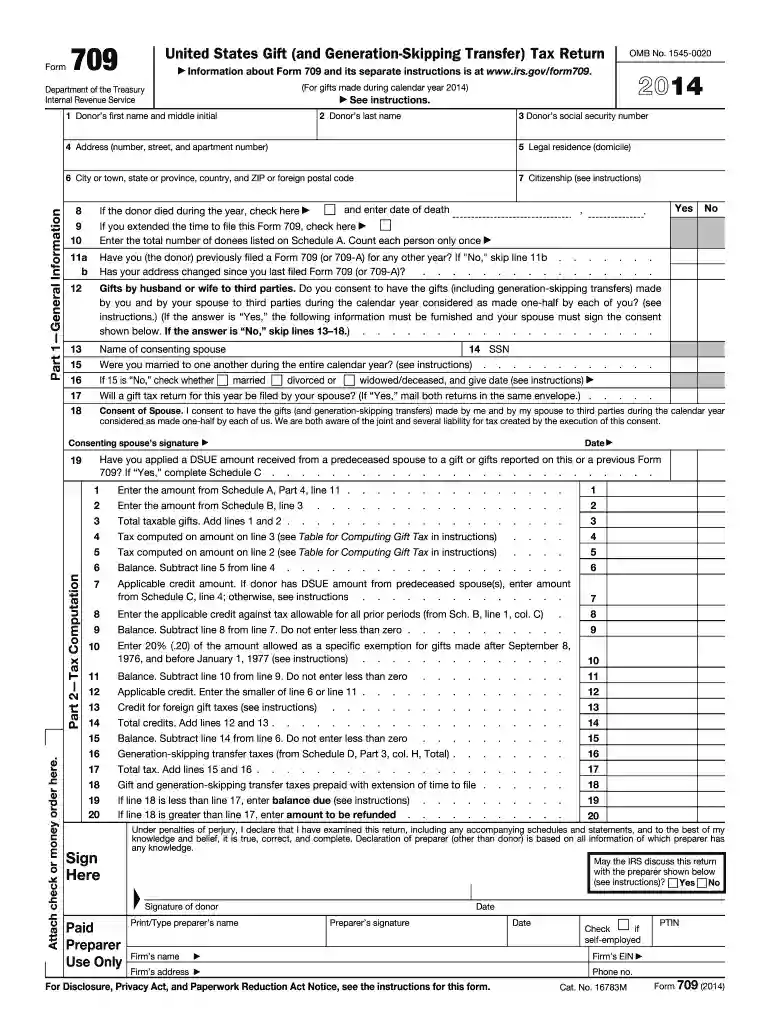
Form 709, officially titled "United States Gift (and Generation-Skipping Transfer) Tax Return," is a federal tax document used to report gifts given by an individual during a calendar year. The form is crucial for calculating any applicable gift taxes and ensuring compliance with IRS regulations. Gift tax applies when a person gives property or money to another individual without expecting fair compensation. The 2014 version covers the reporting requirements for that specific tax year, maintaining the same essential functions and sections present in other iterations.
Form 709 can be accessed and obtained from several sources, ensuring ease of availability for taxpayers. Both digital and paper versions are provided to accommodate different user preferences and accessibility needs.
Understanding why this form is essential highlights the necessity of timely and accurate filing. The form serves more than regulatory compliance; it can be a strategic component in personal tax planning.
Completing Form 709 involves several steps, requiring attention to detail to ensure accuracy and compliance.
Identifying typical users of Form 709 helps clarify its relevance and application across various notable scenarios.
Recognizing critical sections of Form 709 enhances comprehension, promoting efficient navigation and completion.
Following IRS guidelines ensures compliance, minimizing the risk of penalties associated with improper filing or late submissions.
Adhering to key filing deadlines is crucial for avoiding penalties and interest charges.
We've got more versions of the 2014 form 709 form. Select the right 2014 form 709 version from the list and start editing it straight away!
| Versions | Form popularity | Fillable & printable |
|---|---|---|
| 2025 | 4.3 Satisfied (24 Votes) | |
| 2024 | 4.2 Satisfied (58 Votes) | |
| 2023 | 4.4 Satisfied (50 Votes) | |
| 2022 | 4.9 Satisfied (46 Votes) | |
| 2021 | 4.9 Satisfied (24 Votes) | |
| 2020 | 4.3 Satisfied (180 Votes) | |
| 2019 | 4.3 Satisfied (183 Votes) | |
| 2018 | 4.3 Satisfied (183 Votes) | |
| 2017 | 4.2 Satisfied (54 Votes) | |
| 2016 | 4.4 Satisfied (60 Votes) | |
| 2015 | 4 Satisfied (25 Votes) | |
| 2014 | 4 Satisfied (38 Votes) | |
| 2013 | 4.3 Satisfied (55 Votes) | |
| 2012 | 4.1 Satisfied (59 Votes) | |
| 2011 | 4 Satisfied (41 Votes) |
At DocHub, your data security is our priority. We follow HIPAA, SOC2, GDPR, and other standards, so you can work on your documents with confidence.
Oct 31, 2014 If you gave gifts to someone in 2014 totalling more than $14,000 (other than to your spouse), you probably must file Form. 709. But seeRead more
After completing Form 709, submit it to the appropriate IRS processing center based on your state of residence, along with supporting documentation. UseRead more
Our recommendation to detect cases of PA places a high value on avoiding the risks associated with missing a PA diagnosis (and thus forgoing the opportunity ofRead more


