Definition & Purpose of Form 709
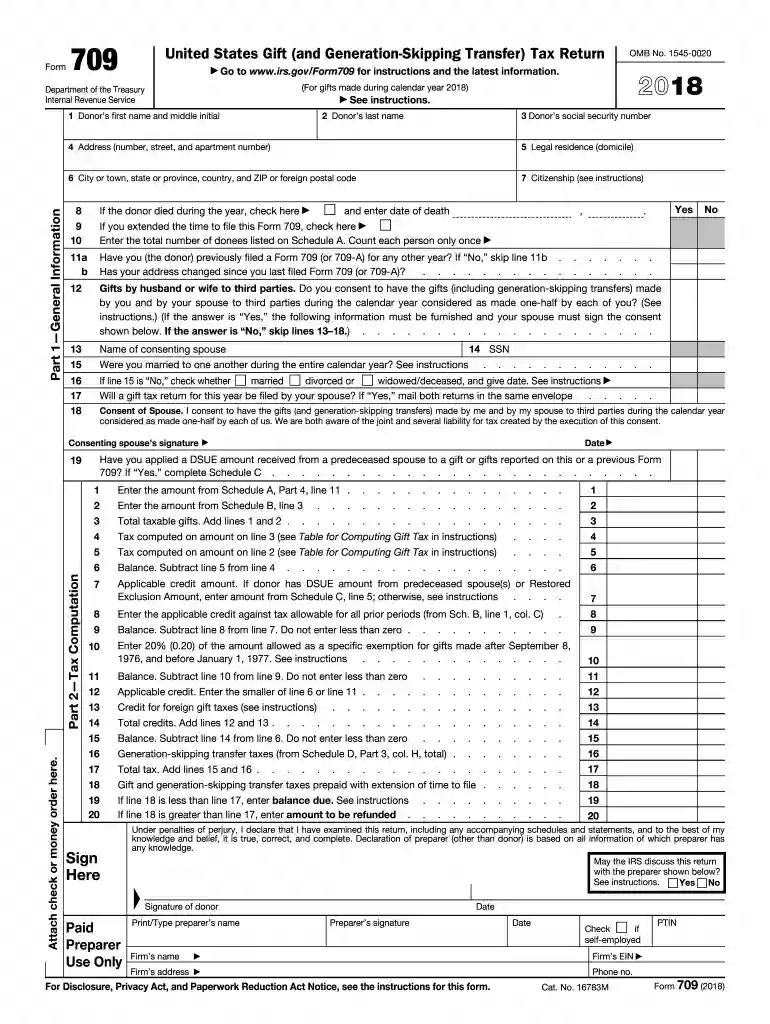
Form 709, known as the United States Gift (and Generation-Skipping Transfer) Tax Return, is used by individuals in the United States to report gifts made during the year and to calculate any owed gift taxes. Its primary function is to track gifts exceeding the annual exclusion limit and to ensure compliance with gift and generation-skipping transfer (GST) tax rules. The form includes sections for basic donor information, calculations for any applicable taxes, and detailed gift reporting.
Relevant Scenarios
- Gifts Exceeding the Exclusion Limit: When an individual gives more than the annual exclusion limit, typically $15,000 as per recent IRS guidelines, Form 709 is mandatory to report and calculate potential taxes.
- Gift Splitting: Married couples electing to split gifts must file the form to ensure proper tax treatment.
- Generation-Skipping Transfers: Reporting transfers meant for beneficiaries two or more generations younger, which may necessitate additional GST taxes, is a key component of the form.
How to Obtain Form 709
Form 709 can be obtained directly through several channels, ensuring ease of access regardless of user preference.
Sources for Retrieval
- IRS Website: The most direct way to obtain Form 709 is through the official IRS website, where downloadable PDFs are available.
- Tax Preparation Software: Platforms like TurboTax or H&R Block often include Form 709 within their suite of tax forms, making digital filing straightforward.
- Tax Professionals: Engaging with a tax advisor or accountant can provide access to the form, ensuring compliance with all related tax laws.
Practical Tips
- Always check for the most recent version of the form, as tax laws and reporting requirements can evolve.
- Consider downloading a digital version if you plan to complete the form electronically, simplifying filing and corrections.
Steps to Complete Form 709
Filling out Form 709 requires careful attention to detail to ensure accurate tax reporting.
Sections to Complete
- Donor Information: Begin with the donor’s personal details, including name and taxpayer identification number.
- Computation of Taxable Gifts: Enter all taxable gifts given during the year, excluding those under the annual exclusion.
- Tax Calculation: Follow IRS-provided tables to determine any owed taxes based on reported gifts.
- Gift Splitting Election: This section applies if the donor and spouse opt to split gifts, impacting exclusion amounts.
- Schedules for Additional Gifts: Detail all other gifts, including charitable donations, specifying recipients and values.
Common Mistakes to Avoid
- Ignoring Gift Splitting: Overlooking this section could result in incorrect tax calculations.
- Incomplete Documentation: Failing to list all beneficiaries and gift amounts accurately can lead to IRS inquiries.
Why Use Form 709
Form 709 serves crucial roles from legal compliance to financial planning for future generations.
Legal and Financial Significance
- Tax Compliance: Ensures adherence to federal gift tax laws by accurately reporting significant gifts.
- Estate Planning: Complements long-term financial strategies, reducing estate taxes by making strategic gifts during a donor's lifetime.
- Avoiding Penalties: Proper filing prevents potential fines related to non-compliance with gift tax laws.
Case Applications
- High Net-Worth Individuals: Those with substantial assets often use Form 709 to manage tax liabilities strategically.
- Estate Reduction Strategies: Giving significant gifts annually can lower future estate taxes, making Form 709 a pivotal component in managing personal finances.
Who Typically Uses Form 709
Understanding the typical user base for Form 709 can clarify its importance in various financial scenarios.
Primary Users
- Wealthy Individuals: Regular giving above the exclusion limit for estate planning requires this form.
- Married Couples: Particularly those electing to split gifts to maximize tax advantages.
- Estate Planners: Advisors helping clients manage long-term wealth transfers frequently utilize Form 709.
Specific Examples
- Business Owners: Those transferring business interests to family members as part of succession planning.
- Philanthropists: Individuals making large charitable contributions may also need to file.
Important Terms Related to Form 709
Several key terms are essential for anyone dealing with Form 709.
Key Definitions
- Annual Exclusion: The maximum amount a donor can give to any recipient tax-free in a given year.
- Gift Tax: A federal tax on transfers of money or property made by a donor without receiving full value in return.
- GST Tax: A tax on transfers to individuals who are more than one generation lower than the donor, such as grandchildren.
Application in Form
- Unified Credit: A cumulative credit against gift and estate taxes, influencing overall tax calculations on the form.
- Donee: The recipient of a gift, whose relationship to the donor can impact tax treatment and reporting.
Key Elements of Form 709
An in-depth understanding of the form's layout is vital for accurate completion.
Core Sections
- Part 1: General Information - Details donor info and gift summary.
- Part 2: Tax Computation - Calculates total gift and GST taxes.
- Schedules A and B: For listing specific gifts and valuations, including deductions for charitable contributions.
Special Considerations
- Supplementary Schedules: Required when detailing complex gifts or when multiple deductions apply.
- Supporting Documents: Often necessary to verify the nature and value of gifts, enhancing clarity and accuracy.
Penalties for Non-Compliance
Understanding the consequences of not filing Form 709 or reporting inaccurately is critical.
Applicable Penalties
- Monetary Fines: Failing to file or incorrect reporting can lead to substantial financial penalties.
- Increased IRS Scrutiny: Patterns of non-compliance might trigger audits or further investigation.
- Interest Accumulation: Penalties may also include interest on unpaid taxes, compounding financial consequences over time.
Mitigation Strategies
- Timely Filing: Submit by the annual deadline to avoid delays.
- Accurate Records: Maintain comprehensive records of all gifts and relevant valuations to support form entries.
This comprehensive breakdown of Form 709 covers its primary purpose, completion steps, important terms, and potential penalties for non-compliance for optimal understanding and compliance.