




01. Edit your form 709 2017 online
Type text, add images, blackout confidential details, add comments, highlights and more.

Type text, add images, blackout confidential details, add comments, highlights and more.

Draw your signature, type it, upload its image, or use your mobile device as a signature pad.

Send 2017 form 709 via email, link, or fax. You can also download it, export it or print it out.
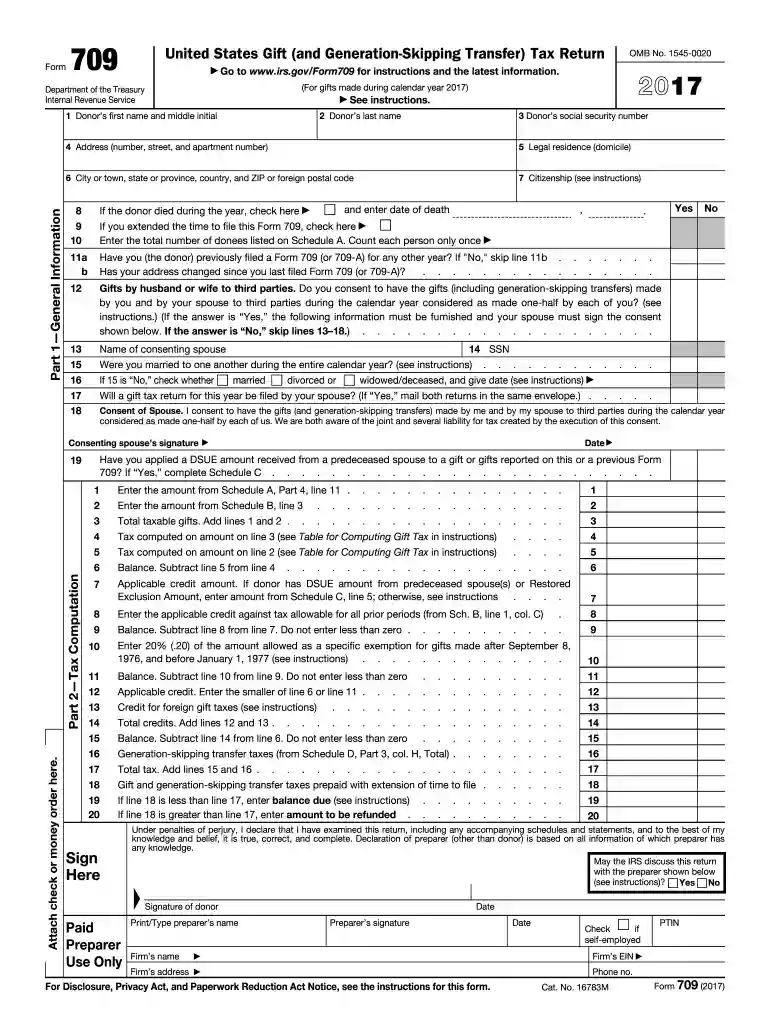
Form 709, 2017, officially known as the United States Gift (and Generation-Skipping Transfer) Tax Return, is used by individuals to report gifts given during the 2017 calendar year. This form is pivotal for donors to disclose taxable gifts and calculate any associated taxes under U.S. tax laws. It encompasses sections for general donor information, details on taxable gifts, and schedules for reporting prior gifts and generation-skipping transfers. The form ensures transparency in gift transfers and helps the IRS monitor compliance with gift tax regulations.
Form 709 can be obtained in multiple ways. The IRS website provides a downloadable PDF version, which can be printed and filled out manually. Alternatively, tax preparation software or services, such as TurboTax or H&R Block, may offer electronic versions of the form, allowing for digital completion and submission. Taxpayers can also request a physical copy from the IRS by calling their toll-free number, ensuring accessibility to the form without internet access.
Provide Personal Information: Fill in the donor's name, address, and social security number. If the donor is married, include spousal information if applicable.
Detail Gift Information: List all gifts made during the year, including the fair market value and description of each gift. Include all economic benefits provided by the donor.
Determine Gift Tax Liability: Compute the total value of taxable gifts and apply any applicable deductions to calculate potential gift tax owed.
Fill Out Schedules: Complete schedules for prior year gifts and generation-skipping transfers, ensuring comprehensive reporting of all gift activities.
File the Completed Form: Review and sign the form before submission. Make copies for records and submit it by the filing deadline.
Form 709 is primarily used by individuals who exceed the annual gift tax exclusion limit, which for 2017 was $14,000 per recipient. Estate planners, wealth management advisors, and individuals involved in estate planning frequently use this form. It is essential for those engaged in large lifetime transfers of wealth to family members or non-charitable beneficiaries, ensuring compliance with federal tax obligations.
Annual Gift Tax Exclusion: The maximum amount that can be gifted to a single recipient annually without incurring gift tax.
Lifetime Gift Tax Exemption: The total amount a person can give over their lifetime without paying federal gift taxes.
Fair Market Value: The price at which property would change hands between willing buyers and sellers.
Generation-Skipping Transfer: A transfer of property to a recipient who is two or more generations below the donor.
Donor Information: Personal and identifying details of the individual making the gift.
Taxable Gifts: A detailed report of all gifts exceeding the annual exclusion limit.
Tax Computation: A section dedicated to calculating the total tax liability after applying deductions and exemptions.
Schedules: Multiple schedules allow for detailed reporting of any prior gifts and generation-skipping transfers.
The IRS provides comprehensive instructions accompanying Form 709 to assist taxpayers in accurately reporting and calculating their gift tax liabilities. These guidelines cover specific scenarios such as gifts splitting between spouses, adjusting valuations for property gifts, and correctly reporting several types of transfers. Adherence to these guidelines is crucial to avoid errors and ensure compliance.
Form 709 for the 2017 tax year was required to be filed by April 15, 2018. This deadline aligns with the federal income tax filing date. If a taxpayer has filed for an extension on their income taxes, the deadline for filing Form 709 is also extended to October of the same year. Missing these deadlines may result in penalties or interest charges, emphasizing the importance of timely submission.
We've got more versions of the form 709 2017 form. Select the right form 709 2017 version from the list and start editing it straight away!
| Versions | Form popularity | Fillable & printable |
|---|---|---|
| 2025 | 4.3 Satisfied (24 Votes) | |
| 2024 | 4.2 Satisfied (58 Votes) | |
| 2023 | 4.4 Satisfied (50 Votes) | |
| 2022 | 4.9 Satisfied (46 Votes) | |
| 2021 | 4.9 Satisfied (24 Votes) | |
| 2020 | 4.3 Satisfied (180 Votes) | |
| 2019 | 4.3 Satisfied (183 Votes) | |
| 2018 | 4.3 Satisfied (183 Votes) | |
| 2017 | 4.2 Satisfied (54 Votes) | |
| 2016 | 4.4 Satisfied (60 Votes) | |
| 2015 | 4 Satisfied (25 Votes) | |
| 2014 | 4 Satisfied (38 Votes) | |
| 2013 | 4.3 Satisfied (55 Votes) | |
| 2012 | 4.1 Satisfied (59 Votes) | |
| 2011 | 4 Satisfied (41 Votes) |
At DocHub, your data security is our priority. We follow HIPAA, SOC2, GDPR, and other standards, so you can work on your documents with confidence.




A gift tax return (Form 709) is filed with the annual income tax return and is due on April 15. The form is required when the value of an annual gift is greaterRead more
For Disclosure, Privacy Act, and Paperwork Reduction Act Notice, see the instructions for this form. Cat. No. 16783M. Form 709 (2017). Page 2. Form 709 (2017).Read more


