




01. Edit your form 709 2013 online
Type text, add images, blackout confidential details, add comments, highlights and more.

Type text, add images, blackout confidential details, add comments, highlights and more.

Draw your signature, type it, upload its image, or use your mobile device as a signature pad.

Send it via email, link, or fax. You can also download it, export it or print it out.
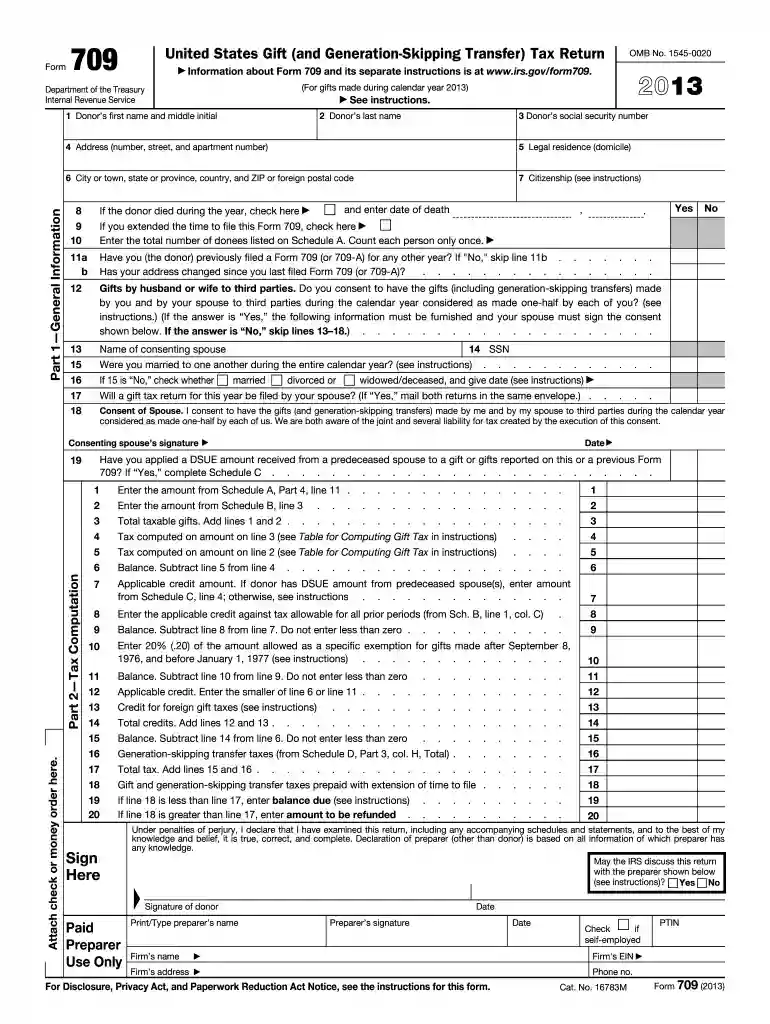
Form 709, officially known as the United States Gift (and Generation-Skipping Transfer) Tax Return, is a document used by individuals in the U.S. to report gifts made during a calendar year. Not only does it allow taxpayers to declare gifts that surpass the annual exclusion amount, but it also details any generation-skipping transfers (GST) that could incur tax liability. The primary purpose of Form 709 is to ensure transparency in gift transactions and to calculate the potential tax owed on such transfers, aligning with the IRS's regulations on taxable gifts.
To effectively use the form, begin by gathering comprehensive information on all gifts given throughout the year. This includes the recipient details, the fair market value of the gifts, and any deductions or applicable credits. Reviewing the IRS instructions for the 709 form is crucial, as these provide insights into filling out each section correctly. It's essential to complete all sections related to donor information, gift details, and calculations regarding taxable amounts. Utilize additional worksheets if required and ensure that computations for taxes are meticulously conducted to prevent discrepancies.
The form can be acquired through several reliable avenues. It is readily available for download on the IRS website, where individuals can acquire a digital copy for either electronic completion or printing. Libraries and local post offices might offer physical copies for those preferring traditional methods. Additionally, tax preparation software often provides updated forms within their platforms, allowing seamless integration when preparing a tax return.
Gather Recipient Information: List all individuals who received gifts, including their names and addresses.
Determine Gift Values: Calculate the fair market value of each gift at the time of transfer.
Complete Tax Computation: Utilize Part 2 of the form to establish tax liabilities, taking into account unused exemptions and applicable credits.
Check Schedules: Examine Supplementary Schedules A and B for detailed reporting of split gifts and charitable contributions.
Review for Accuracy: Double-check all entries for precision, and ensure that all tax calculations conform to current IRS laws.
Sign and Date: Verify that the form is signed and dated, thus proving authenticity and compliance.
Donor Information: Comprehensive details about the donor, including name, address, and Social Security Number.
Gift Details: An itemized list of all gifts exceeding the annual exclusion given during the year.
Tax Computation: Calculations involving total gifts, prior years’ gifts, and tax applicable after accounting for credits and exclusions.
GST Transactions: Specific sections that require detailed reporting of transfers subject to generation-skipping transfer tax.
The IRS provides specific guidelines for accurately completing Form 709. To align with these directives, utilize provided instructions which outline essential steps and describe the applicable tax laws. This includes respecting deadlines, understanding exclusion limits, and recognizing different gift types subject to taxes. Following these guidelines not only facilitates a smooth filing process but also minimizes the risk of error or facing penalties.
For the year 2013, the deadline for submitting Form 709 coincided with the annual tax filing date, typically April 15. It’s critical to either file by this date or request an extension if additional preparation time is required. Missing this deadline without secured permissions can result in late fees and interest charges on any unpaid taxes. Staying informed about tax calendar updates each tax season can ensure adherence to all applicable deadlines.
Form 709 can be submitted through various channels, offering flexibility for filers preferring different approaches:
Online Submission: Utilize tax software that supports digital filing of the form, ensuring quicker processing and immediate confirmation.
Mail: Send a completed form to the appropriate IRS service center. It is advised to send via certified mail for tracking purposes.
In-Person: Though a less common approach, individuals can hand-deliver the form to an IRS office or authorized tax center if such facilities are nearby.
Failure to submit Form 709 appropriately can lead to applicable penalties, usually based on the unreported gift amounts and period of non-compliance. The IRS imposes fines for both failing to file on time and inaccurately reporting gift amounts. To avoid incurring additional costs, adhering strictly to filing instructions and seeking professional assistance if uncertainties arise is advisable.
We've got more versions of the form 709 2013 form. Select the right form 709 2013 version from the list and start editing it straight away!
| Versions | Form popularity | Fillable & printable |
|---|---|---|
| 2025 | 4.3 Satisfied (24 Votes) | |
| 2024 | 4.2 Satisfied (58 Votes) | |
| 2023 | 4.4 Satisfied (50 Votes) | |
| 2022 | 4.9 Satisfied (46 Votes) | |
| 2021 | 4.9 Satisfied (24 Votes) | |
| 2020 | 4.3 Satisfied (180 Votes) | |
| 2019 | 4.3 Satisfied (183 Votes) | |
| 2018 | 4.3 Satisfied (183 Votes) | |
| 2017 | 4.2 Satisfied (54 Votes) | |
| 2016 | 4.4 Satisfied (60 Votes) | |
| 2015 | 4 Satisfied (25 Votes) | |
| 2014 | 4 Satisfied (38 Votes) | |
| 2013 | 4.3 Satisfied (55 Votes) | |
| 2012 | 4.1 Satisfied (59 Votes) | |
| 2011 | 4 Satisfied (41 Votes) |
Sure, electronically drawing your signature is acceptable, but only if you utilize a tool that complies with industry laws and regulations. Consider DocHub, which guarantees eSignature validity under ESIGN and UETA requirements. All you need to eSign your 709 2013 form is an account with DocHub and an internet connection. When you open your document in our editor, click Sign and choose the Draw tool.
If you edit your 709 2013 form with DocHub, you merely require a stable web connection and virtually any browser installed on your device. No need to install any third-party software or study tutorials. Just open a tab with DocHub, drag and drop your file, and edit it on the spot.
At DocHub, your data security is our priority. We follow HIPAA, SOC2, GDPR, and other standards, so you can work on your documents with confidence.
Oct 9, 1990 If you gave gifts to someone in 2013 totalling more than $14,000 (other than to your spouse), you probably must file Form. 709. But seeRead more
by MA Goetting Cited by 5 A federal gift tax return (Form 709) does not need to be filed with the Internal Revenue Service for gifts lower than the annual exclusion ($15,000). The annual.Read more


