




01. Edit your w 9 2013 fillable online
Type text, add images, blackout confidential details, add comments, highlights and more.

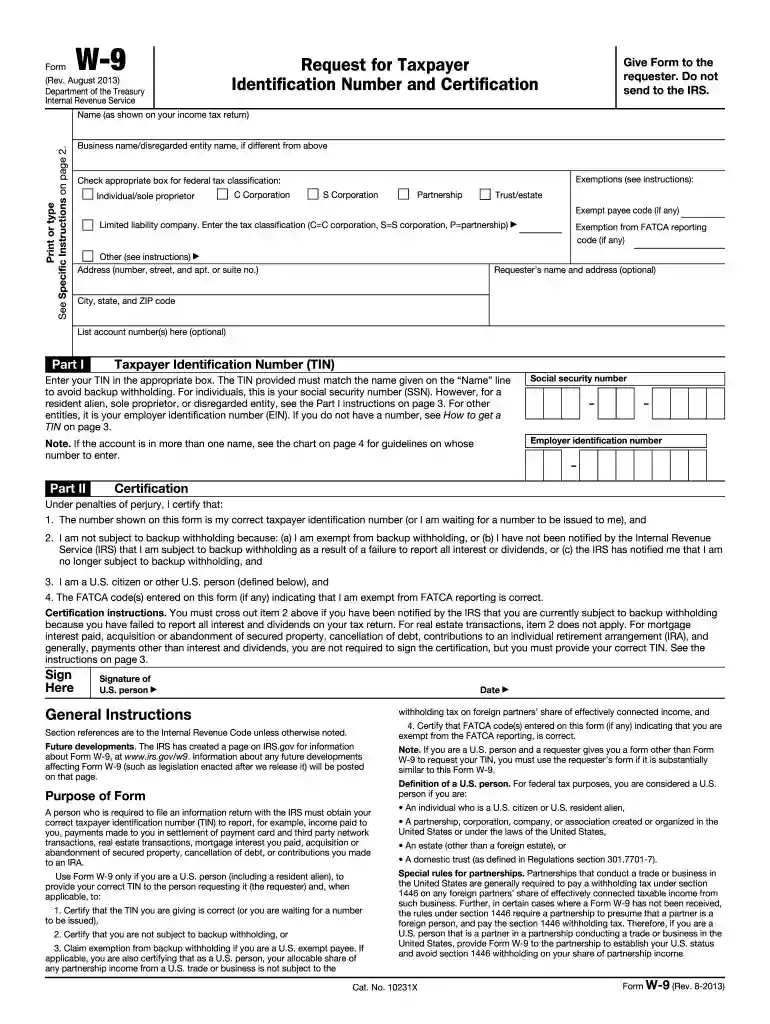
Type text, add images, blackout confidential details, add comments, highlights and more.

Draw your signature, type it, upload its image, or use your mobile device as a signature pad.

Send w 9 form 2013 via email, link, or fax. You can also download it, export it or print it out.
The W-9 form, formally known as the Request for Taxpayer Identification Number and Certification, is a document that U.S. persons use to provide their Taxpayer Identification Number (TIN) to entities that are required to file information returns with the IRS. The form serves as a certification of the taxpayer's correct TIN and information related to backup withholding exemptions.
The W-9 2013 form is generally used by independent contractors, freelancers, and self-employed individuals when engaging in a contract with a business or client.
Preparation: Individuals should prepare by gathering their necessary personal and tax identification information.
Filling Out the Form: Users must accurately fill in their name, business name (if applicable), and address in the designated fields. Correct tax classification ("Individual/Sole proprietor" or "LLC" for example) must be selected.
Certifying Information: Once the form is complete, sign and date it to certify the information provided is accurate.
Provide Your Name: Enter your legal name as it appears on your tax return.
Business Name/Disregarded Entity Name: Fill this in if applicable. For example, if you operate under a business name different from your personal name, list that here.
Federal Tax Classification: Check the appropriate box for your federal tax classification. Options include Individual/Sole Proprietor, C Corporation, S Corporation, and more.
Address: Enter your full address, city, state, and ZIP code.
List Account Numbers: Although optional, you may enter account numbers associated with your TIN.
Taxpayer Identification Number: Provide your Social Security Number (SSN) or Employer Identification Number (EIN).
Certification: Sign and date the form, confirming the information provided is true and correct.


The IRS outlines strict requirements for the use of the W-9 form to ensure compliance:
Failing to submit a completed W-9 form, or submitting incorrect information, can lead to penalties such as:
Certain taxpayers often need to use a W-9 form based on their situation:
Each of these sections aims to provide an understanding of the W-9 2013 form, its purpose, and implications for various taxpayers in the United States. The coverage ranges from basic definitions to in-depth examination of usage, compliance, and relevant scenarios.

We've got more versions of the w 9 2013 fillable form. Select the right w 9 2013 fillable version from the list and start editing it straight away!
| Versions | Form popularity | Fillable & printable |
|---|---|---|
| 2024 | 3.6 Satisfied (166 Votes) | |
| 2018 | 3.8 Satisfied (1092 Votes) | |
| 2017 | 4.4 Satisfied (1259 Votes) | |
| 2014 | 4.4 Satisfied (921 Votes) | |
| 2013 | 4.2 Satisfied (72 Votes) | |
| 2011 | 4.2 Satisfied (69 Votes) | |
| 2011 | 4.2 Satisfied (69 Votes) | |
| 2007 | 4.2 Satisfied (53 Votes) | |
| 2005 | 4.3 Satisfied (40 Votes) | |
| 2005 | 4.3 Satisfied (46 Votes) | |
| 2003 | 4.2 Satisfied (74 Votes) | |
| 2002 | 4.2 Satisfied (40 Votes) | |
| 2002 | 4.2 Satisfied (46 Votes) | |
| 1993 | 4.3 Satisfied (33 Votes) |
At DocHub, your data security is our priority. We follow HIPAA, SOC2, GDPR, and other standards, so you can work on your documents with confidence.



Part I. Taxpayer Identification Number (TIN). Enter your TIN in the appropriate box. The TIN provided must match the name given on the Name line.Read more
Mar 1, 2017 Form W7 15. Form W9 15. Fraud: Form W-4 statements 12. Fringe benefits 13. G. Gambling: Form W-2G 48. Losses 8, 48. Winnings 48. Gross income 25.Read more


