




01. Edit your i 9 form 2005 online
Type text, add images, blackout confidential details, add comments, highlights and more.

Type text, add images, blackout confidential details, add comments, highlights and more.

Draw your signature, type it, upload its image, or use your mobile device as a signature pad.

Send 2005 w9 via email, link, or fax. You can also download it, export it or print it out.
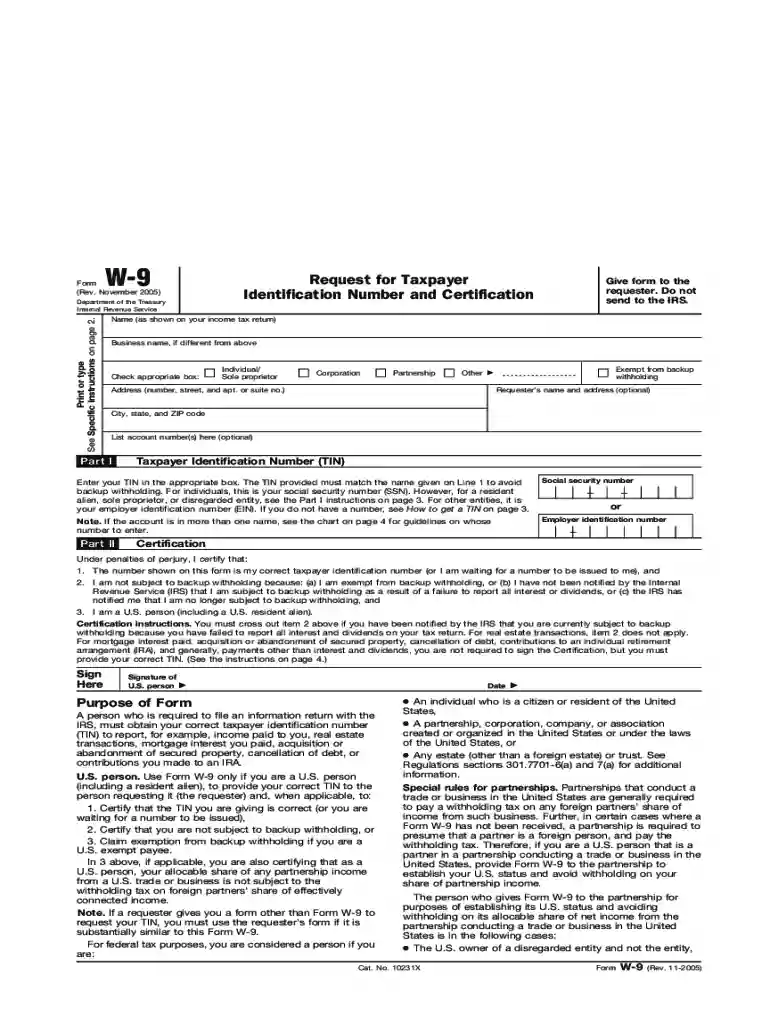
The Form W-9 (2005) is an official document used in the United States, primarily for tax purposes, to request a taxpayer’s identification number (TIN) and certification. Its main function is to gather accurate TINs from U.S. persons, including individuals and entities, who perform services as independent contractors or freelancers. This form helps facilitate proper income reporting to the Internal Revenue Service (IRS), ensuring that the correct amount of income is declared and that taxes are appropriately assessed.
Form W-9 is typically used when a U.S. person performs work as an independent contractor or receives payments other than salary. When a business needs a supplier's TIN for tax reporting purposes, the payee provides a completed Form W-9.
The 2005 version of Form W-9 can be obtained through the IRS website or by requesting it from the business or individual requiring it. Companies that regularly make payments to contractors might also supply a copy directly to their payees.
Completing Form W-9 involves several key steps. Careful accuracy in completing each section is vital to prevent errors that could lead to incorrect reporting or penalties.
Understanding the terminology associated with Form W-9 can aid in its correct completion and use.
Legal compliance with Form W-9 involves correctly reporting all income as a business or individual contractor, adhering to IRS guidelines for income tax reporting.
The IRS provides detailed guidelines on who needs to complete Form W-9 and how it should be processed.
Failing to comply with the requirements associated with Form W-9 can result in fines and penalties from the IRS.
We've got more versions of the i 9 form 2005 form. Select the right i 9 form 2005 version from the list and start editing it straight away!
| Versions | Form popularity | Fillable & printable |
|---|---|---|
| 2024 | 3.6 Satisfied (166 Votes) | |
| 2018 | 3.8 Satisfied (1092 Votes) | |
| 2017 | 4.4 Satisfied (1259 Votes) | |
| 2014 | 4.4 Satisfied (921 Votes) | |
| 2013 | 4.2 Satisfied (72 Votes) | |
| 2011 | 4.2 Satisfied (69 Votes) | |
| 2011 | 4.2 Satisfied (69 Votes) | |
| 2007 | 4.2 Satisfied (53 Votes) | |
| 2005 | 4.3 Satisfied (40 Votes) | |
| 2005 | 4.3 Satisfied (46 Votes) | |
| 2003 | 4.2 Satisfied (74 Votes) | |
| 2002 | 4.2 Satisfied (40 Votes) | |
| 2002 | 4.2 Satisfied (46 Votes) | |
| 1993 | 4.3 Satisfied (33 Votes) |
At DocHub, your data security is our priority. We follow HIPAA, SOC2, GDPR, and other standards, so you can work on your documents with confidence.
Aug 7, 2025 Find IRS forms, instructions, publications, and notices for prior years back to 1864. If a PDF file wont open, try downloading the file to your device.Read more
Form 1040A filers, use the worksheet on page 9. the amount shown below for your filing status. For this purpose, earned income includes only: a. Married filingRead more
Do not send to the IRS. Form W-9. Request for Taxpayer. Identification Number and Certification. (Rev. January 2005).Read more


