




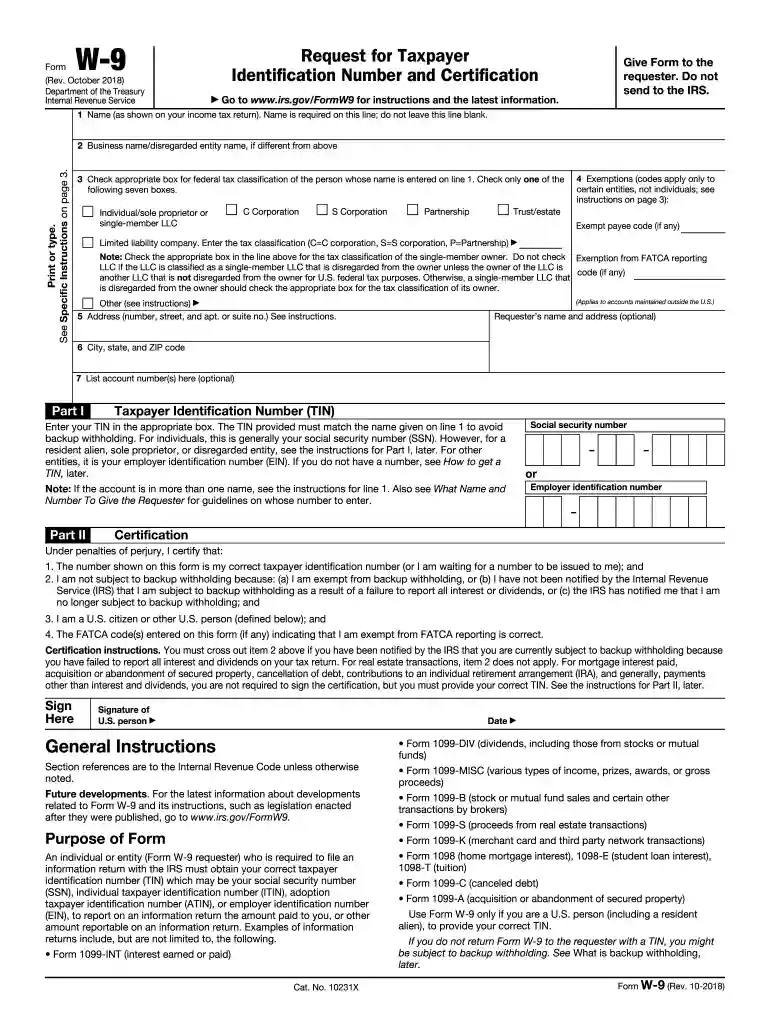
01. Edit your free 2018 w 9 fillable online
Type text, add images, blackout confidential details, add comments, highlights and more.

Type text, add images, blackout confidential details, add comments, highlights and more.

Draw your signature, type it, upload its image, or use your mobile device as a signature pad.

Send w9 texas 2018 dochub via email, link, or fax. You can also download it, export it or print it out.
The W-9 form, officially titled "Request for Taxpayer Identification Number and Certification," serves a pivotal role in the U.S. financial landscape. Its primary purpose is to collect a taxpayer’s identification number (TIN), which is required for tax reporting obligations. This form is predominantly used in transactions involving independent contractors or freelancers, attributing earnings correctly to the taxpayer. To ensure contracting entities have essential tax data, the W-9 captures critical details like name, address, and TIN. Without accurate completion, it heightens the risk of penalties and potential complications with the Internal Revenue Service (IRS).
The 2022 iteration of the W-9 form encompasses specific fields designed to streamline tax reporting:
Utilizing the W-9 effectively requires understanding its facilitation in financial dealings. Typically, when a taxpayer receives payment that necessitates IRS reporting—such as over $600 for independent contracting work—they are obliged to fill out and submit a W-9 to the payer. The information on the W-9 helps the payer complete the 1099 form at year-end, documenting payments made. A notable point is that completing a W-9 doesn’t automatically result in tax withholding unless dictated by backup withholding requirements.
Attention to detail is paramount when completing the W-9. Errors in the taxpayer information can result in withholding issues or misallocated tax responsibilities. Moreover, because the W-9 discloses sensitive information, safeguarding against unauthorized disclosure is a significant consideration for both taxpayer and payer entities. Typically, W-9 forms are exchanged directly and securely between involved parties.
Acquiring the W-9 form is straightforward, ensuring adherence to IRS protocols:
For digital transactions, using PDF editors like DocHub can facilitate online filling, ensuring rapid completion and submission. Digital handling of the W-9 is a practical solution, aligning with modern, paperless work environments.
Completing the W-9 form involves several precise steps:
Before submission, verifying each detail can avert errors leading to IRS penalties. Addressing all sections completely assures the payer of the taxpayer's compliance status, thereby avoiding backup withholding scenarios.
The W-9 form holds critical importance in maintaining fiscal responsibility. It:
In businesses heavily reliant on freelancers or independent contractors, the W-9 becomes a continual part of vendor onboarding and bookkeeping processes, thus influencing operational practices.
Several entities primarily engage with the W-9:


It differs from W-4, which governs employee withholding, by catering to independent income channels, thus highlighting its relevance across industries engaging non-employee services.
The legal usage of the W-9 form is paramount for federal compliance:
Providing incorrect or fraudulent information on a W-9 can induce penalties, emphasizing the importance of exactness and honesty in disclosures.
The IRS stipulates specific guidelines for W-9 form processing, critical for accurate tax reporting mechanics:
Referencing the IRS publication regularly helps taxpayers and payers remain compliant with current legal frameworks and regulations surrounding information reporting standards.
These blocks, through a thorough examination, provide a holistic view of the W-9 form, emphasizing its fundamental role in the domestic financial lattice while showcasing the utility, compliance, and submission dynamics therein.
We've got more versions of the free 2018 w 9 fillable form. Select the right free 2018 w 9 fillable version from the list and start editing it straight away!
| Versions | Form popularity | Fillable & printable |
|---|---|---|
| 2024 | 3.6 Satisfied (166 Votes) | |
| 2018 | 3.8 Satisfied (1092 Votes) | |
| 2017 | 4.4 Satisfied (1259 Votes) | |
| 2014 | 4.4 Satisfied (921 Votes) | |
| 2013 | 4.2 Satisfied (72 Votes) | |
| 2011 | 4.2 Satisfied (69 Votes) | |
| 2011 | 4.2 Satisfied (69 Votes) | |
| 2007 | 4.2 Satisfied (53 Votes) | |
| 2005 | 4.3 Satisfied (40 Votes) | |
| 2005 | 4.3 Satisfied (46 Votes) | |
| 2003 | 4.2 Satisfied (74 Votes) | |
| 2002 | 4.2 Satisfied (40 Votes) | |
| 2002 | 4.2 Satisfied (46 Votes) | |
| 1993 | 4.3 Satisfied (33 Votes) |
At DocHub, your data security is our priority. We follow HIPAA, SOC2, GDPR, and other standards, so you can work on your documents with confidence.





The number shown on this form is my correct taxpayer identification number (or I am waiting for a number to be issued to me); and. 2. I am not subject to backupRead more
Form W-9; Request for Taxpayer Identification Number (TIN) and Certification How do I answer the question on the Form 1040? (added March 10, 2022).Read more
An individual or entity (Form W-9 requester) who is required to file an information return with the IRS must obtain your correct taxpayer identification numberRead more


