




01. Edit your w9 form 2023 online
Type text, add images, blackout confidential details, add comments, highlights and more.

Type text, add images, blackout confidential details, add comments, highlights and more.

Draw your signature, type it, upload its image, or use your mobile device as a signature pad.

Send w9 form 2023 pdf via email, link, or fax. You can also download it, export it or print it out.
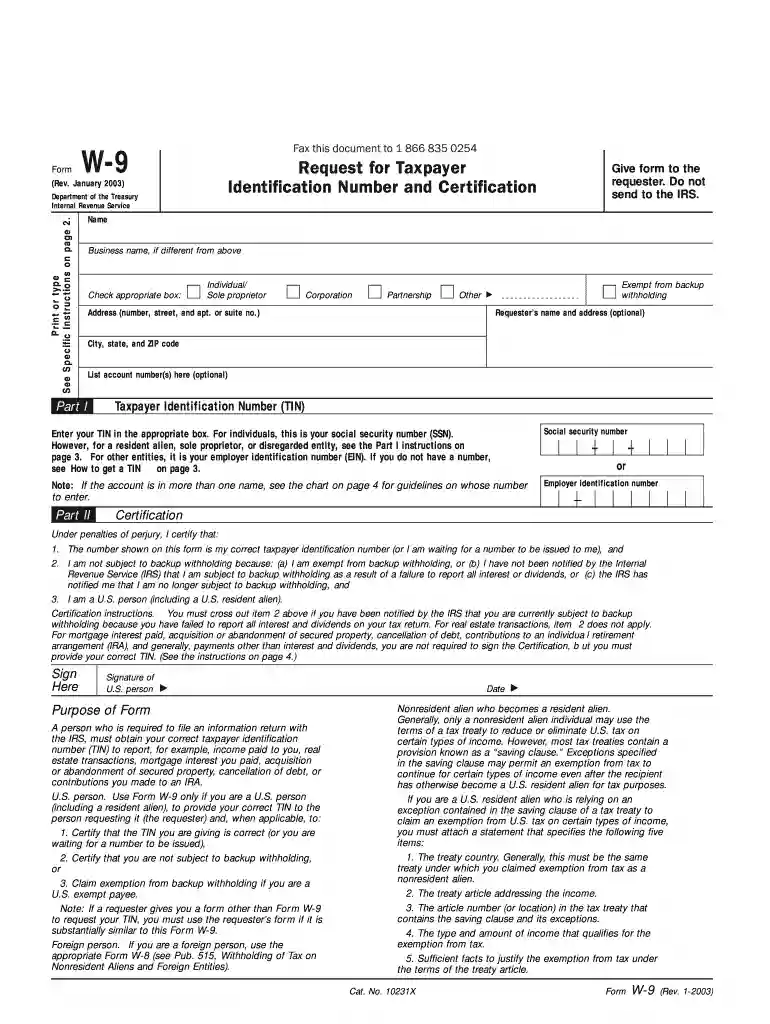
The W-9 form, officially known as the "Request for Taxpayer Identification Number and Certification," is a document issued by the Internal Revenue Service (IRS) in the United States. It is primarily used to collect information needed for federal tax reporting. The form requests a taxpayer identification number (TIN) and other pertinent personal details from individuals or businesses. The key function of the W-9 is to provide the correct TIN, which is essential for processing income that must be reported to the IRS.
The form also includes a section for certification to confirm the accuracy of the information provided and to declare exemption from backup withholding, if applicable. This certification is a legal requirement and is crucial for both the issuer and recipient to avoid miscommunication and potential penalties.
To effectively use a blank W-9 form, the issuer must provide it to any person or entity from whom they intend to receive services or other taxable financial transactions. The user receiving the form must then accurately fill out the document by entering personal or business name, type of business entity, and the corresponding taxpayer identification number.
Recipients can use different formats for providing their TIN, including a Social Security Number (SSN) for individuals and an Employer Identification Number (EIN) for businesses. They must also complete the certification section, affirming the accuracy of the information and confirming their tax obligations.
Once completed, the W-9 should be returned to the requestor, who will use the information to accurately report payments and other related transactions to the IRS.
A blank W-9 form can be obtained in several ways. The IRS website offers free downloads of the form in PDF format, ensuring that users have easy access to an official version. It’s crucial to use the most current version to ensure compliance with IRS regulations. Alternatively, businesses that regularly require W-9 forms from vendors or subcontractors often maintain a supply of blank forms.
Many accounting and tax preparation software programs also include access to blank W-9 forms as part of their document library. Utilizing these resources ensures that the form is filled out correctly and that users stay updated with any changes to the form's format or requirements.
Provide Personal Details:
Business Entity Type:
Enter Your TIN:
Exemptions:
Certification:
Return the Form:
The W-9 form includes several critical sections, each designed to capture specific information:
Thorough understanding and completion of these elements are essential to ensure proper tax reporting and compliance.
The W-9 form serves a vital role in the legal framework of tax reporting. It is required when engaging in any taxable financial transactions with individuals or entities expected to report income to the IRS. This includes independent contractors, freelancers, and others working on a non-employee basis.
The form complies with U.S. tax laws, particularly concerning the provision of correct taxpayer information. Ensuring the authenticity of the TIN and the certification section's completion helps avoid issues such as backup withholding, which occurs if the information provided is incorrect.
A W-9 form is widely used by various parties involved in U.S. business operations. Individuals working as independent contractors or freelancers often complete this form when entering contracts with businesses. Corporations and LLCs may also fill out the form when providing services or goods to other businesses.
Financial institutions may request a W-9 to accurately record interest and dividend income for their clients. Users might include:


Failing to provide a completed W-9 form or submitting incorrect information can result in penalties. Non-compliance with IRS requirements may lead to backup withholding, where the payer must withhold a percentage of payments for tax purposes. Incorrect or fraudulent information reported on a W-9 can also lead to fines and further scrutiny from the IRS.
To avoid such penalties, individuals and businesses must ensure the information on the W-9 is correct, complete, and consistent with IRS guidelines. Regular updates or renewals of the form may be necessary if changes occur in business or personal TIN details.
We've got more versions of the w9 form 2023 form. Select the right w9 form 2023 version from the list and start editing it straight away!
| Versions | Form popularity | Fillable & printable |
|---|---|---|
| 2024 | 3.6 Satisfied (166 Votes) | |
| 2018 | 3.8 Satisfied (1092 Votes) | |
| 2017 | 4.4 Satisfied (1259 Votes) | |
| 2014 | 4.4 Satisfied (921 Votes) | |
| 2013 | 4.2 Satisfied (72 Votes) | |
| 2011 | 4.2 Satisfied (69 Votes) | |
| 2011 | 4.2 Satisfied (69 Votes) | |
| 2007 | 4.2 Satisfied (53 Votes) | |
| 2005 | 4.3 Satisfied (40 Votes) | |
| 2005 | 4.3 Satisfied (46 Votes) | |
| 2003 | 4.2 Satisfied (74 Votes) | |
| 2002 | 4.2 Satisfied (40 Votes) | |
| 2002 | 4.2 Satisfied (46 Votes) | |
| 1993 | 4.3 Satisfied (33 Votes) |
At DocHub, your data security is our priority. We follow HIPAA, SOC2, GDPR, and other standards, so you can work on your documents with confidence.
Dec 1, 2017 A worksheet, Form 1120-W, is available to help you estimate your tax for the year. Fiscal-Year Taxpayers. If you use a fiscal year (rather thanRead more
You must enter one of the following on this line; do not leave this line blank. The name should match the name on your tax return. If this Form W-9 is for aRead more


