
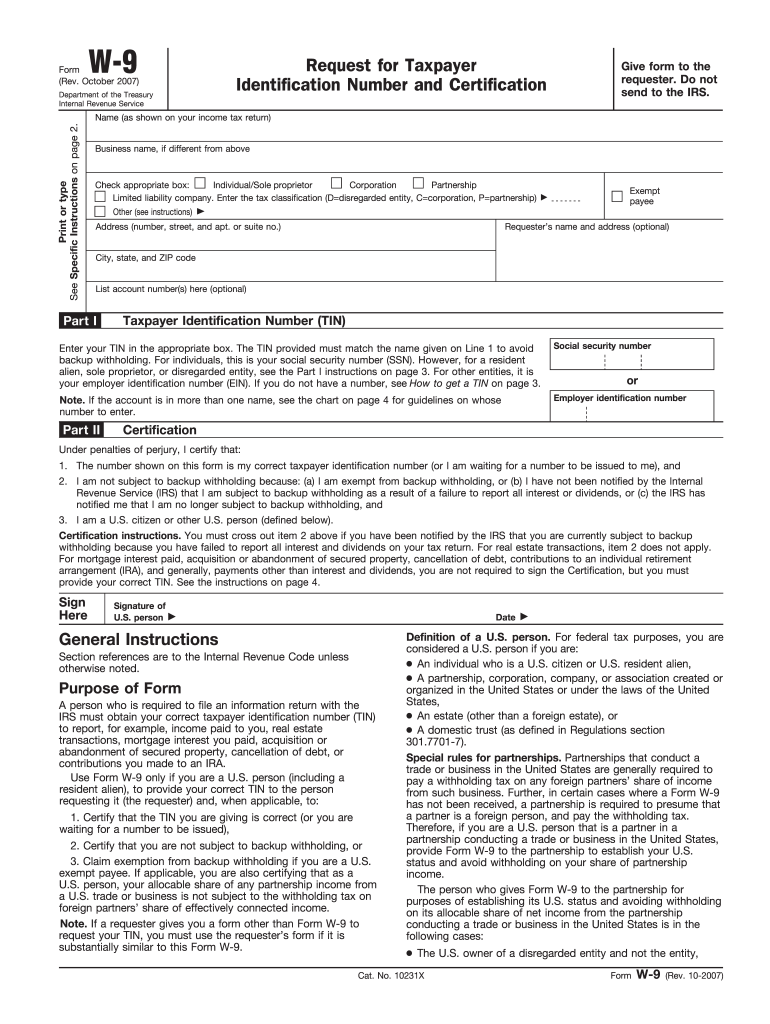







Definition and Meaning of the 2007 W-9 Form
The 2007 W-9 Form is a request for taxpayer identification number and certification used in the United States. This form is primarily required by businesses or other entities to obtain the correct Taxpayer Identification Number (TIN) of U.S. persons. The TIN could be a Social Security Number (SSN) or an Employer Identification Number (EIN), depending on the individual or business entity. The W-9 form is essential for reporting income, real estate transactions, and other financial activities to the IRS. It includes sections for personal information, TIN entry, and certification of accuracy. Completing this form accurately helps avoid penalties related to incorrect or incomplete tax reporting.
How to Use the 2007 W-9 Form
When using the 2007 W-9 Form, individuals and businesses need to provide specific personal and tax information. This includes your name, business name (if applicable), and address. Additionally, you'll need to enter your TIN and select the appropriate federal tax classification for tax reporting purposes. The form must be signed to certify the accuracy of the information provided. Once completed, this form should be returned to the requesting entity, not the IRS. It is used by the requester to accurately report income to the IRS.
Key Steps for Using the Form
- Gather necessary personal and business information.
- Determine your federal tax classification (e.g., individual, corporation, partnership).
- Fill in the required sections accurately.
- Sign and date the form to certify its accuracy.
- Return the completed form to the requester.
Obtaining the 2007 W-9 Form
Acquiring the 2007 W-9 Form is straightforward, as it is accessible through various channels. The IRS website offers downloadable PDF versions of the form. Additionally, many businesses provide the form directly to contractors or vendors upon commencing a business relationship. You can also find it integrated into tax preparation software tools commonly used by tax professionals and businesses. For those who prefer to work with physical documents, a printed version can be requested from an employer or downloaded and printed from online resources.
Methods to Obtain the Form
- Download the form from the official IRS website.
- Receive a copy from the business or entity requesting the form.
- Access the form through tax preparation software (e.g., TurboTax, QuickBooks).
Completing the 2007 W-9 Form
Filling out the 2007 W-9 Form requires careful attention to each section to ensure accurate information. Start with providing your name and business name, if applicable. Indicate your federal tax classification, such as "Individual/Sole proprietor" or "C Corporation." Enter your address, TIN, and ensure you review the instructions regarding backup withholding and exemptions. The form must be signed and dated to validate the information. Double-check all entries for accuracy before submission to avoid potential issues or financial penalties.
Detailed Instructions
- Enter full legal name and business name if applicable.
- Select federal tax classification from the provided options.
- Provide complete mailing address.
- Input correct TIN (SSN or EIN).
- Review form for accuracy, sign, and date.
Key Elements of the 2007 W-9 Form
The key elements of the 2007 W-9 Form are essential for accurately reporting tax information. These include the requester’s details, taxpayer’s name, business name, federal tax classification, mailing address, and TIN. The certification section where the taxpayer signs is crucial, as it attests that the information is correct and up-to-date, and that the taxpayer is not subject to backup withholding unless otherwise indicated.
Essential Components
- Requester and taxpayer's information sections.
- Tax classification and TIN entry.
- Certification with signature and date.
Important Terms Related to the 2007 W-9 Form
Understanding the terminologies associated with the 2007 W-9 Form will aid in completing it accurately. Terms like "TIN" (Taxpayer Identification Number), "backup withholding," and "exempt payee" are essential. A TIN is a crucial identifier for tax purposes. Backup withholding might apply if the taxpayer has failed to report interest or dividends, or if a TIN is not provided. An exempt payee is a taxpayer not subject to backup withholding, and understanding qualification for this status is important for accuracy.
Critical Terms Defined
- TIN: Identifier issued for tax purposes.
- Backup Withholding: Tax withholding required if taxpayer has not complied with IRS regulations.
- Exempt Payee: An individual or entity not subject to backup withholding requirements.
Legal Use of the 2007 W-9 Form
The W-9 Form's legal use pertains to obtaining and verifying taxpayer information for reporting purposes. The form serves as a certification for correct TIN reporting and helps with compliance under U.S. tax laws. It is critical in ensuring businesses report accurate income paid to taxpayers, such as freelancers or independent contractors. Misuse of the form, such as providing incorrect TIN information, can lead to penalties and the implementation of backup withholding protocols.
Penalties for Non-Compliance with the 2007 W-9 Form
Failure to complete the 2007 W-9 Form accurately, or neglecting to provide it when requested, can lead to penalties enforced by the IRS. Providing incorrect or incomplete TINs can result in fines and mandatory backup withholding. It's also essential to ensure that all information is current and accurate to avoid the risk of financial penalties. Ensuring compliance with IRS requirements by submitting the form on time helps mitigate these risks.
Consequences of Non-Compliance
- Fines for incorrect TIN information.
- Implementation of backup withholding if form requirements are unmet.
- Increased scrutiny on financial transactions with incorrect reporting.




