




01. Edit your schedule c form online
Type text, add images, blackout confidential details, add comments, highlights and more.

Type text, add images, blackout confidential details, add comments, highlights and more.

Draw your signature, type it, upload its image, or use your mobile device as a signature pad.

Send schedule c fillable form 2020 via email, link, or fax. You can also download it, export it or print it out.
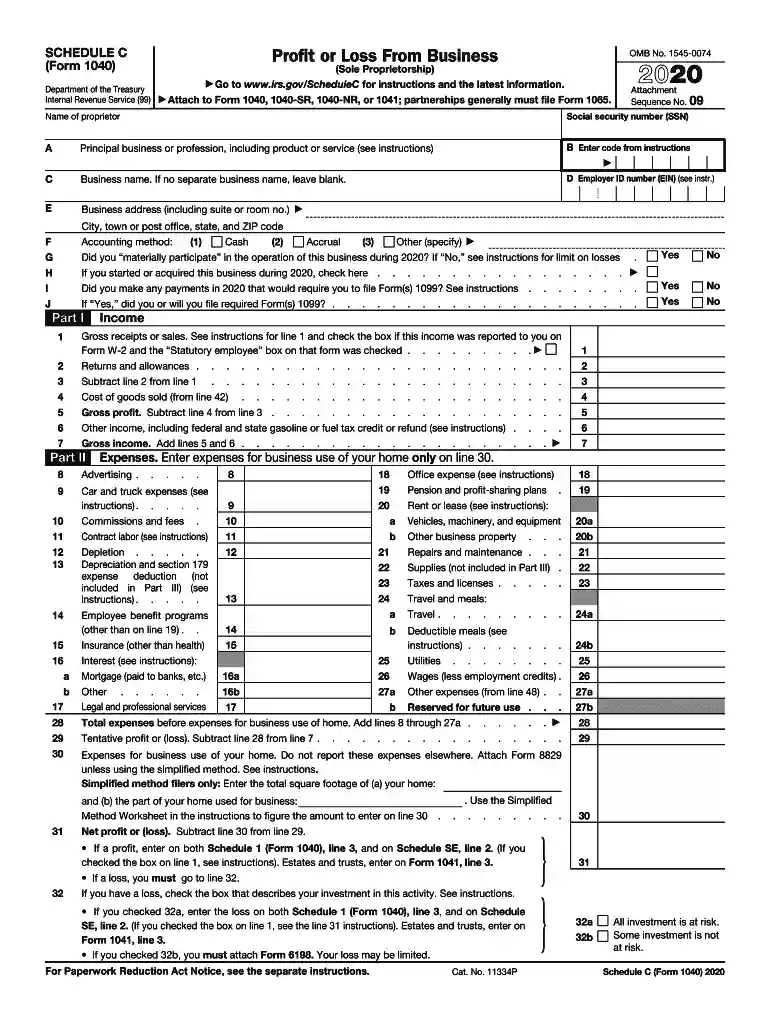
Schedule C (Form 1040) is a crucial form used by sole proprietors in the United States to report income or loss from a business you operated or a profession you practiced as a sole proprietor. If you were an independent contractor, this is the form to use to report your income. The main sections of Schedule C include income, expenses, cost of goods sold, and other important financial details. Using this form is essential for accurately calculating your net profit or loss from business activities, ultimately affecting your tax liabilities.
Using Schedule C involves several steps to ensure accurate completion. The form begins with basic information such as your name, Social Security number, business name, and business address. All of these details must match the records submitted to the IRS. Moving further into the form, you will enter specifics about your income, attaching supporting documentation when necessary. Taxpayers must also document various business expenses, ranging from advertising costs to travel expenses, to capture the full financial picture. All of this information culminates in determining the net profit or loss, which directly influences your tax obligation on Form 1040.
Collect Important Information: Start by gathering all necessary documents, including income statements, expense records, and receipts.
Enter Basic Information: Fill out fields for your personal and business details.
Declare Income: Record gross receipts or sales. It's important to subtract any returns or allowances.
List Expenses: Detail business expenses, including salaries, supplies, and utilities.
Compute Cost of Goods Sold: Calculate the cost of purchased or manufactured goods sold.
Determine Net Income: Deduct total expenses from total income to find your net profit or loss.
Review and Submit: Double-check your entries for accuracy before submission, either electronically or via mail.
Schedule C is used predominantly by individuals who operate as sole proprietors. This includes freelancers, gig workers, and small business owners who report business income on their personal tax returns. These individuals do not operate under a separate business entity like a corporation or partnership. Consequently, they must directly report business profits or losses on their tax returns through Schedule C.


The key elements of Schedule C include:
Income Section: This area captures total gross receipts or sales from business operations, adjusted for returns or allowances.
Expense Section: Deductible expenses are detailed here, such as advertising, rent, and employee wages.
Cost of Goods Sold: If your business involves selling goods, you'll report inventory costs here.
Profit and Loss Calculation: After accounting for income and expenses, this section finalizes the net business profit or loss.
Other Expenses: Additional costs not explicitly listed in prior sections are itemized here.
Following IRS guidelines is vital when completing Schedule C. This includes properly categorizing income and expenses, accurately reporting earnings, and maintaining thorough documentation. The IRS provides resources and publications, like Publication 334, Tax Guide for Small Business, to assist taxpayers in complying with federal tax laws. Adhering to these guidelines helps avoid potential audits and ensures accurate tax calculations.
Schedule C submissions must align with individual tax return deadlines, typically April 15 for most years. However, if this date falls on a weekend or holiday, the deadline may extend to the next business day. Additionally, applying for an extension can extend the filing deadline to October 15. Recognizing these dates and submitting forms on time prevents potential penalties and interest charges.
To successfully complete Schedule C, preparation of several documents is necessary. Essential documents include records of all business income, such as invoices and sales receipts. Expense documentation, like receipts, bills, and bank statements, is crucial for claiming deductions. Maintaining accurate records throughout the year simplifies the completion process of Schedule C and provides support in case of IRS inquiries.
Practically, let’s consider different scenarios where Schedule C is advantageous:
Freelance Graphic Designer: A freelancer earning income from diverse clients will use Schedule C to report earnings and deductions for expenses like software subscriptions and advertising.
Independent Consultant: An independent consultant would report their income from several businesses along with office supplies and travel expenses.
Online Retailer: An individual selling handcrafted goods online reports sales revenue, inventory purchases, and shipping costs using Schedule C.
By detailing each of these examples, the utility of Schedule C becomes clear, illustrating its role in accommodating diverse business activities and ensuring compliant tax reporting.
We've got more versions of the schedule c form form. Select the right schedule c form version from the list and start editing it straight away!
| Versions | Form popularity | Fillable & printable |
|---|---|---|
| 2024 | 4.6 Satisfied (31 Votes) | |
| 2023 | 4.4 Satisfied (54 Votes) | |
| 2022 | 4.3 Satisfied (38 Votes) | |
| 2021 | 4.8 Satisfied (140 Votes) | |
| 2020 | 4.4 Satisfied (93 Votes) | |
| 2019 | 4.1 Satisfied (38 Votes) | |
| 2018 | 4.3 Satisfied (239 Votes) | |
| 2017 | 4.3 Satisfied (233 Votes) | |
| 2016 | 4.1 Satisfied (110 Votes) | |
| 2015 | 3.5 Satisfied (95 Votes) | |
| 2014 | 4.1 Satisfied (54 Votes) | |
| 2013 | 4 Satisfied (44 Votes) | |
| 2012 | 4 Satisfied (27 Votes) | |
| 2011 | 4.2 Satisfied (66 Votes) | |
| 2010 | 4 Satisfied (34 Votes) |
At DocHub, your data security is our priority. We follow HIPAA, SOC2, GDPR, and other standards, so you can work on your documents with confidence.



Use Schedule C (Form 1040) to report income or loss from a business you operated or a profession you practiced as a sole proprietor.Read more
The term Schedule C means a form or information filed by a taxpayer to report income or loss from a business operated or a profession practiced as a soleRead more
Complete this part ONLY if you are claiming car or truck expenses on line 10 and are not required to file Form 4562 for this business. See the instructions forRead more


