




01. Edit your 2013 schedule c form online
Type text, add images, blackout confidential details, add comments, highlights and more.

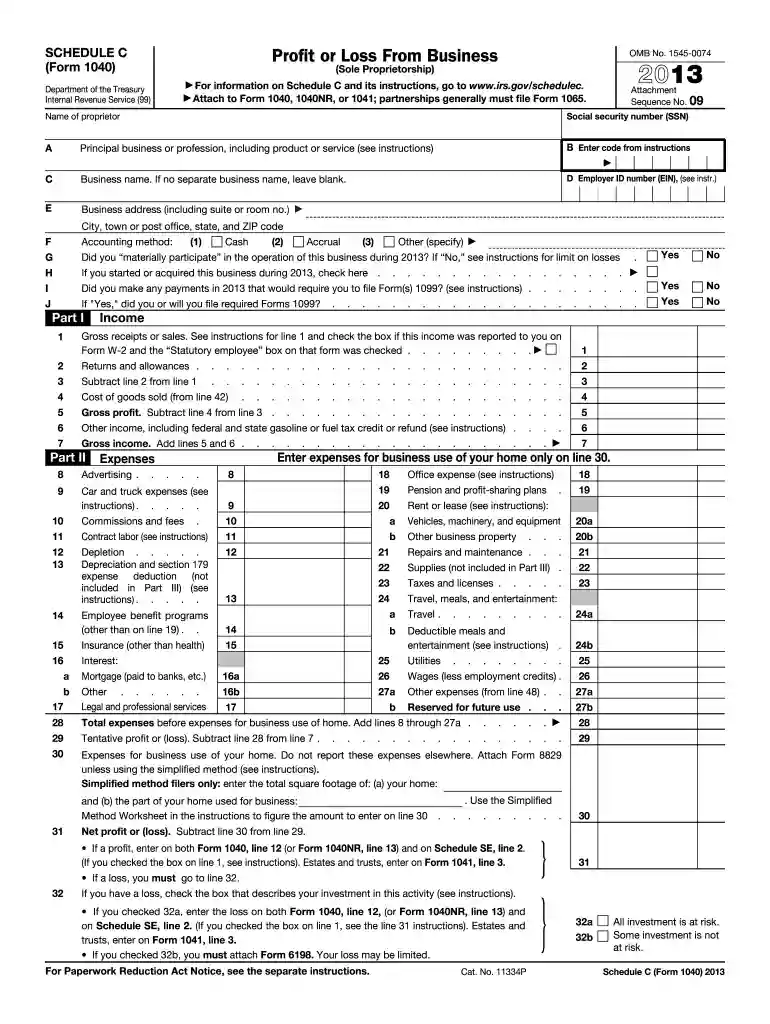
Type text, add images, blackout confidential details, add comments, highlights and more.

Draw your signature, type it, upload its image, or use your mobile device as a signature pad.

Send schedule c form 2013 via email, link, or fax. You can also download it, export it or print it out.
Schedule C (Form 1040) for the year 2013 is primarily used by sole proprietors to report their business income and expenses, helping them to calculate their net profit or loss. This document plays a critical role in the tax process for individuals running a business or trade alone, assisting in fulfilling federal tax obligations. It includes sections dedicated to various elements of business operations, such as income, expenses, and cost of goods sold, offering a detailed breakdown of financial activities for the year.
To use the Schedule C 2013 form effectively, begin by gathering all necessary financial documents that outline your income and expenses for the year in question. This includes sales receipts, invoices, and records of business expenses. Structuring your form accurately involves:
Completing the Schedule C 2013 form involves several steps:
Section A - Gross Income:
Section B - Business Expenses:
Section C - Cost of Goods Sold (COGS):
Section D - Vehicle Information:
Final Review:
The form is structured with essential components crucial for accurately reporting business finances:
Schedule C (2013) is primarily employed by sole proprietors and single-member LLCs who must report their business income and deductions. The form is particularly relevant for freelancers, independent contractors, and small business owners who run their operations without formally incorporating their business as a separate taxable entity.
Adhering to IRS guidelines is crucial when filing the Schedule C form. Key rules include:
Several terms are commonly associated with the Schedule C (2013) form:
For the 2013 tax year, the filing deadline for the Schedule C form coincided with the broader individual tax filing deadline:
Understanding and adhering to these deadlines is critical to avoid penalties and ensure compliance with federal tax obligations.
We've got more versions of the 2013 schedule c form form. Select the right 2013 schedule c form version from the list and start editing it straight away!
| Versions | Form popularity | Fillable & printable |
|---|---|---|
| 2024 | 4.6 Satisfied (31 Votes) | |
| 2023 | 4.4 Satisfied (54 Votes) | |
| 2022 | 4.3 Satisfied (38 Votes) | |
| 2021 | 4.8 Satisfied (140 Votes) | |
| 2020 | 4.4 Satisfied (93 Votes) | |
| 2019 | 4.1 Satisfied (38 Votes) | |
| 2018 | 4.3 Satisfied (239 Votes) | |
| 2017 | 4.3 Satisfied (233 Votes) | |
| 2016 | 4.1 Satisfied (110 Votes) | |
| 2015 | 3.5 Satisfied (95 Votes) | |
| 2014 | 4.1 Satisfied (54 Votes) | |
| 2013 | 4 Satisfied (44 Votes) | |
| 2012 | 4 Satisfied (27 Votes) | |
| 2011 | 4.2 Satisfied (66 Votes) | |
| 2010 | 4 Satisfied (34 Votes) |
At DocHub, your data security is our priority. We follow HIPAA, SOC2, GDPR, and other standards, so you can work on your documents with confidence.




In addition to filing a Schedule C, taxpayers in a trade or business may also be required to file one or more of the following forms: Form 4797, Sales of.Read more
List only depreciable property that requires or is entitled to a depreciation modification when computing ENI (see Form CT-399-I,. Instructions for Form CT-399)Read more
Use Schedule C (Form 1040) to report income or loss from a business you operated or a profession you practiced as a sole proprietor.Read more


