




01. Edit your 2016 schedule c online
Type text, add images, blackout confidential details, add comments, highlights and more.

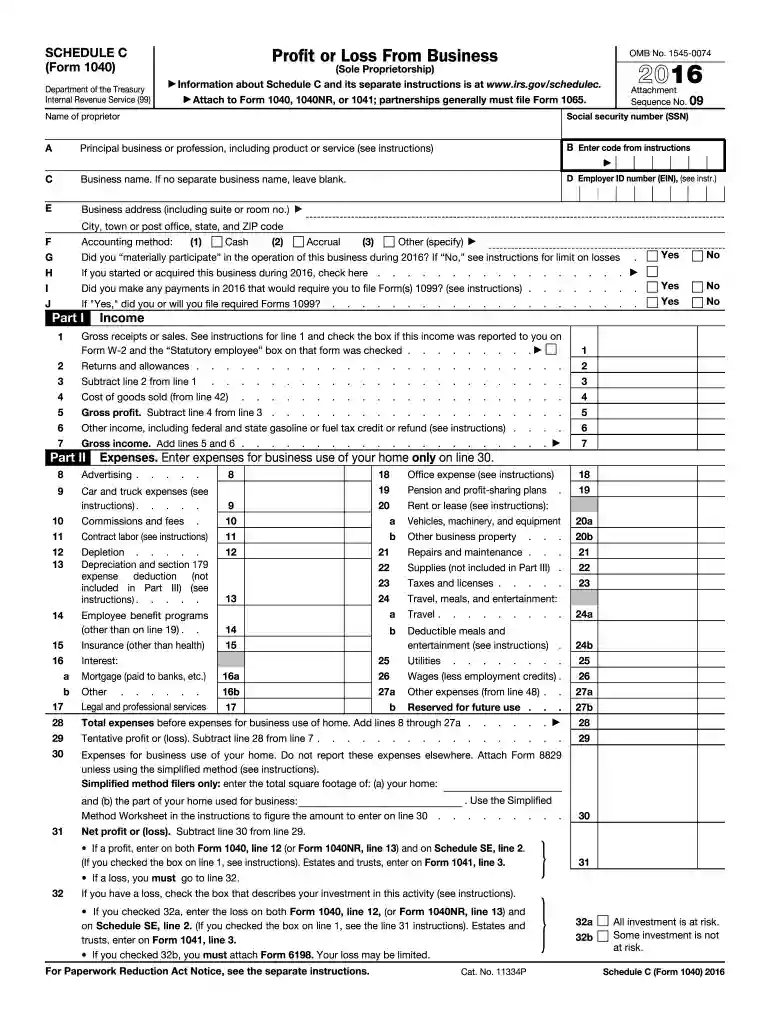
Type text, add images, blackout confidential details, add comments, highlights and more.

Draw your signature, type it, upload its image, or use your mobile device as a signature pad.

Send schedule c 2016 via email, link, or fax. You can also download it, export it or print it out.
The Schedule C Form 2016, officially known as "Profit or Loss from Business," is a critical document used by sole proprietors to report their business income and expenses to the IRS. This form plays a pivotal role for U.S.-based small business owners who operate as sole proprietors, freelancers, or independent contractors. The primary purpose of Schedule C is to calculate the net profit or loss from a business which is then transferred to the individual's Form 1040. This calculation impacts the overall tax payable or the refund due. Ensuring accurate and thorough completion of the Schedule C is essential for both compliance and optimizing tax obligations.
To effectively utilize the Schedule C Form 2016, business owners should gather relevant financial records to ensure accurate reporting. The form requires detailed documentation of both gross income and business expenses. Key steps include:
Completing the Schedule C Form 2016 involves several methodical steps to ensure correctness and compliance:
The Schedule C Form 2016 is composed of several critical sections:
Preparation for filing the Schedule C Form necessitates gathering several documents to ensure comprehensive reporting:
The IRS provides specific guidelines for completing the Schedule C Form 2016, which include:
Failure to accurately complete and file the Schedule C Form 2016 can result in several penalties:
Understanding key terms associated with the Schedule C Form 2016 provides clarity and aids accurate completion:
We've got more versions of the 2016 schedule c form. Select the right 2016 schedule c version from the list and start editing it straight away!
| Versions | Form popularity | Fillable & printable |
|---|---|---|
| 2024 | 4.6 Satisfied (31 Votes) | |
| 2023 | 4.4 Satisfied (54 Votes) | |
| 2022 | 4.3 Satisfied (38 Votes) | |
| 2021 | 4.8 Satisfied (140 Votes) | |
| 2020 | 4.4 Satisfied (93 Votes) | |
| 2019 | 4.1 Satisfied (38 Votes) | |
| 2018 | 4.3 Satisfied (239 Votes) | |
| 2017 | 4.3 Satisfied (233 Votes) | |
| 2016 | 4.1 Satisfied (110 Votes) | |
| 2015 | 3.5 Satisfied (95 Votes) | |
| 2014 | 4.1 Satisfied (54 Votes) | |
| 2013 | 4 Satisfied (44 Votes) | |
| 2012 | 4 Satisfied (27 Votes) | |
| 2011 | 4.2 Satisfied (66 Votes) | |
| 2010 | 4 Satisfied (34 Votes) |
At DocHub, your data security is our priority. We follow HIPAA, SOC2, GDPR, and other standards, so you can work on your documents with confidence.


Jan 26, 2017 Deduct the contributions you make for your commonlaw employees on your tax return. For example, sole proprietors deduct them on. Schedule C (Read more
Stated simply, Schedule C accounts for all income and expenses accrued during the course of business activities. The spreadsheets attached to this document are
If a profit, enter on both Form 1040, line 12 (or Form 1040NR, line 13) and on Schedule SE, line 2. (If you checked the box on line 1, see instructions).Read more


