






Definition & Meaning
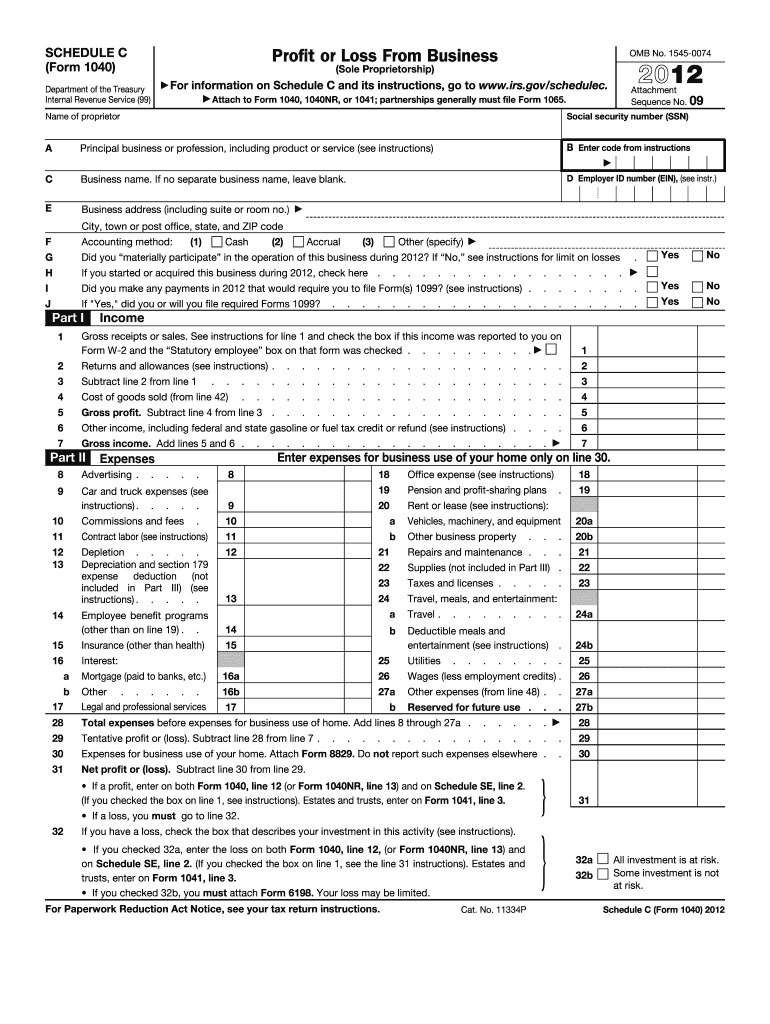
Schedule C (Form 1040) for the year 2012 is a tax form used by sole proprietors to report income or losses from their business activities. The form is essential for declaring profits or losses, helping business owners ensure accurate tax reporting. It includes sections pertinent to various income and expense categories, providing a framework for calculating net profit or loss, which ultimately affects the amount owed in taxes or the potential refund.
Importance of Schedule C
- Key document for sole proprietors who need to report business-related income and expenses to the IRS.
- Essential for determining taxable income and, consequently, the amount of tax owed or refund due.
- Ensures compliance with federal tax laws by requiring detailed breakdowns of income and expenses.
Steps to Complete the Schedule C 2012 Form
-
Gather Business Information:
- Proprietor's name and Social Security Number.
- Business name (if applicable) and address.
- Accounting method used (cash or accrual).
-
Report Income:
- Total gross receipts or sales.
- Returns and allowances to calculate net revenue.
-
Deduct Expenses:
- Standard business expenses like rent, utilities, and wages.
- Specific costs like materials and inventory can also be included.
-
Calculate Net Profit or Loss:
- Subtract total business expenses from total business income.
- Enter the result on Line 31, which impacts overall tax liability.
Important Terms Related to Schedule C 2012 Form
Gross Receipts or Sales
Reflects the total income before expenses are deducted. This figure is foundational when calculating net earnings for tax purposes.
Cost of Goods Sold (COGS)
Includes costs directly related to the production of goods sold by a business. It involves direct labor, materials, and manufacturing expenses.
Net Profit or Loss
- Net profit: Positive difference between total income and expenses.
- Net loss: Negative difference, indicating expenses exceed income.
Required Documents
- Income records: Invoices, receipts, and ledger entries reflecting business income.
- Expense receipts: Proof of purchases and payments relevant to business operations.
- Loan and interest agreements: Necessary for claiming deductions on interest expenses.
Additional Documents
- Mileage logs for vehicle-related deductions.
- Inventory records if applicable to the business type.
IRS Guidelines
The IRS provides detailed instructions on completing the Schedule C form correctly. Understanding these guidelines helps ensure accurate reporting, which can prevent costly audits and penalties.
Key Points
- Eligible deductions: Understanding allowable expenses, such as office supplies, utilities, and travel.
- Accuracy: The IRS emphasizes accurate record-keeping to substantiate claims.
Penalties for Non-Compliance
Failure to accurately complete or file the Schedule C form may result in penalties, including fines or interest charges. Non-compliance could also trigger an IRS audit that would necessitate a more detailed review of your tax records.
Avoiding Penalties
- Ensure all information is correct and submitted by the tax deadline.
- Maintain comprehensive records to support all entries on the form.
Software Compatibility
Several tax preparation software solutions offer compatibility with Schedule C, making it easier to fill out and submit the form accurately.
Examples of Compatible Software
- TurboTax: Guides users through each section of the Schedule C form.
- QuickBooks: Helps track business expenses and income, directly transferring data to Schedule C.
- H&R Block: Provides tools and tips for accurately completing and e-filing the form.
Taxpayer Scenarios
Schedule C is primarily used by sole proprietors, including freelancers, independent contractors, and small business owners. However, it may also be used by individuals in other professional situations that involve business activity independent of employment.


Typical User Profiles
- Self-employed consultants managing multiple projects.
- Online business owners selling products or services.
- Professionals providing personal or specialized services independently.
Form Submission Methods (Online / Mail / In-Person)
Electronic Filing
The IRS encourages electronic filing for faster processing and greater accuracy. Most tax preparation software supports e-filing directly to the IRS.
Mail Submission
Submitting via mail is also possible, though it can result in longer processing times. Mailing requires sending the completed form to the appropriate IRS processing center based on your location.