




01. Edit your irs schedule c 2011 online
Type text, add images, blackout confidential details, add comments, highlights and more.

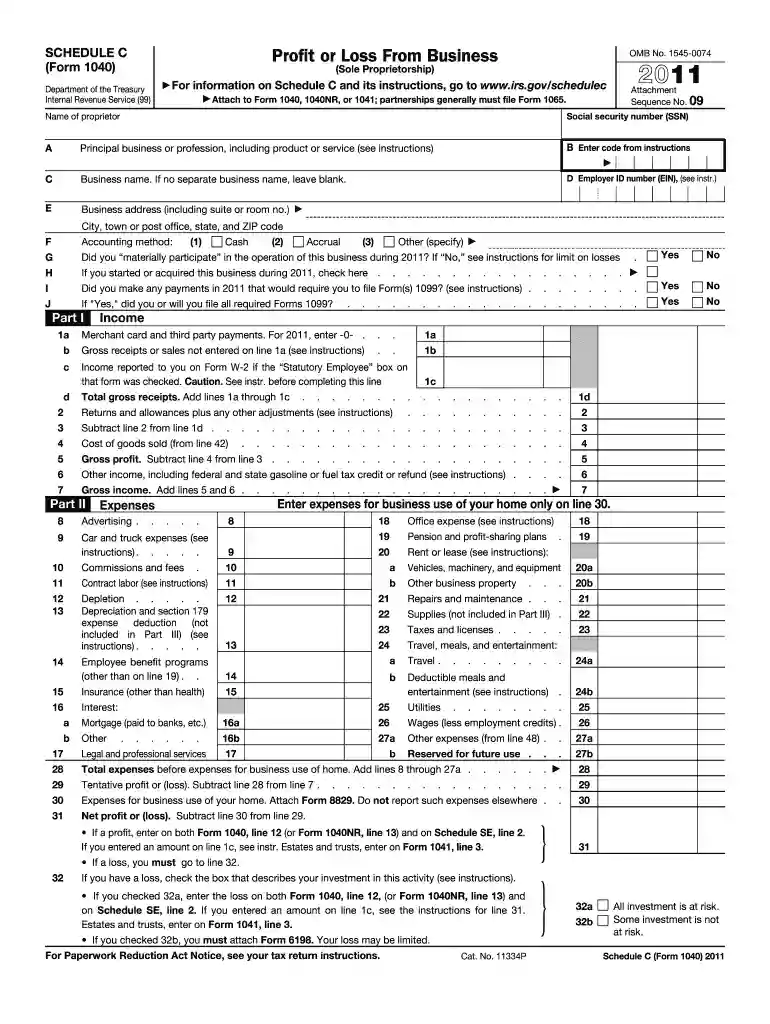
Type text, add images, blackout confidential details, add comments, highlights and more.

Draw your signature, type it, upload its image, or use your mobile device as a signature pad.

Send 1040 schedule c via email, link, or fax. You can also download it, export it or print it out.
The 2011 Schedule C Form, officially known as Schedule C (Form 1040), is used by sole proprietors to report their business income and expenses to the Internal Revenue Service (IRS). This form is vital for calculating the net profit or loss of a business, which in turn affects the amount of tax owed. Typically, this form is attached to the individual’s Form 1040 during tax filing. Sole proprietors—including freelancers and contractors—rely on this document to accurately reflect their business activities for the 2011 tax year.
Understanding specific terms is essential when completing the 2011 Schedule C Form. Key terms include:
These terms create a foundation for accurately completing and understanding the form's requirements.
Filling out the 2011 Schedule C Form involves several steps:
The primary users of the 2011 Schedule C Form are:


Timely filing is crucial for avoiding penalties. Key dates include:
Submitting on time ensures compliance and avoids additional costs.
Gathering the correct documents assists in accurate completion:
Having thorough documentation supports the figures reported on the form.
Compliance with IRS guidelines is essential:
Adhering to these guidelines prevents complications and potential audits.
Failing to comply with filing requirements can result in penalties:
Understanding these penalties underscores the importance of timely and accurate filing.
Submitting the 2011 Schedule C Form can be done through:
Each method has specific advantages, and selecting the right one hinges on individual needs and preferences.
We've got more versions of the irs schedule c 2011 form. Select the right irs schedule c 2011 version from the list and start editing it straight away!
| Versions | Form popularity | Fillable & printable |
|---|---|---|
| 2024 | 4.6 Satisfied (31 Votes) | |
| 2023 | 4.4 Satisfied (54 Votes) | |
| 2022 | 4.3 Satisfied (38 Votes) | |
| 2021 | 4.8 Satisfied (140 Votes) | |
| 2020 | 4.4 Satisfied (93 Votes) | |
| 2019 | 4.1 Satisfied (38 Votes) | |
| 2018 | 4.3 Satisfied (239 Votes) | |
| 2017 | 4.3 Satisfied (233 Votes) | |
| 2016 | 4.1 Satisfied (110 Votes) | |
| 2015 | 3.5 Satisfied (95 Votes) | |
| 2014 | 4.1 Satisfied (54 Votes) | |
| 2013 | 4 Satisfied (44 Votes) | |
| 2012 | 4 Satisfied (27 Votes) | |
| 2011 | 4.2 Satisfied (66 Votes) | |
| 2010 | 4 Satisfied (34 Votes) |
At DocHub, your data security is our priority. We follow HIPAA, SOC2, GDPR, and other standards, so you can work on your documents with confidence.





You can use Schedule C-EZ instead of Schedule C if you operated a business or practiced a profession as a sole proprietorship or qualified joint venture, or
Attach Schedule C or C-EZ . . . . . . . . . . 12. 13. Capital gain or (loss). Attach Schedule D if required. If not required, check here ▷. 13. 14. Other gainsRead more
Dec 21, 2011 Income tax. 1040 and Schedule C or C-EZ2. 15th day of 4th month after end of tax year. Self-employment tax. Schedule SE. File with Form 1040.Read more


