




01. Edit your 2008 schedule c online
Type text, add images, blackout confidential details, add comments, highlights and more.

Type text, add images, blackout confidential details, add comments, highlights and more.

Draw your signature, type it, upload its image, or use your mobile device as a signature pad.

Send 2008 form 1040 schedule via email, link, or fax. You can also download it, export it or print it out.
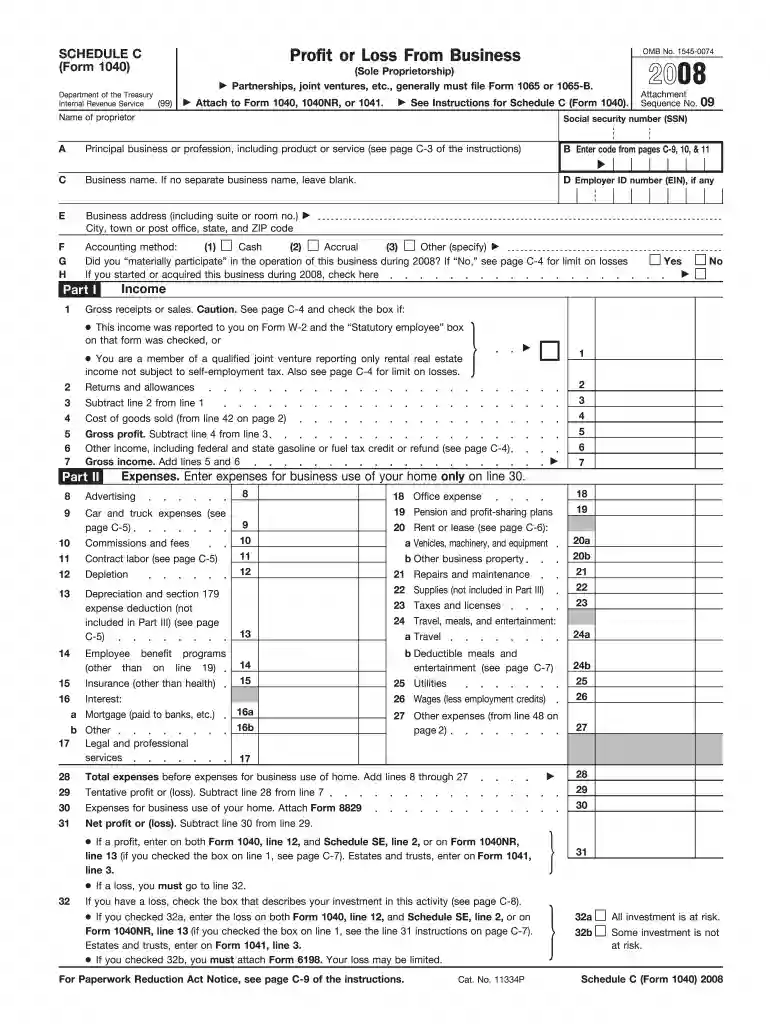
The 2008 Schedule C (Form 1040) is a document used by U.S. sole proprietors to report their business income and expenses. It plays a crucial role in determining the profit or loss from business operations, which is then included in the proprietor's individual tax return. This form features sections that require detailed documentation of income, expenses, and additional data such as cost of goods sold. Understanding the purpose and structure of the Schedule C form is essential for accurately reporting business activities to the Internal Revenue Service (IRS).
The form comprises several sections, each serving a distinct purpose in financial reporting:
Understanding these components is essential for ensuring compliance with tax regulations and optimizing potential deductions. Misreporting or omitting information can lead to complications and penalties.
Filing the Schedule C form requires careful attention to detail. Use this step-by-step guide to ensure accurate completion:
Completing this form with precision is critical to avoid IRS scrutiny and maximize allowable deductions.
The Schedule C form is primarily utilized by self-employed individuals operating as sole proprietors. This includes a wide range of professions such as freelancers, independent contractors, and small business owners. Each of these entities can benefit from detailing their business finances through the form, providing a clear picture of their taxable income after allowable expenses.


These users typically rely on the Schedule C form as a vital tool in managing their tax responsibilities and leveraging deductions.
Familiarity with the terminology associated with the Schedule C form is beneficial for accurate completion and compliance. Some crucial terms include:
Understanding these terms is key to navigating the form effectively and grasping the nuances of business tax reporting.
The IRS provides detailed instructions for filling out the 2008 Schedule C form, ensuring taxpayers report their financial activities accurately and transparently. Following these guidelines helps prevent miscalculations and potential audits, ensuring compliance with federal regulations.
Compliance with these guidelines ensures a smoother filing process and minimizes the risk of errors or penalties.
Failure to accurately complete the Schedule C form can result in several penalties, impacting financial stability and IRS standing. Penalties may include fines for late submission, interest on unpaid amounts, and potential audits for repeated discrepancies.
Understanding these penalties emphasizes the importance of timely and accurate filing.
The 2008 Schedule C form can be completed in either digital or paper formats, each offering various advantages and considerations depending on the user's preference and circumstance.
Weighing these options allows taxpayers to choose the method that best suits their needs and capabilities.
While federal guidelines dictate the general use of Schedule C, state-specific regulations may alter reporting requirements, affecting deductions and filing procedures. Awareness of these variations ensures compliance and maximizes potential benefits.
Consulting state tax agencies or professional accountants can provide valuable insights into local requirements and obligations.
We've got more versions of the 2008 schedule c form. Select the right 2008 schedule c version from the list and start editing it straight away!
| Versions | Form popularity | Fillable & printable |
|---|---|---|
| 2024 | 4.6 Satisfied (31 Votes) | |
| 2023 | 4.4 Satisfied (54 Votes) | |
| 2022 | 4.3 Satisfied (38 Votes) | |
| 2021 | 4.8 Satisfied (140 Votes) | |
| 2020 | 4.4 Satisfied (93 Votes) | |
| 2019 | 4.1 Satisfied (38 Votes) | |
| 2018 | 4.3 Satisfied (239 Votes) | |
| 2017 | 4.3 Satisfied (233 Votes) | |
| 2016 | 4.1 Satisfied (110 Votes) | |
| 2015 | 3.5 Satisfied (95 Votes) | |
| 2014 | 4.1 Satisfied (54 Votes) | |
| 2013 | 4 Satisfied (44 Votes) | |
| 2012 | 4 Satisfied (27 Votes) | |
| 2011 | 4.2 Satisfied (66 Votes) | |
| 2010 | 4 Satisfied (34 Votes) |
At DocHub, your data security is our priority. We follow HIPAA, SOC2, GDPR, and other standards, so you can work on your documents with confidence.
Schedule C (Form 1065) 2008. For Paperwork Reduction Act Notice, see the Instructions for Form 1065. Cat. No. 49945S. At any time during the tax year, wereRead more
If a profit, enter on both Form 1040, line 12, and Schedule SE, line 2, or on Form 1040NR, line 13 (if you checked the box on line 1, see page C-7). Estates andRead more
8. beginning ending. Staple forms here. Schedule C Limitations of EZ capital tax credit (New York S corporations do not complete Schedule C). Part 1 FiftyRead more


