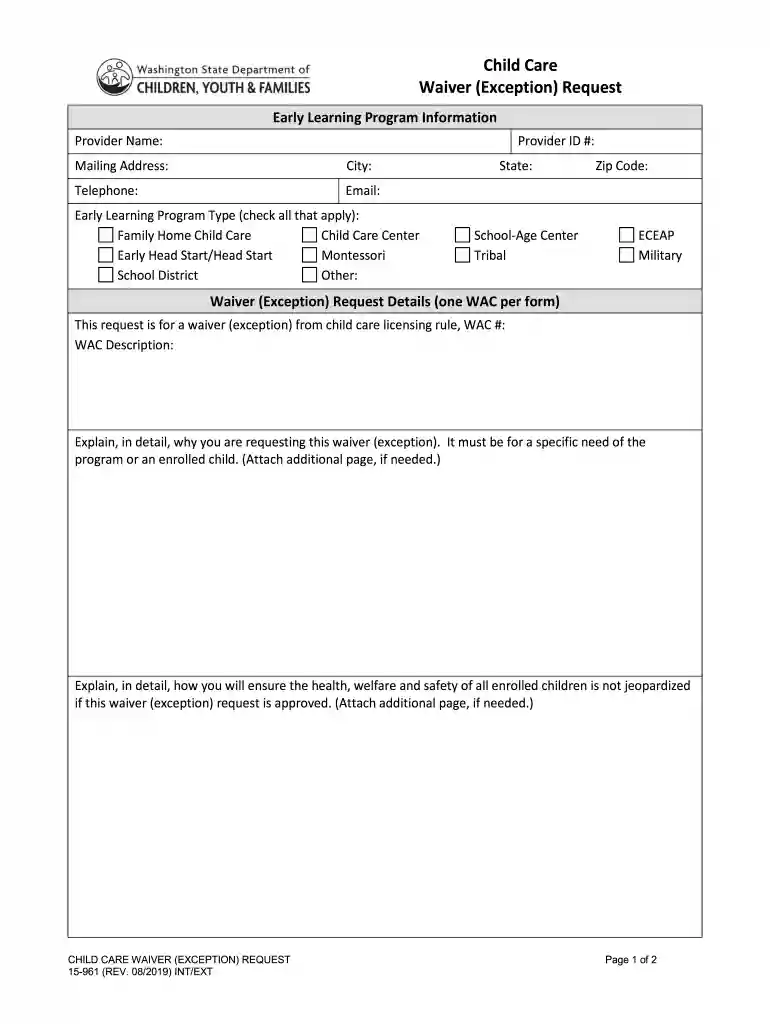
Definition & Meaning of a Waiver (Exception) Request
A Waiver (Exception) Request is a formal appeal submitted to obtain permission to deviate from specific regulations or requirements. This form is often used in contexts where an organization or individual seeks exemptions from set rules, such as child care licensing requirements in early learning programs. The request typically necessitates detailed information about the rule to be waived, justifications for the exemption, and assurances regarding associated safety and legal compliance. In the realm of early education, this form helps providers address unique circumstances without compromising the welfare of enrolled children. Approval of such a waiver is usually mandatory before any deviation from the regulation can occur, and it often requires written authorization from governing bodies like the Department of Children, Youth, and Families (DCYF).
How to Use the Waiver (Exception) Request
To effectively use a Waiver (Exception) Request, one must first identify the specific requirement or regulation from which an exception is needed. The typical steps involve:
- Identify the Regulation: Clearly define the particular rule you are seeking to waive. Understanding the regulation's intent and scope is crucial to crafting a compelling request.
- Justify the Request: Articulate the reasons why the exception is necessary. This could include explaining unique circumstances, ongoing challenges, or potential benefits of the waiver.
- Provide Assurance: Offer assurances that the waiver will not compromise health, safety, or legal standards. This can include a plan for maintaining these standards if the waiver is granted.
- Gather Necessary Information: Collect all required documentation and detailed descriptions needed to substantiate the request. This might include operation plans, safety measures, or other relevant documents.
- Submission: Submit the completed request form along with any accompanying documents to the appropriate authority.
Steps to Complete the Waiver (Exception) Request
Completing a Waiver (Exception) Request involves several precise steps:
- Access the Form: Obtain the Waiver (Exception) Request form from the relevant authority or download it from official websites.
- Fill in Personal and Organizational Details: Include the provider’s name, contact information, and related institutional details.
- Specify the Rule to Be Waived: Clearly indicate the specific licensing rule or regulation from which a waiver is sought.
- Detail the Reason for the Waiver: Provide a thorough explanation of the necessity of the waiver, supported by factual evidence, scenarios, or data.
- Outline Measures for Compliance: Describe how the institution will continue to uphold safety and compliance without the regulation in place.
- Finalize and Review: Ensure all sections are completed accurately and support your requests with compelling narratives and proof.
- Submit the Request: Forward the form through designated channels, ensuring compliance with all submission guidelines.
Key Elements of the Waiver (Exception) Request
The Waiver (Exception) Request contains several key components:
- Provider Information: Details about the entity or individual making the request, including contact information and accreditation status.
- Rule Specification: The exact regulation for which the waiver is being requested, including any associated clause or subsection.
- Justification for Request: A persuasive argument explaining why the waiver is necessary, supported by data and narrative description.
- Safety Assurance: Statements or documentation that ensure health and safety won't be compromised despite the waiver.
- Supporting Documentation: Any additional documents that underpin the request, such as safety protocols, alternative compliance plans, or expert testimonies.
Legal Use of the Waiver (Exception) Request
The legal use of a Waiver (Exception) Request is governed by specific statutes and regulations relevant to the field of application. Important legal considerations include:
- Approval Process: Only legally valid upon approval by an authorized body, ensuring that requests align with legislative intent.
- Compliance Obligations: Even with a waiver, entities must abide by broader regulatory frameworks to maintain legality.
- Temporary or Conditional Nature: Waivers may be subject to renewal, periodic review, or conditions that necessitate compliance evaluation.
State-Specific Rules for the Waiver (Exception) Request
State-specific rules play a substantial role in the processing and approval of Waiver (Exception) Requests:
- Varied Guidelines: States may have distinct processes, requirements, and documentation standards for waiver requests.
- Jurisdictional Differences: Regulatory nuances could affect the eligibility for a waiver based on regional priorities or local statutes.
- Approval Authorities: Different states assign approval responsibilities to varied departments, affecting submission channels and timelines.
Examples of Using the Waiver (Exception) Request
Several scenarios illustrate the practical application of the Waiver (Exception) Request:
- Child Care Licensing: A daycare facility applies for a waiver to exceed class size limits during staffing shortages, pledging enhanced supervision.
- Educational Policy: A university requests an academic waiver to accommodate a specialized curriculum for international students, ensuring educational standards.
- Healthcare Compliance: A hospital requests waiver flexibility for storage constraints due to an emergency, while maintaining patient safety through alternative methods.
Application Process & Approval Time
The application process and anticipated timeline for approval of a Waiver (Exception) Request typically involve the following:
- Submission of Request: Complete and submit the waiver form according to specified guidelines.
- Review Period: The reviewing body assesses the request, necessitating a thorough evaluation of the justifications and assurances provided.
- Approval Timeline: Approval time varies based on complexity, with notifications typically within weeks or a few months, dependent on the urgency and completeness of submissions.