
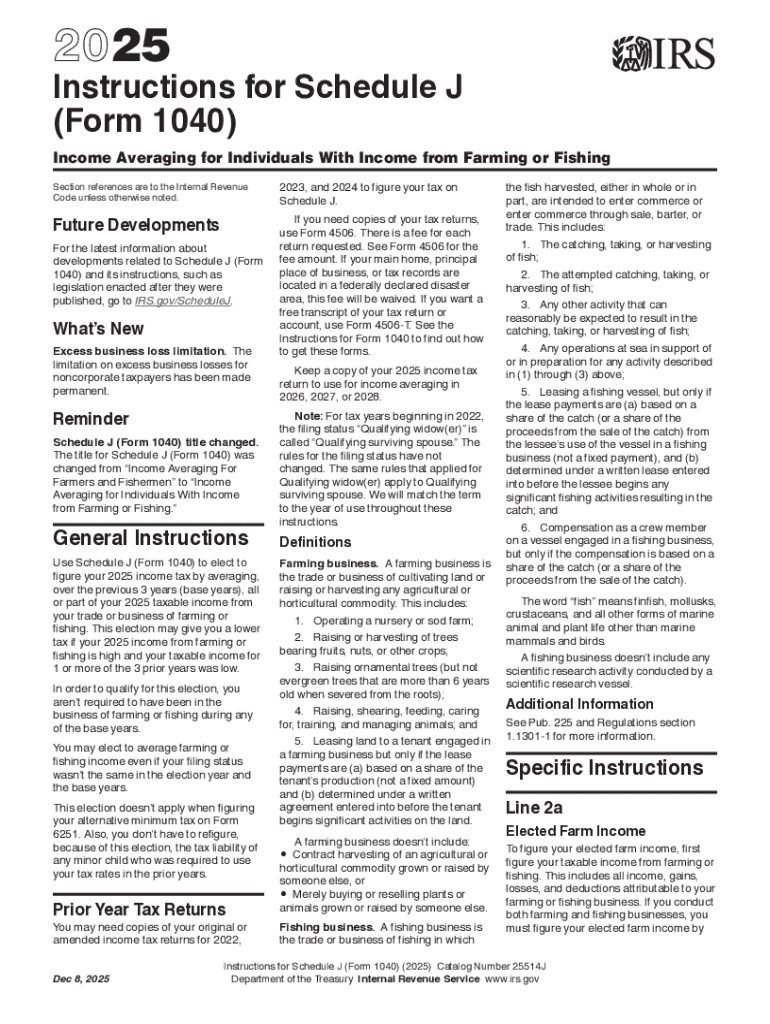







Definition and Purpose of Schedule J (Form 1040)
Schedule J (Form 1040) is utilized by certain individuals to average their income from farming or fishing over a three-year period, which can potentially lower their overall tax liability. Income averaging effectively spreads the income for these occupations, accounting for fluctuating profits common in farming and fishing industries. This form is vital for those whose livelihoods are significantly impacted by variable annual income, as it helps stabilize the tax amount owed.
Key Terms and Concepts
- Income Averaging: A tax provision allowing taxpayers to average their taxable income over multiple years.
- Qualifying Income: Primarily pertains to income derived from farming and fishing activities.
- Base Period Years: The three preceding years used to calculate average income.
Importance of Using Schedule J (Form 1040)
Taxpayers in the farming and fishing industries face unique financial challenges due to inconsistent income patterns. Schedule J (Form 1040) offers a strategic way for these taxpayers to manage their tax responsibilities by evening out income spikes across several years, which can lead to advantageous tax treatment.
Benefits of Income Averaging
- Tax Liability Reduction: Potential to lower taxes by leveraging lower tax rates from prior years.
- Cash Flow Management: Stabilizes tax payments, aiding in budget planning and financial management.
- Risk Mitigation: Reduces risk from unexpectedly high tax payments in profitable years.
Steps to Complete Schedule J (Form 1040)
- Determine Eligibility: Verify that your income qualifies under IRS guidelines for farming or fishing income.
- Gather Documents: Collect all relevant tax documents, including those from previous three years.
- Calculate Income: Aggregate the income subject to averaging, including any Schedule F, K-1, or 1099 related to farming or fishing.
- Complete the Form: Enter calculated figures on the Schedule J form based on instructions provided by the IRS.
- Attach to 1040: Schedule J must be filed with your annual Form 1040 tax return.
Detailed Guidance
- Documentation Requirements: Ensure all filings from the prior three years are accurate and accessible.
- Consultation with a Tax Advisor: Consider professional advice to navigate complexities around eligibility and calculations.
Relevant IRS Guidelines
IRS guidelines provide detailed instructions on how to calculate and report income on Schedule J. They define what qualifies as farming or fishing income, and specify how taxpayers should compute income averaging. The IRS also outlines scenarios when income averaging cannot be used, such as certain restrictions on tax credits or timing.
Important Regulatory Points
- IRS Publication 225: Offers comprehensive tax guidance for farmers.
- IRS Publication 595: Details tax considerations for those in the fishing industry.
Filing Deadlines and Important Dates
The Schedule J must be submitted along with your federal income tax return by the annual tax deadline, typically April 15. It's crucial to file on time to avoid unnecessary penalties and interest.
Planning and Preparation
- Early Preparation Recommended: Begin preparing documentation early in the tax season.
- Consider Extensions: If necessary, file for an extension by the due date to avoid penalties.
Eligibility Criteria for Schedule J (Form 1040)
Eligible taxpayers primarily include individual farmers and fishers. Eligibility hinges on having substantial income from these sectors subject to annual volatility.


Who Typically Files?
- Farmers and Fishers: Individuals with unreliably fluctuating income year-over-year from these specific industries.
- Joint Filers: Spouses who file jointly may also leverage income averaging if one or both have qualifying income.
Penalties for Non-Compliance
Failure to properly file Schedule J or incorrectly calculate income can lead to IRS penalties. It’s important to ensure that all numbers are accurately reported and deadlines are met to avoid financial repercussions.
Common Compliance Issues
- Missed Deadlines: Filing after the tax due date without an extension.
- Inaccurate Reporting: Miscalculating income or averaging periods.
Software Compatibility and Digital Filing
Schedule J is compatible with most tax software solutions, such as TurboTax and QuickBooks. These platforms can simplify the process by guiding users step-by-step through form completion, ensuring calculations are correct and all IRS guidelines are adhered to.
Advantages of Digital Filing
- Error Reduction: Automated calculations and cross-referencing against IRS regulations.
- Efficient Process: Easier tracking of previous years’ data for income averaging.
Real-World Scenarios for Schedule J (Form 1040)
Consider a farmer who in 2023 had a significant spike in income due to an exceptionally good harvest. Using Schedule J, this spike can be averaged out with lower income years 2020, 2021, and 2022, thereby possibly reducing the year's tax bracket and overall liability.
Additional Examples
- Fishing Success: A fisher who capitalizes on a particularly bountiful catch can buffer tax impacts by spreading income over previous lean years.
- Drought Recovery: Farmers recovering from previous years of drought or disaster may find relief in reduced means.
These structured approaches help ensure thorough understanding and precise action when dealing with Schedule J (Form 1040), ultimately aiming to harmonize the taxing process for industries traditionally prone to income volatility.


