




01. Edit your form online
Type text, add images, blackout confidential details, add comments, highlights and more.

Type text, add images, blackout confidential details, add comments, highlights and more.

Draw your signature, type it, upload its image, or use your mobile device as a signature pad.

Send it via email, link, or fax. You can also download it, export it or print it out.
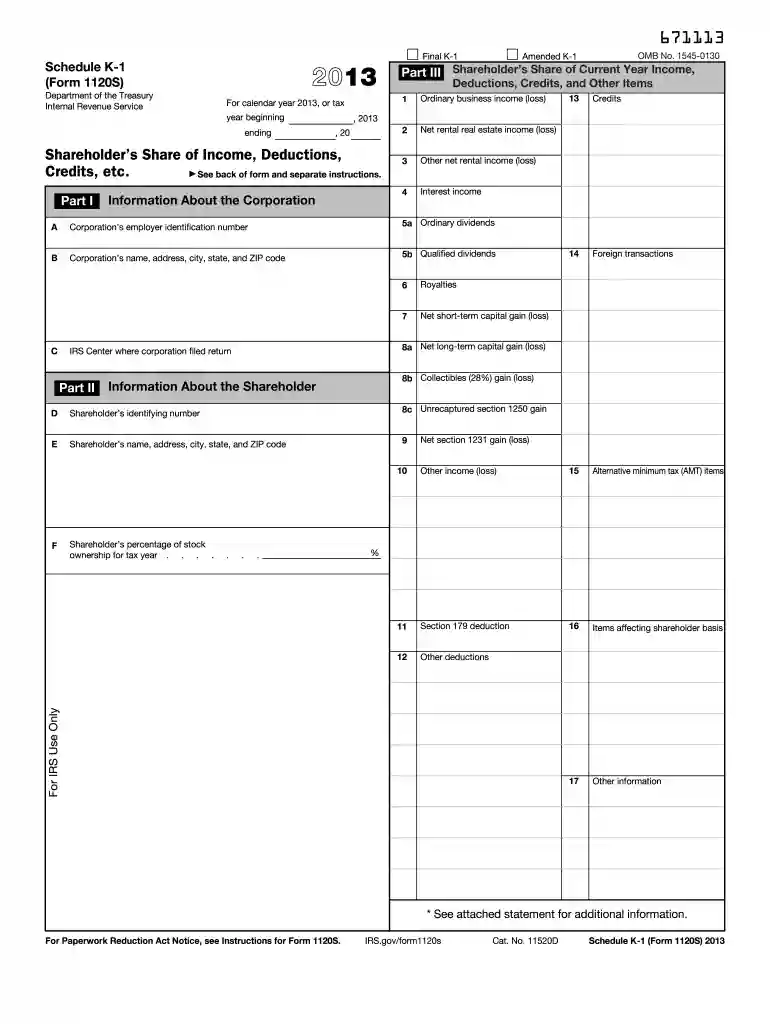
The 2013 Form 1120-S is an official United States federal tax document used by S corporations to report income, deductions, gains, losses, etc. S corporations pass these financial elements onto their shareholders, who then report these on their individual tax returns. Each shareholder receives a Schedule K-1, which outlines their share of the corporation's financial activities.
Form 1120-S includes several key sections:
This form is primarily used by S corporations and their shareholders. Typically, small to medium-sized business entities that elect to be treated as S corporations for tax purposes use this form. This structure allows these entities to avoid double taxation, as income is passed through to the shareholders.


Filing Form 1120-S correctly is essential for ensuring compliance with U.S. tax laws. It provides the necessary documentation for declaring business income and expenses, helping to mitigate the risk of audits and penalties. This form is legally binding and provides a transparent record of the company's financial activities.
The Internal Revenue Service (IRS) provides detailed instructions for completing Form 1120-S:
Typically, Form 1120-S must be filed by March 15 for calendar-year corporations. If additional time is needed, businesses can request an automatic six-month extension using Form 7004, but any taxes owed must still be paid by the original deadline to avoid interest and penalties.
Failure to timely file Form 1120-S or provide accurate Schedule K-1s to shareholders can lead to significant penalties. The IRS may impose fines for late filings or incorrect documentation. It's crucial to adhere to deadlines and maintain accuracy to avoid financial and legal consequences.
We've got more versions of the 2013 form 1120 s form. Select the right 2013 form 1120 s version from the list and start editing it straight away!
| Versions | Form popularity | Fillable & printable |
|---|---|---|
| 2025 | 4.1 Satisfied (37 Votes) | |
| 2024 | 4.3 Satisfied (24 Votes) | |
| 2023 | 4.1 Satisfied (28 Votes) | |
| 2022 | 4.5 Satisfied (32 Votes) | |
| 2021 | 4.8 Satisfied (80 Votes) | |
| 2020 | 4.3 Satisfied (86 Votes) | |
| 2019 | 4.3 Satisfied (67 Votes) | |
| 2018 | 4.3 Satisfied (118 Votes) | |
| 2017 | 4.2 Satisfied (97 Votes) | |
| 2016 | 4.4 Satisfied (267 Votes) | |
| 2015 | 4.2 Satisfied (76 Votes) | |
| 2014 | 4.3 Satisfied (67 Votes) | |
| 2013 | 4 Satisfied (36 Votes) | |
| 2012 | 4 Satisfied (48 Votes) | |
| 2011 | 4.4 Satisfied (26 Votes) |
At DocHub, your data security is our priority. We follow HIPAA, SOC2, GDPR, and other standards, so you can work on your documents with confidence.




Apr 15, 1976 Increased section 179 deduction dollar limits. The maximum amount you can elect to deduct for most sec- tion 179 property you placed inRead more
Use Form 1120S to report the income, gains, losses, deductions, credits, etc., of a domestic corporation or other entity for any tax year covered by an election.Read more
Check the box for the return for which you are using this Form 8879-EO and enter the applicable amount, if any, from the return. If you check the box on line 1aRead more


