2010 k 1 form-2026

Get Form
2010 k Preview on Page 1

Here's how it works

01. Edit your 2010 k online
Type text, add images, blackout confidential details, add comments, highlights and more.

02. Sign it in a few clicks
Draw your signature, type it, upload its image, or use your mobile device as a signature pad.

03. Share your form with others
Send it via email, link, or fax. You can also download it, export it or print it out.

Definition and Meaning of the 2010 K-1 Form

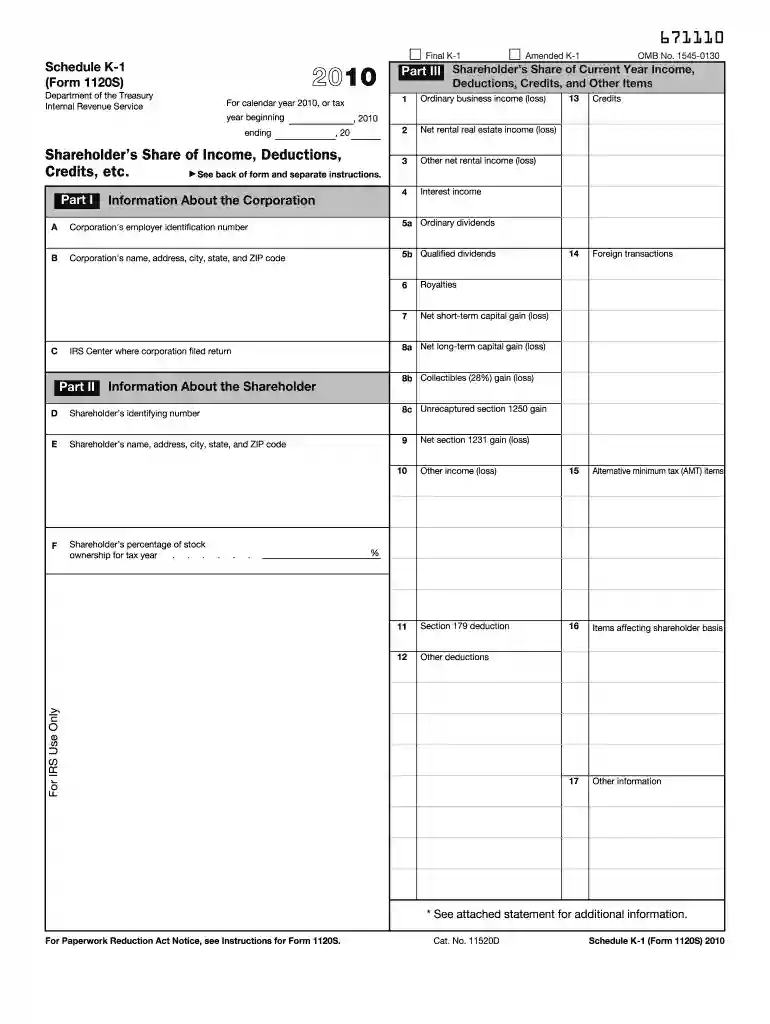
The 2010 K-1 form, specifically known as Schedule K-1 (Form 1120S), is an essential document issued by the Internal Revenue Service (IRS) for reporting income, deductions, credits, and other tax-related information for shareholders of S corporations. This form is crucial for shareholders as it details their specific share of the corporation's income, losses, and other tax attributes, which they must report on their individual tax returns. Understanding its components can help in accurate tax filing and compliance with IRS regulations.

Components of the 2010 K-1 Form

  • Income Reporting: The form includes a section to report ordinary business income, rental income, dividends, and capital gains realized by the corporation throughout the year.
  • Deductions and Credits: Shareholders can also see their share of deductions and credits, allowing them to benefit from business expenses incurred by the corporation.
  • Adjustments: The form may include various adjustments based on partners' and shareholders' local, state, or federal tax regulations.

Key Elements of the 2010 K-1 Form

Several critical elements must be adequately filled out on the 2010 K-1 form to ensure compliance and accurate reporting by shareholders:

  • Part I - Information About the Corporation: This section contains the corporation's details, including its name, address, and identifying number.
  • Part II - Information About the Shareholder: Here, the individual's information is captured, which includes their name, address, social security number, and ownership percentage in the corporation.
  • Part III - Income, Deductions, and Credits: This part of the form delineates the amounts each shareholder is responsible for reporting on their taxes, including ordinary business income, capital gains, and various credits.

How to Use the 2010 K-1 Form

Using the 2010 K-1 form effectively is vital for shareholders to ensure they report their income accurately. To utilize the form, shareholders should:

  1. Receive the Form: Shareholders should first ensure they receive their K-1 form from the corporation they invested in. This should be provided by the filing deadline.
  2. Review the Information: Check all entries for accuracy, including income, deductions, and personal information. Any discrepancies should be addressed with the corporation immediately.
  3. Include in Tax Return: Shareholders must report the information from the K-1 on their personal Form 1040, ensuring they adhere to the instructions outlined in the IRS guidelines.

Real-World Scenarios

  • Partnership Income: If a shareholder receives a K-1 that reports $10,000 in ordinary business income, they must declare this amount on their personal tax return and may need to pay taxes on it, depending on their overall income situation.
  • Losses to Offset Income: If the form indicates that the corporation experienced losses, these can potentially offset other income, which could lower the shareholder's tax liability.

Steps to Complete the 2010 K-1 Form

Completing the 2010 K-1 form correctly is critical for accurate tax reporting. Here are the detailed steps to follow:

  1. Gather Required Information: Before starting, gather all necessary personal and corporate financial documents, including your partnership or corporate agreement.
  2. Fill Out Part I: Enter the corporation's name, tax identification number, and address as required on the first section of the form.
  3. Complete Part II: Provide your details, including your name, address, and identifying number, ensuring they match IRS records.
  4. Accurately Fill Part III: Carefully input information regarding income, deductions, and credits. Ensure these values accurately reflect what has been communicated to you.
  5. Double-Check Entries: Review all entries for errors before submitting or distributing the completed form to the shareholders.

Filings and Deadlines Associated with the 2010 K-1 Form

The due dates for filing the 2010 K-1 form are closely aligned with corporate tax deadlines. Generally, the forms must be issued to shareholders by March 15 of the year following the tax year, reflecting the income and activities from the previous year. Similarly, shareholders should file their individual tax returns (Form 1040) by April 15, allowing time to report income accurately from the K-1.

Importance of Adherence to Deadlines

  • Avoiding Penalties: Filing on time helps avoid potential tax penalties associated with late filings.
  • Ensuring Accurate Tax Reporting: Timely receipt and reporting of the K-1 information ensure compliance with tax laws, reducing the risk of IRS audits.

Important Terms Related to the 2010 K-1 Form

Certain terms frequently arise when discussing the 2010 K-1 form, which can aid in understanding its implications and uses:

  • S Corporation: A type of corporation that meets specific IRS requirements, allowing earnings, losses, and tax deductions to pass through directly to shareholders.
  • Ordinary Business Income: Income generated through the primary operations of the business, excluding gains from the sale of capital assets.
  • Pass-Through Entity: A business structure where profits or losses are passed directly to investors to avoid double taxation at the corporate and individual levels.

Clarifying Roles and Responsibilities

  • Shareholders: Responsible for using the K-1 information in their tax returns.
  • Corporations: Required to accurately report and distribute K-1 forms to their shareholders, ensuring compliance with tax obligations.

Who Typically Uses the 2010 K-1 Form

The 2010 K-1 form is typically used by stakeholders in S Corporations, which are structured to pass their income, deductions, credits, and other tax items directly to shareholders. This includes individuals who are:

  • Shareholders of S Corporations: Individuals owning shares in an S Corporation who need to report their portion of the income.
  • Partners in Partnerships: Many partners will also receive forms similar to K-1, capturing their specific share of the partnership’s financial outcomes.
  • Members of Limited Liability Companies (LLCs): Certain LLCs treated as pass-through entities may also issue K-1 forms to report income to their members.
decoration image ratings of Dochub

Examples of Typical Beneficiaries

  • Small Business Owners: Individuals with investments in small S Corporations may benefit from the tax pass-through, particularly those actively involved in business operations.
  • Estate and Trust Beneficiaries: Those receiving distributions from entities structured in this manner will also use K-1 forms for individual tax compliance.

Examples of Using the 2010 K-1 Form

Practical applications of the 2010 K-1 form illustrate its importance in tax reporting and compliance. Consider the following examples:

  • Reporting Rental Income: A shareholder receiving $5,000 in reported rental income must document this on their tax return, reflecting their share accurately.
  • Claiming Business Deductions: If a corporation reports that shareholders can claim $2,000 in business expenses, individuals can enter this amount in their tax filings to reduce taxable income.

Real-World Scenarios for Organizational Structure

  • Investment Decisions: Understanding how the K-1 calculation impacts individual tax returns can influence potential investors' decisions when considering investment in S Corporations versus other business structures.
  • Tax Planning: Shareholders may modify their investment strategies based on the implications of K-1 forms, allowing them to optimize tax reduction strategies effectively.

Each of these components underscores the importance of the 2010 K-1 form in accurately representing a shareholder's stake in an S Corporation and ensuring compliance with tax laws.

See more 2010 k 1 form versions

We've got more versions of the 2010 k 1 form form. Select the right 2010 k 1 form version from the list and start editing it straight away!
Versions Form popularity Fillable & printable
2023 4.1 Satisfied (28 Votes)
2022 4.5 Satisfied (32 Votes)
2021 4.8 Satisfied (80 Votes)
2020 4.3 Satisfied (86 Votes)
2019 4.3 Satisfied (67 Votes)
2018 4.3 Satisfied (118 Votes)
2017 4.2 Satisfied (97 Votes)
2016 4.4 Satisfied (267 Votes)
2015 4.2 Satisfied (76 Votes)
2014 4.3 Satisfied (67 Votes)
2013 4 Satisfied (36 Votes)
2012 4 Satisfied (48 Votes)
2011 4.4 Satisfied (26 Votes)
2010 4 Satisfied (58 Votes)
2009 4.1 Satisfied (64 Votes)
be ready to get more

Complete this form in 5 minutes or less

Get form

Got questions?

We have answers to the most popular questions from our customers. If you can't find an answer to your question, please contact us.
Contact us
A K-1 form is usually prepared by the accountant who manages the entitys taxes, before being issued to each partner, shareholder, or beneficiary.
The Schedule K-1 tax form is for inheritance recipients who need to report their share of income, deductions, or credits from the trust or estate. Get the clarity you need to file your income taxes correctly as a beneficiary.
What Happens If You Dont File a K-1? The IRS doesnt expect you, the taxpayer, to file the actual Schedule K-1 form. However, it does expect that you will include all the financial information on the K-1 that you were issued on your personal income tax return.
How Does Schedule K-1 Affect Personal Taxes? A Schedule K-1 can impact your personal taxes in key ways. It reports income from partnerships, S-corporations, and trusts. This income is often considered pass-through, meaning it goes directly to you without being taxed at the entity level.
K-1 income generated from an S Corp where you materially participate is considered non-passive income. It is not necessarily earned income and it is not passive income. It is something in between, but definitely without the Social Security and Medicare tax element.
be ready to get more

Complete this form in 5 minutes or less

Get form

People also ask

Some trusts and estates pass income through to the beneficiaries. In these cases, the beneficiaries receive a K-1. It shows the income they must report on their tax returns.
The Schedule K-1 is the form that reports the amounts passed to each party with an interest in an entity, like a business partnership or an S corporation. The parties use the information on the K-1 to prepare their separate tax returns.

Related links