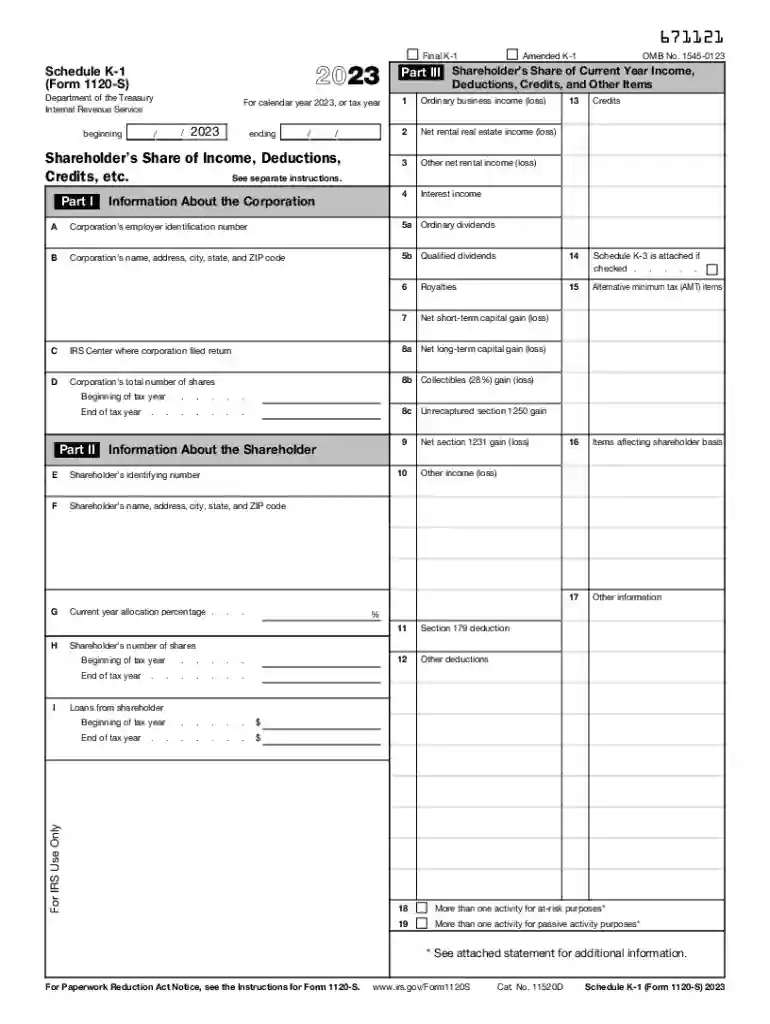
Schedule K-1 (Form 1120-S) - Shareholder's Share of-2026

Get Form
k1 form 2023 Preview on Page 1

Here's how it works

01. Edit your k1 form 2023 online
Type text, add images, blackout confidential details, add comments, highlights and more.

02. Sign it in a few clicks
Draw your signature, type it, upload its image, or use your mobile device as a signature pad.

03. Share your form with others
Send 2023 form 1120s k 1 via email, link, or fax. You can also download it, export it or print it out.

Definition and Purpose of Schedule K-1 (Form 1120-S)

The Schedule K-1 (Form 1120-S) is a tax document used primarily by S corporations to report income, deductions, and credits to shareholders. This form provides detailed insights into each shareholder’s share of the corporation's income, losses, and distributions during the tax year.

Understanding its purpose is crucial for shareholders, as the data on the K-1 form is necessary for accurate reporting on individual tax returns. The form breaks down the taxpayer's portion of surrendering income, much like a pass-through entity would, which means the company's tax obligations are passed on to the shareholders’ personal tax returns.

Components of Schedule K-1 (Form 1120-S)

  • Ordinary Business Income: Reflects the company’s regular income from operations.
  • Net Rental Income: Reports income from rental activities.
  • Dividends: Represents any dividends distributed to shareholders.
  • Capital Gains: Reflects any gains on the sale of assets by the corporation.
  • Other Income or Loss: Includes any additional income or deductions that do not fit into other categories.

Each component is crucial for tax calculations, further emphasizing the importance of careful record-keeping by the S corporation throughout the tax year.

How to Use Schedule K-1 (Form 1120-S)

When shareholders receive the Schedule K-1 (Form 1120-S), it plays a vital role in filing personal income tax returns. Each shareholder must report the information provided on the K-1 form accurately on their Form 1040.

Steps for Using Schedule K-1

  1. Receive Schedule K-1: Obtain the K-1 form from the S corporation, typically by March 15, following the end of the tax year.
  2. Review the Information: Check that your name and Social Security number are correct, and ensure all amounts listed are accurate.
  3. Report Income on Form 1040: Transfer the appropriate amounts from the K-1 to the corresponding sections of your Form 1040.
  4. Consult Tax Filing Software or a Professional: If you utilize tax filing software like TurboTax, ensure it accommodates K-1 forms for seamless integration.

Failure to properly report K-1 income can lead to a delay in processing your tax return and complications with the IRS.

Steps to Complete the Schedule K-1 (Form 1120-S)

Completing the Schedule K-1 involves careful attention to detail and accuracy. The process begins with gathering essential information about the S corporation and its shareholders.

Detailed Steps for Completing Schedule K-1

  1. Identify the Shareholder: Gather all necessary identification details, including the name, address, and taxpayer identification number (TIN) for each shareholder.
  2. Determine Shareholder's Ownership Percentage: Calculate the percentage of the corporation owned by each shareholder, as this affects the calculation of income allocated to them.
  3. Calculate Income and Deductions: Compile all relevant financial data, including:
    • Ordinary business income
    • Rental income
    • Any capital gains or losses
    • Distributions made to shareholders
  4. Complete Line Items: Fill out all applicable sections of the K-1 form according to the IRS guidelines, ensuring accuracy throughout.
  5. Distribute Copies to Shareholders and IRS: Once completed, provide copies of the K-1 to each shareholder and file the original with the IRS.

It is beneficial to ensure that the documentation aligns with the corporation's financial records to avoid inconsistencies.

Important Terms Related to Schedule K-1 (Form 1120-S)

Understanding the terminology associated with Schedule K-1 is essential for shareholders. Familiarizing oneself with these terms improves comprehension and ensures accurate tax filing.

Key Terminology

  • Pass-Through Entity: This refers to business structures like S corporations which pass income directly to shareholders, avoiding corporate taxation.
  • Distributions: Payments made to shareholders that represent a return on their investment in the corporation.
  • Basis: Refers to the amount of the shareholder's investment in the corporation, which can affect tax implications when selling shares.

Having a solid grasp of these terms aids in navigating the complexities of S corporation taxation.

IRS Guidelines for Schedule K-1 (Form 1120-S)

The IRS provides clear guidelines governing the use and submission of Schedule K-1 (Form 1120-S). Adherence to these regulations is key to ensuring compliance.

Essential IRS Guidelines

  • Filing Requirements: S corporations must file Form 1120-S and provide a K-1 to each shareholder by March 15 each year.
  • Correctness of Information: It is crucial for all data reported on the K-1 to be precise, as inaccuracies can result in penalties or audits.
  • Record Keeping: Both S corporations and shareholders are advised to retain copies of K-1 forms and associated documentation for at least three years for potential IRS review.

Following these guidelines not only facilitates smooth processing of tax returns but also mitigates the risk of complications with the IRS.

Tax Implications of Schedule K-1 (Form 1120-S)

Understanding the tax implications tied to Schedule K-1 (Form 1120-S) is paramount for shareholders, as income reported on the K-1 affects their overall tax obligations.

Tax Treatment

  • Ordinary Income Tax Rates: Income reported on K-1 is taxed at the shareholder's personal income tax rate, which may differ from corporate tax rates.
  • Loss Utilization: Shareholders can potentially use losses reported on the K-1 to offset other income on their tax returns, subject to limitations.
  • State Taxes: Shareholders must also be aware of state-specific tax implications that may affect how K-1 income is treated.

Thus, it is crucial for shareholders to consult tax professionals familiar with their respective situations and states to optimize their tax strategy.

See more Schedule K-1 (Form 1120-S) - Shareholder's Share of versions

We've got more versions of the Schedule K-1 (Form 1120-S) - Shareholder's Share of form. Select the right Schedule K-1 (Form 1120-S) - Shareholder's Share of version from the list and start editing it straight away!
Versions Form popularity Fillable & printable
2023 4.1 Satisfied (28 Votes)
2022 4.5 Satisfied (32 Votes)
2021 4.8 Satisfied (80 Votes)
2020 4.3 Satisfied (86 Votes)
2019 4.3 Satisfied (67 Votes)
2018 4.3 Satisfied (118 Votes)
2017 4.2 Satisfied (97 Votes)
2016 4.4 Satisfied (267 Votes)
2015 4.2 Satisfied (76 Votes)
2014 4.3 Satisfied (67 Votes)
2013 4 Satisfied (36 Votes)
2012 4 Satisfied (48 Votes)
2011 4.4 Satisfied (26 Votes)
2010 4 Satisfied (58 Votes)
2009 4.1 Satisfied (64 Votes)
be ready to get more

Complete this form in 5 minutes or less

Get form

Got questions?

We have answers to the most popular questions from our customers. If you can't find an answer to your question, please contact us.
Contact us
If a shareholder receives a non-dividend distribution from an S corporation, the distribution is tax-free to the extent it does not exceed the shareholders stock basis. Debt basis is not considered when determining the taxability of a distribution.
Common information on a K-1 form includes interest, ordinary dividends, qualified dividends, royalties, net short-term capital gain (or loss), and net long-term capital gains.
Each shareholders distribution amount for the corporations fiscal year should be reported on Schedule K-1 (Form 1120-S) Shareholders Share of Income, Deductions, Credits, etc., Line 16, with D as the reference code.
Two methods for entering Shareholder distributions in an 1120S return: Go to Interview Form K-10 - Schedule K Other Items, Distributions and Adjustments to Retained Earnings. Enter box 60 - Total distributions for automatic allocation. Enter data in boxes 61 - 65.
Certain entities and partnerships file Schedule K-1 forms with the IRS and issue them forms to partners and shareholders. While individual taxpayers typically dont file K-1 forms, you can use the information you receive from a K-1 on your personal income tax return.
be ready to get more

Complete this form in 5 minutes or less

Get form

People also ask

Tax law calls your individual net income adjusted gross income (AGI) on your individual income tax return. If you operate your business as an S corporation, your AGI includes your net gain or loss from your S corporation.
When its time to prepare tax returns, distributions show up in two important places: On the business side, distributions show up on the balance sheet section of your tax return (total distributions since the business started) and in Section M-1, which shows distributions that have been made throughout the year.
The purpose of Schedule K-1 is to report each partners share of the partnerships earnings, losses, deductions, and credits. It serves a similar purpose for tax reporting as one of the various Forms 1099, which report dividend or interest income from securities or income from the sale of securities.

k 1 form 2023