




01. Edit your form online
Type text, add images, blackout confidential details, add comments, highlights and more.

Type text, add images, blackout confidential details, add comments, highlights and more.

Draw your signature, type it, upload its image, or use your mobile device as a signature pad.

Send it via email, link, or fax. You can also download it, export it or print it out.
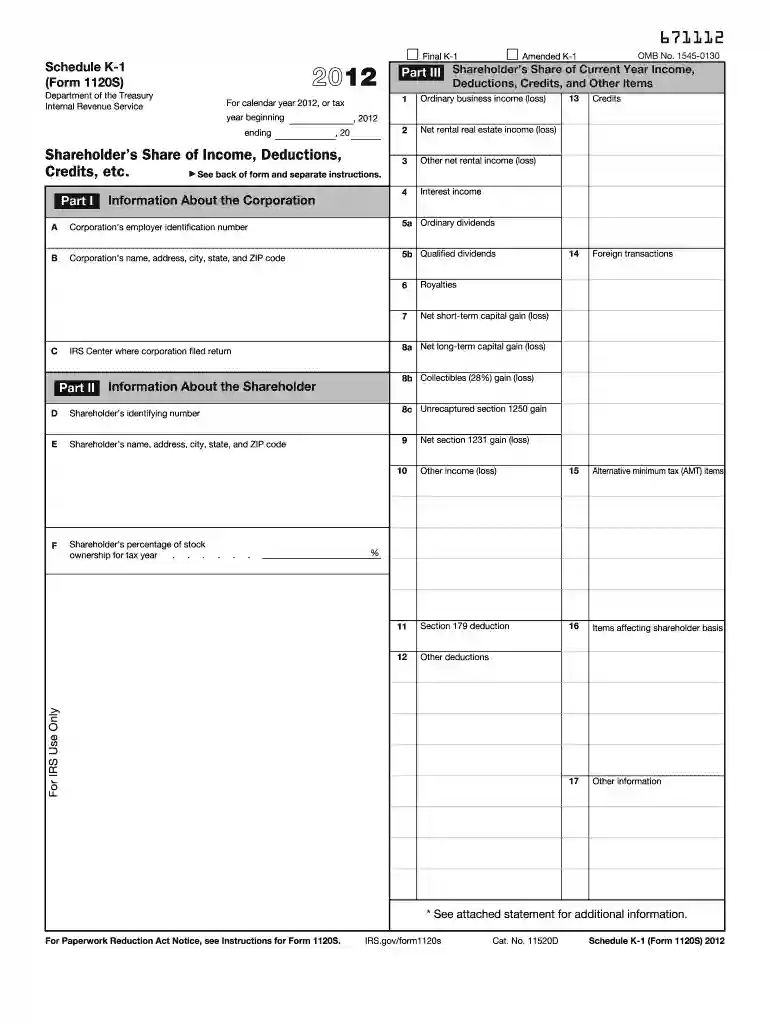
The 1120S Schedule K-1 is a form issued by the Internal Revenue Service (IRS) used for reporting each shareholder's share of income, deductions, credits, etc., from an S corporation for the tax year. For the 2012 tax year, this form served as a crucial document for S corporation shareholders, enabling them to accurately report their share of the corporation's financials on their personal tax returns. The "Schedule K-1 (Form 1120S)" facilitates the flow-through taxation process, where shareholders report these amounts on their individual tax returns to avoid double taxation, reflecting the pass-through of income in the entity.
To effectively use the 1120S K-1 2012 IRS form, shareholders should:
Review Allocated Shares: Examine the form to understand the allocated shares of income and deductions. This involves verifying details like ordinary business income, rental income, and any applicable deductions.
Report on Personal Return: Allocate the reported figures from the Schedule K-1 to their corresponding sections on personal tax forms, such as the IRS Form 1040. For example, business income moves to Schedule E of Form 1040.
Calculate Adjustments: Incorporate any adjustments to basis or loss limitations which can impact the tax liability and permissible deductions.
Retain Documentation: Keep the completed K-1 form along with the personal tax return for a minimum of three years for future verification or audit purposes.
Collect Information: Gather necessary financial and transactional records from the S corporation.
Input Shareholder Information: Fill in pertinent details including the shareholder’s name, address, and taxpayer identification number (TIN).
Record Distributive Shares: Enter each shareholder's portion of income, deductions, credits, and other tax attributes. This requires a comprehensive breakdown into various categories such as ordinary business income or loss, dividend distributions, and foreign transactions, if applicable.
Review and Verify Accuracy: Prior to submission, ensure all data aligns with the S corporation’s financial records. Cross-check figures to confirm accuracy.
Submit and Distribute: Once complete, provide copies to both the IRS and the shareholders by the designated deadlines; this is typically by March 15 if the corporation operates on a calendar year basis.
The primary users of the 1120S K-1 form are shareholders of S corporations. These individuals benefit from this form as it reports their allocable share of the corporation's earnings and operations to be included on personal tax returns. This includes individuals actively involved in the management of the S corporation as well as passive investors seeking to report income from their investment.


Issuance Deadline: The S corporation must disseminate the K-1 forms to all shareholders by March 15, aligning with tax season requirements.
Personal Tax Return Deadline: Shareholders need to incorporate K-1 information into their personal tax filings, typically due by April 15, unless extensions are sought.
Failing to properly fill out and distribute the 1120S K-1 form can result in significant penalties for the S corporation. These include fines for late issuance to shareholders and incorrect or incomplete information reporting. There are also related penalties for shareholders who fail to timely report the data on their own tax returns, potentially leading to additional interest on taxes owed and increased scrutiny from the IRS.
Many taxpayers utilize software solutions such as TurboTax or QuickBooks for accurate processing of the 1120S K-1 forms. These platforms not only streamline calculations but provide easy integration with electronic filings, helping both corporations and individual shareholders manage and submit required information efficiently.
We've got more versions of the 1120s k 1 2012 irs form form. Select the right 1120s k 1 2012 irs form version from the list and start editing it straight away!
| Versions | Form popularity | Fillable & printable |
|---|---|---|
| 2025 | 4.1 Satisfied (37 Votes) | |
| 2024 | 4.3 Satisfied (24 Votes) | |
| 2023 | 4.1 Satisfied (28 Votes) | |
| 2022 | 4.5 Satisfied (32 Votes) | |
| 2021 | 4.8 Satisfied (80 Votes) | |
| 2020 | 4.3 Satisfied (86 Votes) | |
| 2019 | 4.3 Satisfied (67 Votes) | |
| 2018 | 4.3 Satisfied (118 Votes) | |
| 2017 | 4.2 Satisfied (97 Votes) | |
| 2016 | 4.4 Satisfied (267 Votes) | |
| 2015 | 4.2 Satisfied (76 Votes) | |
| 2014 | 4.3 Satisfied (67 Votes) | |
| 2013 | 4 Satisfied (36 Votes) | |
| 2012 | 4 Satisfied (48 Votes) | |
| 2011 | 4.4 Satisfied (26 Votes) |
At DocHub, your data security is our priority. We follow HIPAA, SOC2, GDPR, and other standards, so you can work on your documents with confidence.
Ordinary business income (loss). Determine whether the income (loss) is passive or nonpassive and enter on your return as follows: Report on. Passive loss.Read more
Form 1120S, page 1, and supporting schedules . See instructions . 1 Net income per books . . . . . . . . . . . . . . . . . . . . . 2 Income included onRead more
Aug 1, 2012 Form 1120S, U.S. Income Tax Return for an S. Corporation, is used to report the income, gains, losses, deductions, credits, etc., of a domesticRead more


