




01. Edit your form 8889 t online
Type text, add images, blackout confidential details, add comments, highlights and more.

Type text, add images, blackout confidential details, add comments, highlights and more.

Draw your signature, type it, upload its image, or use your mobile device as a signature pad.

Send 8889 t form via email, link, or fax. You can also download it, export it or print it out.
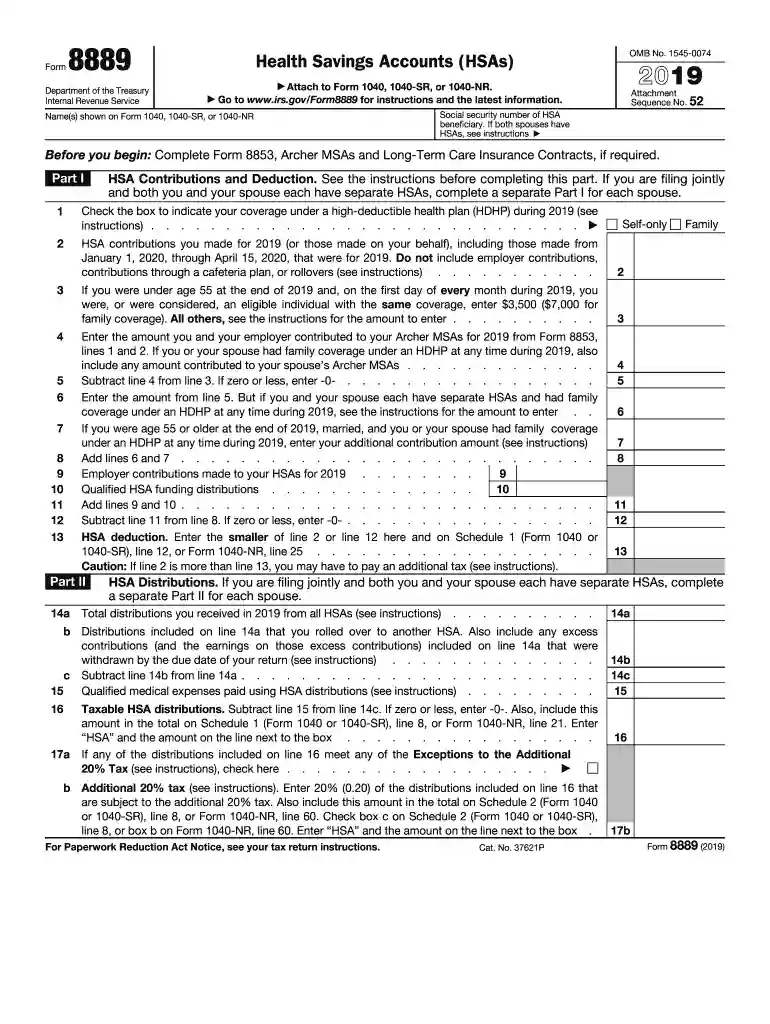
Form 8889 is essential for individuals in the United States who have a Health Savings Account (HSA). It is used to report contributions made to the HSA, claim deductions, report distributions, and calculate any additional taxes related to maintaining an HSA.
If you contribute $3,000 to your HSA, and your annual limit is $3,650, your deduction is straightforward. However, if your contribution exceeds the limit, the form provides a procedure to handle the excess.
Form 8889 includes sections for recording distributions from your HSA, which are typically tax-free if used for qualified medical expenses.
If you used $1,000 from your HSA for medical expenses, those distributions are non-taxable. However, withdrawing $500 for non-medical expenses incurs additional taxes, which Form 8889 helps calculate.
Form 8889 must be attached to your Form 1040, 1040-SR, or 1040-NR when you file your taxes.
Form 8889 is aimed at individuals enrolled in a High-Deductible Health Plan (HDHP) who maintain an HSA. This includes:
Here's a step-by-step process to complete the form efficiently:
Adhering to IRS guidelines is vital when dealing with Form 8889.
Having the correct documentation ready aids in a smooth filing process:
This comprehensive approach to understanding and completing Form 8889 ensures compliance and maximizes the benefits of using an HSA.
We've got more versions of the form 8889 t form. Select the right form 8889 t version from the list and start editing it straight away!
| Versions | Form popularity | Fillable & printable |
|---|---|---|
| 2025 | 4.2 Satisfied (47 Votes) | |
| 2024 | 4.9 Satisfied (35 Votes) | |
| 2023 | 4.7 Satisfied (38 Votes) | |
| 2022 | 4.6 Satisfied (30 Votes) | |
| 2021 | 4.8 Satisfied (199 Votes) | |
| 2020 | 4.4 Satisfied (264 Votes) | |
| 2019 | 4.3 Satisfied (24 Votes) | |
| 2018 | 4.3 Satisfied (31 Votes) | |
| 2017 | 4.2 Satisfied (82 Votes) | |
| 2016 | 4.4 Satisfied (585 Votes) | |
| 2015 | 4 Satisfied (58 Votes) | |
| 2014 | 4 Satisfied (41 Votes) | |
| 2013 | 4 Satisfied (43 Votes) | |
| 2012 | 4.3 Satisfied (68 Votes) | |
| 2011 | 4 Satisfied (56 Votes) |
At DocHub, your data security is our priority. We follow HIPAA, SOC2, GDPR, and other standards, so you can work on your documents with confidence.
May 2, 2017 Also see Form 8889,. Health Savings Accounts (HSAs), and Pub. 969. Lost Form W-2reissued statement. If an employee loses a Form W-2, writeRead more
File Form 8889 with your tax return to report your HSA contributions and distributions. Completing Form 8889 requires information from Form 1099-SA, which showsRead more
Jan 23, 2026 File Form 8889 to: Report health savings account (HSA) contributions (including those made on your behalf and employer contributions).Read more


