




01. Edit your 2017 form 8889 online
Type text, add images, blackout confidential details, add comments, highlights and more.

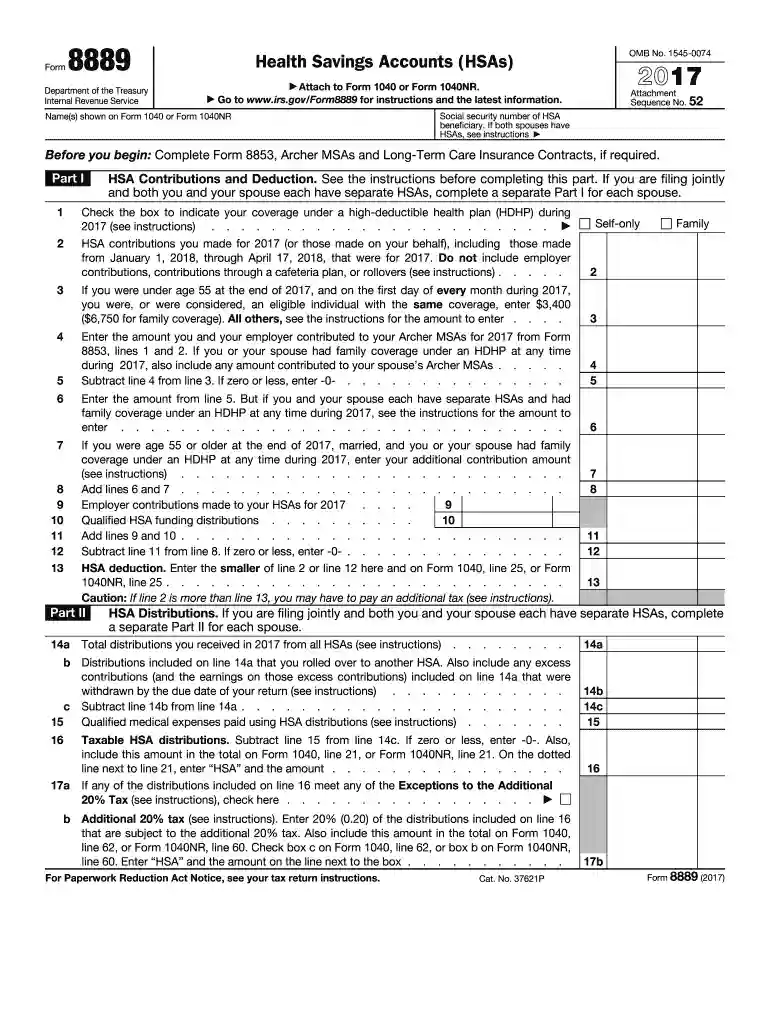
Type text, add images, blackout confidential details, add comments, highlights and more.

Draw your signature, type it, upload its image, or use your mobile device as a signature pad.

Send it via email, link, or fax. You can also download it, export it or print it out.
Form 8889, officially known as the "Health Savings Account (HSA) Contributions and Distributions" form, is used by individuals in the United States to report their Health Savings Account activities for the year 2017. It is a vital document for taxpayers who contribute to or withdraw from an HSA within that tax year. This form is essential for detailing contributions, deductions, and distributions, and must be attached to Form 1040 or Form 1040NR when filing your annual taxes. The information reported on this form helps determine the taxpayer's eligibility for tax deductions or potential penalties.
To effectively use the 8889 Form for the 2017 tax year, individuals need to adhere to the following steps:
Ensure accuracy by double-checking all entries, as mistakes can lead to miscalculations of tax benefits or liabilities.
Filling out the Form 8889 requires careful attention to detail. Here's a step-by-step breakdown:
Using the Form 8889 is crucial for individuals with an HSA, as it:
This form is primarily used by:


According to IRS guidelines, taxpayers using Form 8889 must comply with the following:
When filing Form 8889 for the tax year 2017, it is crucial to adhere to these deadlines:
When completing Form 8889 for the 2017 tax year, ensure you have access to the following:
The accuracy and completeness of these documents are critical to ensure the form reflects truthful and comprehensive data.
We've got more versions of the 2017 form 8889 form. Select the right 2017 form 8889 version from the list and start editing it straight away!
| Versions | Form popularity | Fillable & printable |
|---|---|---|
| 2025 | 4.2 Satisfied (47 Votes) | |
| 2024 | 4.9 Satisfied (35 Votes) | |
| 2023 | 4.7 Satisfied (38 Votes) | |
| 2022 | 4.6 Satisfied (30 Votes) | |
| 2021 | 4.8 Satisfied (199 Votes) | |
| 2020 | 4.4 Satisfied (264 Votes) | |
| 2019 | 4.3 Satisfied (24 Votes) | |
| 2018 | 4.3 Satisfied (31 Votes) | |
| 2017 | 4.2 Satisfied (82 Votes) | |
| 2016 | 4.4 Satisfied (585 Votes) | |
| 2015 | 4 Satisfied (58 Votes) | |
| 2014 | 4 Satisfied (41 Votes) | |
| 2013 | 4 Satisfied (43 Votes) | |
| 2012 | 4.3 Satisfied (68 Votes) | |
| 2011 | 4 Satisfied (56 Votes) |
At DocHub, your data security is our priority. We follow HIPAA, SOC2, GDPR, and other standards, so you can work on your documents with confidence.
Report on Form. 8889, Health Savings Accounts (HSAs). YDeferrals under a section 409A nonqualified deferred compensation plan. Page 5. 2016 W-2 InstructionsRead more
Jan 12, 2018 Use Form 8889 to: Report health savings account (HSA) contributions (including those made on your behalf and employer contributions),. FigureRead more
May 25, 2018 Regardless of mail class, a customs declaration (PS Form 2976, PS. Form 2976-A, or PS Form 2976-B) is required for all items weighing 16.Read more


