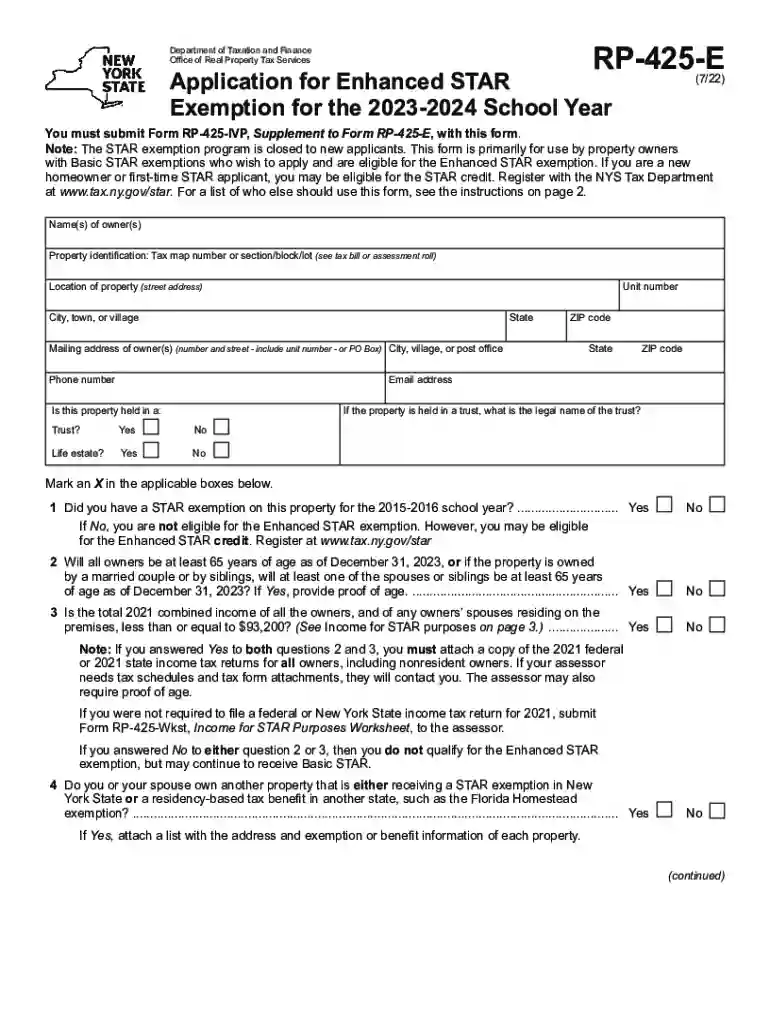
Form RP-425-E Application for Enhanced STAR Exemption for the 2023-2024 School Year Revised 7/22-2026

Get Form
enhanced star application 2024 Preview on Page 1

Here's how it works

01. Edit your enhanced star application 2024 online
Type text, add images, blackout confidential details, add comments, highlights and more.

02. Sign it in a few clicks
Draw your signature, type it, upload its image, or use your mobile device as a signature pad.

03. Share your form with others
Send enhanced star application online via email, link, or fax. You can also download it, export it or print it out.

Definition and Purpose of Form RP-425-E

The Form RP-425-E is specifically designed for property owners seeking an Enhanced STAR exemption for the 2 school year in the state of New York. It is aimed at individuals who already receive the Basic STAR exemption and wish to upgrade to the Enhanced STAR exemption. This form is crucial for applicants who meet certain age and income criteria, enabling them to potentially reduce their property tax bills. The STAR program is essential for New York homeowners, but it is closed to new applicants, making the RP-425-E form applicable only to those seeking changes to existing exemptions.

Eligibility Criteria for Enhanced STAR Exemption

To qualify for the Enhanced STAR exemption through Form RP-425-E, applicants must meet specific eligibility requirements. Primarily, senior homeowners aged 65 or older are eligible, but age is just one facet of the criteria. Additionally, income limits are established and vary annually; for the 2 school year, the household income threshold must be adhered to as defined by the New York State Department of Taxation and Finance. Meeting these conditions is essential for securing the enhanced benefits through this exemption.


decoration image ratings of Dochub

Detailed Requirements

  • Age Requirement: At least one owner must be 65 years old by the end of the year.
  • Income Limit: Total annual income caused by all household members must be below the specified limit.
  • Primary Residence: The property must be the primary residence of the applicant.

How to Obtain Form RP-425-E

Obtaining the Form RP-425-E can be accomplished through several methods. It is available for download from the New York State Department of Taxation and Finance’s website. Applicants may also acquire this form by visiting their local assessor's office in person, ensuring that they receive the most current version. Moreover, it is possible to request a copy by mail directly from the relevant tax authorities, ensuring that no potential applicant is left without access due to digital barriers.

Steps to Complete the Form RP-425-E

Completing Form RP-425-E requires meticulous attention to detail to prevent delays or rejections. The steps outlined here serve as a guide for applicants seeking to correctly fill out this form:

  1. Personal Information: Provide accurate personal and property details.
  2. Income Verification: Attach proof of income that matches or falls below the specified limits.
  3. Proof of Age: Supply necessary documentation confirming that the age criteria is met.
  4. Applications Consolidation: If not previously enrolled, include Form RP-425-IVP with your submission to verify personal identification information.
  5. Certification and Signature: Ensure all parts are correctly filled out, and the declaration is signed.

Required Documents for Submission

Submission of Form RP-425-E necessitates attaching several key documents. These documents must be current and reflect the financial and personal conditions of the applicant and owner of the property:

  • Identification: Government-issued ID showing proof of age.
  • Income Statements: Recent tax returns or income verification documents.
  • Primary Residence Proof: Utility bills or similar documents indicating the property as your main home.

Filing Deadlines and Important Dates

Important deadlines must be strictly observed to retain eligibility. The deadline for submitting Form RP-425-E typically correlates with local assessment periods, often occurring before April 1st of the year preceding the exemption. Therefore, applicants must check with their local assessor’s office for precise deadlines, as these can vary slightly between different jurisdictions within the state.

Submission Methods: Online, Mail, or In-Person

There are several submission methods for the Form RP-425-E, providing flexibility based on applicant preference and accessibility.

  • Online Submission: Some jurisdictions may offer electronic submission; consult the local assessor's website for availability.
  • Mail: Send the completed form and documents via postal services to the assessor’s office.
  • In-Person: Direct submission is preferred for immediate receipt acknowledgment and for seeking clarifications during submission.

Application Process and Approval Timeline

Post-submission, the application undergoes a verification process by the local assessor’s office. The review period may vary, but applicants are typically notified of approval or additional requirements within a few weeks. Understanding this timeline is crucial, as any need for supplementary documentation can impact the overall process duration.

See more Form RP-425-E Application for Enhanced STAR Exemption for the 2023-2024 School Year Revised 7/22 versions

We've got more versions of the Form RP-425-E Application for Enhanced STAR Exemption for the 2023-2024 School Year Revised 7/22 form. Select the right Form RP-425-E Application for Enhanced STAR Exemption for the 2023-2024 School Year Revised 7/22 version from the list and start editing it straight away!
Versions Form popularity Fillable & printable
2023 4.3 Satisfied (39 Votes)
2022 4.7 Satisfied (52 Votes)
2021 4.8 Satisfied (116 Votes)
2020 4.4 Satisfied (136 Votes)
2019 4.4 Satisfied (292 Votes)
2018 4.3 Satisfied (64 Votes)
2018 4.2 Satisfied (85 Votes)
2016 4.4 Satisfied (71 Votes)
be ready to get more

Complete this form in 5 minutes or less

Get form

Got questions?

We have answers to the most popular questions from our customers. If you can't find an answer to your question, please contact us.
Contact us
A tax credit directly reduces how much you owe in taxes. A tax deduction, on the other hand, reduces your taxable income. Tax credits can provide more tax relief than tax deductions in the same amount.
A: No. Once youve registered, well automatically review your eligibility for the credit every year for as long as you continue to own and occupy your home.
A: The main difference is that the STAR exemption reduces your school tax bill while the STAR credit results in a direct payment to you. Another difference is that you may receive a larger benefit if you switch to the STAR credit.
Exemption is a better deal because you get the benefit earlier in the year. The state is offering 2% increase (which is like $20 for me) if you swap from exemption to credit. You dont need to do swap unless you want the 2%.
All primary-residence homeowners are eligible for the Basic STAR exemption, regardless of age or income. The amount of the basic exemption is $30,000, subject to equalization and other adjustments.

Security and compliance

At DocHub, your data security is our priority. We follow HIPAA, SOC2, GDPR, and other standards, so you can work on your documents with confidence.

Learn more
ccpa2
pci-dss
gdpr-compliance
hipaa
soc-compliance

People also ask

In contrast to exemptions and deductions, which reduce a filers taxable income, credits directly reduce a filers tax liability that is, the amount of tax a filer owes.
Yearly STAR exemption amounts YearBASIC STAR $$ savingsSENIOR STAR $$ savings 2020 $1,580.12 $3,592 2021 $1,550.60 $3,592 2022 $1,551 $3,592 2023 $1,392 $3,59222 more rows
After the tentative assessment roll has been filed, property owners who wish to give up their STAR exemptions without switching to the STAR credit must renounce their exemption using Form RP-496, Application to Renounce Previously Granted Exemption(s). The same procedure applies for exemptions granted in prior years.

star application form