







Definition and Purpose of IRS Form 8889
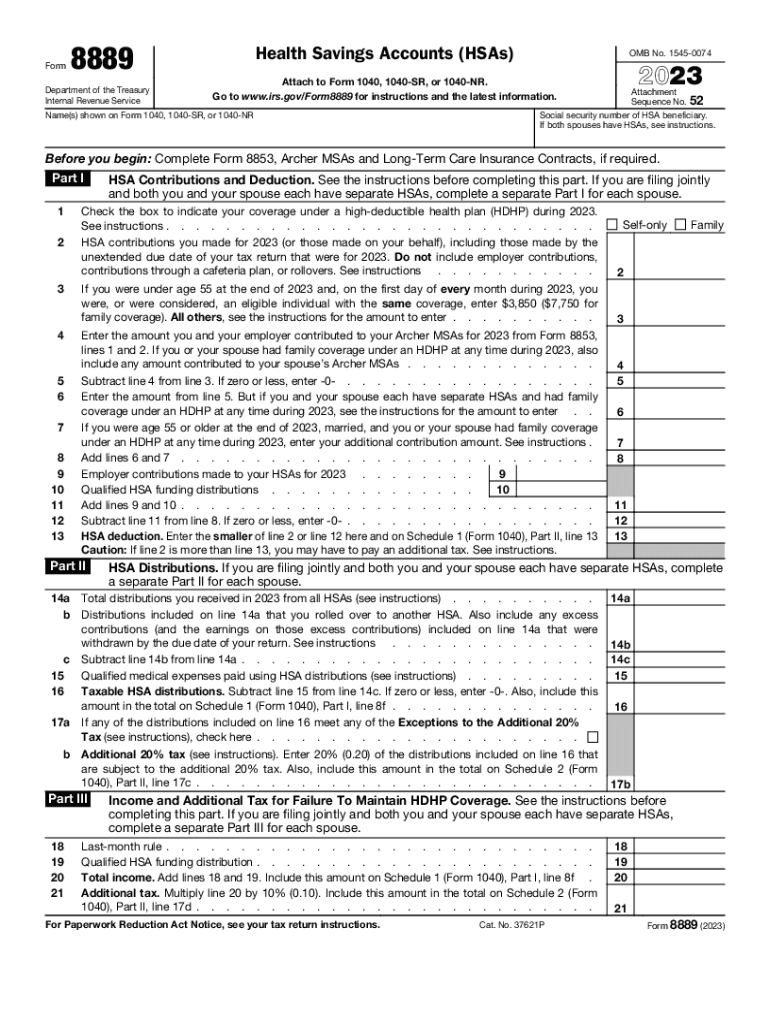
IRS Form 8889 is used to report Health Savings Accounts (HSAs) to the Internal Revenue Service (IRS) for the tax year 2023. Taxpayers who have HSAs need to fill out this form when filing their federal income tax returns using Form 1040, 1040-SR, or 1040-NR. The form manages several critical aspects, such as contributions to HSAs, tax deductions, distributions made from the accounts, and the calculation of any additional taxes owed on HSAs that do not comply with IRS rules.
How to Use IRS Form 8889
To effectively use IRS Form 8889, begin by gathering all pertinent information related to your Health Savings Account. This includes details about contributions made to the HSA, any distributions taken during the tax year, and any other financial activities that may affect the account's standing. The form is divided into parts that cover contributions, distributions, and potential additional taxes, each of which requires careful examination of your financial documentation to ensure accuracy and compliance.
Steps to Complete IRS Form 8889
-
Part I - Contributions and Deductions: Enter the total amount of all HSA contributions made by you or others on your behalf that were not made through payroll deductions. These include personal deposits or any additional funds put into the account.
-
Line-by-Line Completion: Carefully follow each line on the form. Lines one through thirteen are focused on contributions and add-ons. Particular attention should be paid to ensuring that contributions do not exceed IRS-imposed limits.
-
Part II - HSA Distributions: Record any distributions taken from your HSA on lines fourteen through sixteen. You will need to differentiate between distributions used for qualified medical expenses and those used for other purposes, as the latter may incur taxes or penalties.
-
Part III - Income Calculations: This section computes any income that may be subject to additional taxes due to non-qualified distributions or contributions beyond the allowable limit.
-
Review and Finalize: Ensure all data has been accurately recorded and reviewed before submitting.
Important Terms Related to IRS Form 8889
- Health Savings Account (HSA): A savings account used in conjunction with a high-deductible health plan, allowing for tax-advantaged contributions and withdrawals for qualified medical expenses.
- Qualified Medical Expenses: These include medical, dental, and vision expenses approved by the IRS under the regulations governing HSAs.
- Contribution Limits: The IRS sets annual limits on how much an individual and family can contribute to an HSA.
IRS Guidelines and Requirements
Consult the IRS Publication 969 to understand specific guidelines associated with HSAs. This publication provides detailed guidance on what is considered a qualified medical expense and outlines contribution and distribution measures to ensure compliance with tax laws.
Filing Deadlines and Important Dates
- Tax Year: The form typically covers activities within the calendar tax year. Therefore, it must be included with your annual tax filing by the April deadline in the following year.
- Contribution Cut-off Date: Contributions for the previous year can generally be made up until the tax return filing deadline, excluding extensions.
Who Typically Uses IRS Form 8889
Individuals using high-deductible health plans and who have an HSA will need to use Form 8889. This form is necessary for self-employed individuals, freelancers, and employees in high-deductible health plans who want to contribute to their tax-advantaged savings accounts.
Examples of Using IRS Form 8889
-
Example Scenario 1: A taxpayer maxes out their HSA contribution limit and uses all distributions for qualified medical expenses. Here, they only need to record straightforward entries in Parts I and II without triggering additional taxes.
-
Example Scenario 2: An individual taking non-qualified distributions will use the form to calculate taxes owed due to penalties on those distributions, thus filling out Part III to manage applicable taxes.
Guidelines for Form Submission
- Online Submission: You can file Form 8889 electronically if you prepare your taxes using IRS-approved tax software such as TurboTax or QuickBooks.
- Mail Submission: If you prefer filing by mail, be sure to include it with your Form 1040 submission, ensuring all documentation is organized accurately.
Penalties for Non-Compliance
Failing to properly report your HSA activities can result in penalties, especially if non-qualified distributions are taken without being reported, or if contributions exceed the IRS limits. It's crucial to adhere to IRS rules to avoid unexpected fines or audits.
By carefully following these guidelines, you can efficiently manage your Health Savings Account benefits while ensuring compliance with IRS regulations through the accurate completion and submission of Form 8889.




