




01. Edit your form online
Type text, add images, blackout confidential details, add comments, highlights and more.

Type text, add images, blackout confidential details, add comments, highlights and more.

Draw your signature, type it, upload its image, or use your mobile device as a signature pad.

Send it via email, link, or fax. You can also download it, export it or print it out.
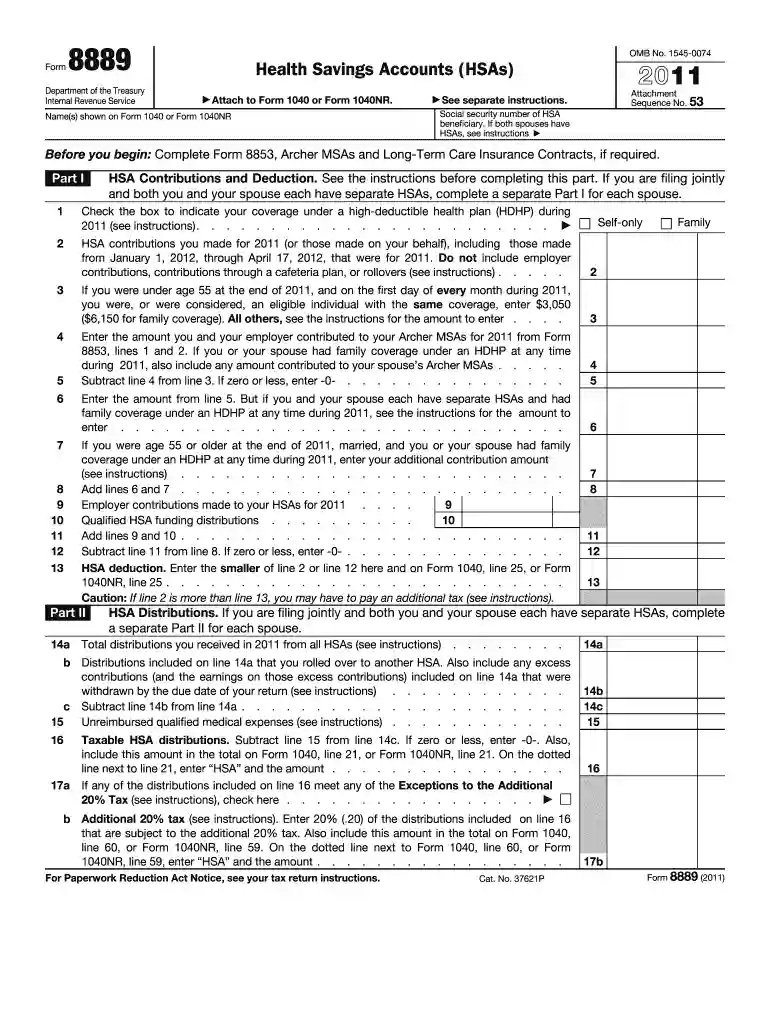
The 2011 Form 8889 is a tax form issued by the Internal Revenue Service (IRS) for taxpayers who have a Health Savings Account (HSA). It is used to report contributions to and distributions from HSAs. The form also captures details related to maintaining a high-deductible health plan (HDHP), which is necessary for making tax-deductible contributions to an HSA. Completing this form is crucial for capitalizing on tax advantages associated with healthcare savings.
Form 8889 is utilized to document the amount contributed to your HSA, any distributions made from the account, and to calculate the HSA deduction. The form ensures that you comply with tax rules on contributions or distributions. When completing this form, taxpayers must provide detailed information about contributions made by themselves and any contributions made by their employers. Any withdrawals, qualifying medical expenses, or any refunds from the HSA should also be stated.
Filing Form 8889 enables you to claim deductions for contributions to your HSA and document withdrawals accurately, which helps maximize tax savings and ensure compliance with IRS regulations. Additionally, the form assists in correctly calculating any taxes or penalties on ineligible expenses, providing a clear view of your financial activities related to health savings.
The form is primarily used by individuals with Health Savings Accounts who satisfy the conditions of an HDHP and who wish to leverage their contributions' tax advantages. Additionally, employers may utilize this form for employees participating in employer-assisted HSA plans. Self-employed individuals who fund personal HSAs also commonly engage with Form 8889.


Legal adherence to IRS mandates, the form confirms correct reporting of contributions and distributions in alignment with U.S. tax law, particularly for HSAs. Misreporting or neglect in filing can lead to penalties, making legal awareness crucial for taxpayers. Compliance ensures that taxpayers don't face unwarranted compliance penalties or challenges from the IRS.
The IRS outlines explicit guidelines for the contributions to HSAs, deductions, and permissible HSA withdrawals. These guidelines are critical in completing the form accurately, ensuring you benefit fully from tax deductions. Following the IRS's rules on what constitutes a qualified medical expense is essential for availing the associated tax advantages.
To accurately complete your 2011 Form 8889, several documents should be readily available:
We've got more versions of the 2011 form 8889 form. Select the right 2011 form 8889 version from the list and start editing it straight away!
| Versions | Form popularity | Fillable & printable |
|---|---|---|
| 2025 | 4.2 Satisfied (47 Votes) | |
| 2024 | 4.9 Satisfied (35 Votes) | |
| 2023 | 4.7 Satisfied (38 Votes) | |
| 2022 | 4.6 Satisfied (30 Votes) | |
| 2021 | 4.8 Satisfied (199 Votes) | |
| 2020 | 4.4 Satisfied (264 Votes) | |
| 2019 | 4.3 Satisfied (24 Votes) | |
| 2018 | 4.3 Satisfied (31 Votes) | |
| 2017 | 4.2 Satisfied (82 Votes) | |
| 2016 | 4.4 Satisfied (585 Votes) | |
| 2015 | 4 Satisfied (58 Votes) | |
| 2014 | 4 Satisfied (41 Votes) | |
| 2013 | 4 Satisfied (43 Votes) | |
| 2012 | 4.3 Satisfied (68 Votes) | |
| 2011 | 4 Satisfied (56 Votes) |
At DocHub, your data security is our priority. We follow HIPAA, SOC2, GDPR, and other standards, so you can work on your documents with confidence.
Form 8889 (2011) If you are filing jointly and both you and your spouse each have separate HSAs, complete a separate Part III for each spouse. Form 8889 (2011).Read more
For Paperwork Reduction Act Notice, see your tax return instructions. Cat. No. 37621P. Form 8889 (2011). Page 2. Form 8889 (2011). Page 2. Part III. Income andRead more


