




01. Edit your 3520 form 2022 online
Type text, add images, blackout confidential details, add comments, highlights and more.

Type text, add images, blackout confidential details, add comments, highlights and more.

Draw your signature, type it, upload its image, or use your mobile device as a signature pad.

Send form 3520 2022 via email, link, or fax. You can also download it, export it or print it out.
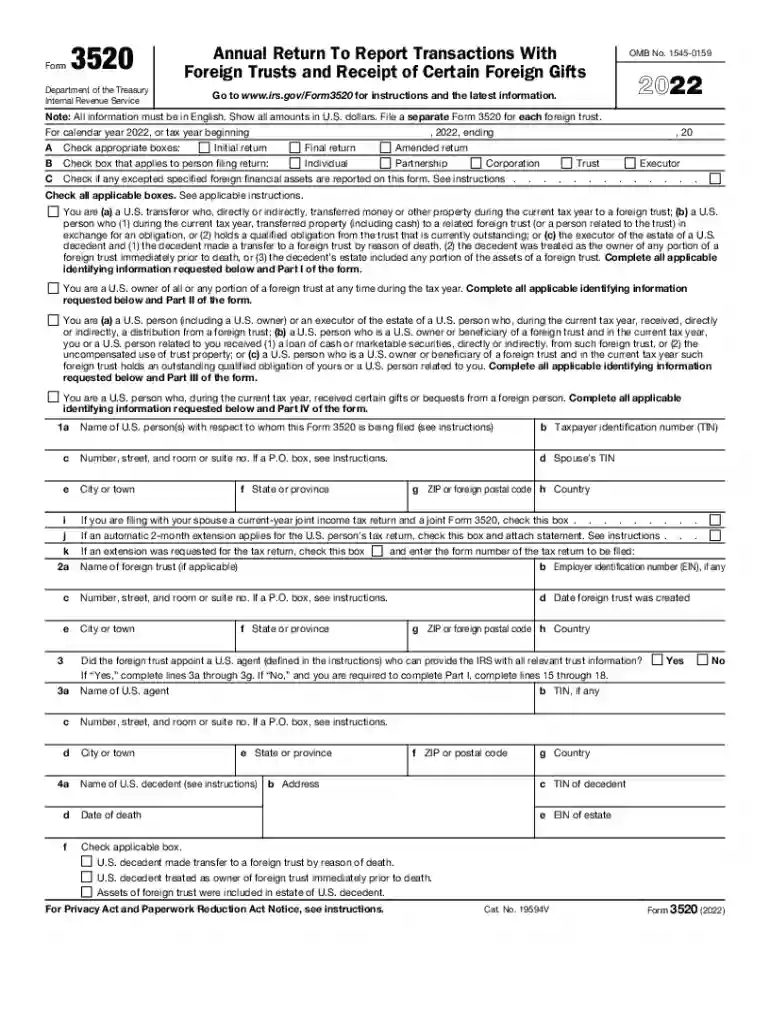
Form 3520, officially known as the Annual Return to Report Transactions with Foreign Trusts and Receipt of Certain Foreign Gifts, is a critical document required by the U.S. Internal Revenue Service (IRS). U.S. persons who have engaged in transactions involving foreign trusts or received substantial gifts or bequests from foreign individuals or entities are obligated to file this form. The goal is to ensure transparency and compliance with U.S. tax regulations regarding foreign income and assets.
Filing Form 3520 is essential to comply with federal tax laws that monitor international financial activities. It helps the IRS track the transfer of assets and funds from foreign connections, ensuring that U.S. taxpayers report foreign income and pay applicable taxes. Non-compliance can lead to significant penalties, emphasizing the importance of timely and accurate filing.
Completing Form 3520 involves several key steps designed to capture comprehensive information about the filer’s involvement with foreign trusts or monetary gifts:
Supporting documents may include:
The deadline for filing Form 3520 typically aligns with the U.S. tax return deadline, which is April 15. Extensions may be filed, but this does not affect any penalties associated with late filing of the form itself.
Form 3520 can be submitted:
Failure to file Form 3520 on time or inaccurately can result in heavy penalties. The IRS imposes severe fines, which can be calculated as a percentage of the non-reported amount:
In cases of fraudulence or willful neglect, additional legal actions may be pursued by the IRS.
The IRS has established comprehensive guidelines to facilitate accurate reporting on Form 3520. These guidelines outline the necessity to disclose:
Full disclosure is mandated to prevent underreporting of foreign transactions. Taxpayers are urged to accurately present all applicable data as provided in the IRS instructions for Form 3520, ensuring responsible reporting.
Form 3520 must be filed by:


Common scenarios requiring Form 3520 filing include:
Tax software like TurboTax and QuickBooks offers limited direct support for Form 3520 due to its complexity, but they provide resources for integrating data with broader tax filings. Consulting tax professionals or dedicated international tax software is often recommended for complex filings.
While the form can be completed digitally for ease of use, it often needs to be printed and mailed due to specific IRS requirements. Maintaining digital records for personal verification is advisable.
By understanding the intricacies of Form 3520, individuals can ensure compliance with international tax regulations, minimize penalties, and efficiently manage their international financial interactions.
We've got more versions of the 3520 form 2022 form. Select the right 3520 form 2022 version from the list and start editing it straight away!
| Versions | Form popularity | Fillable & printable |
|---|---|---|
| 2023 | 4.9 Satisfied (32 Votes) | |
| 2022 | 4.5 Satisfied (49 Votes) | |
| 2021 | 4.8 Satisfied (105 Votes) | |
| 2020 | 4.3 Satisfied (48 Votes) | |
| 2019 | 4.3 Satisfied (101 Votes) | |
| 2018 | 4.3 Satisfied (103 Votes) | |
| 2017 | 4.2 Satisfied (63 Votes) | |
| 2016 | 4.4 Satisfied (595 Votes) | |
| 2015 | 4.1 Satisfied (31 Votes) | |
| 2014 | 4 Satisfied (28 Votes) | |
| 2013 | 4 Satisfied (27 Votes) | |
| 2012 | 3.8 Satisfied (41 Votes) | |
| 2010 | 4 Satisfied (39 Votes) |
At DocHub, your data security is our priority. We follow HIPAA, SOC2, GDPR, and other standards, so you can work on your documents with confidence.


