




01. Edit your form 3520 online
Type text, add images, blackout confidential details, add comments, highlights and more.

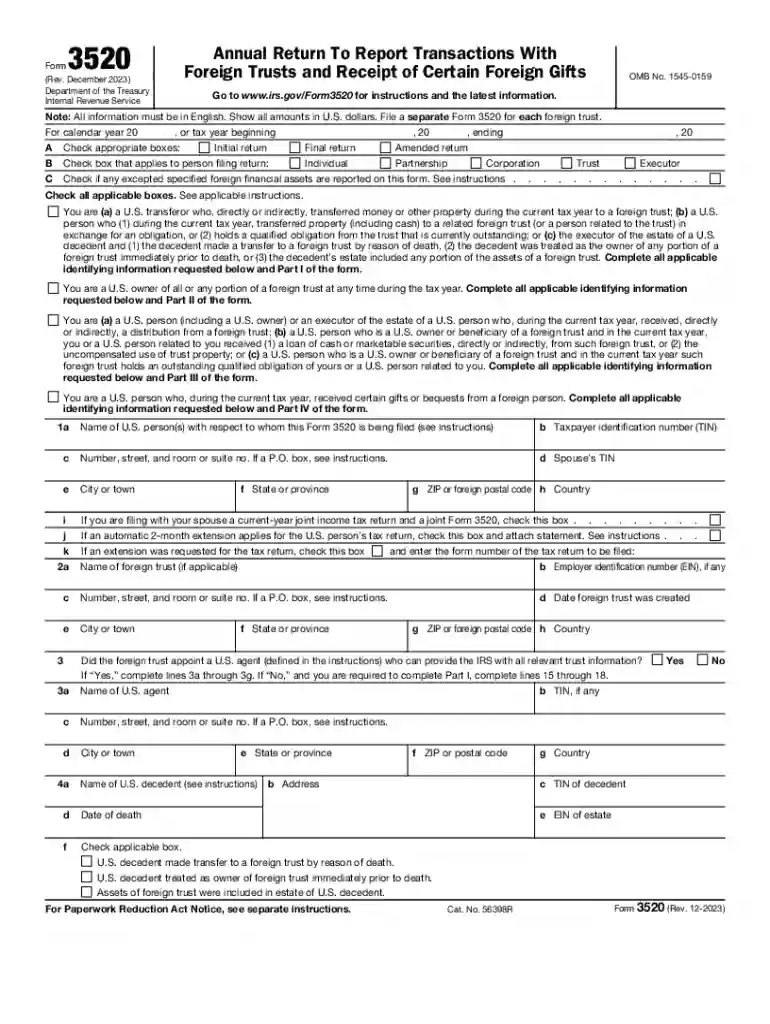
Type text, add images, blackout confidential details, add comments, highlights and more.

Draw your signature, type it, upload its image, or use your mobile device as a signature pad.

Send form 3520 pdf via email, link, or fax. You can also download it, export it or print it out.
Form 3520, officially known as the "Annual Return To Report Transactions With Foreign Trusts and Receipt of Certain Foreign Gifts," is a critical document mandated by the IRS for U.S. persons involved with foreign trusts or receiving substantial foreign gifts. This form allows the IRS to track and regulate financial transactions involving foreign entities, ensuring compliance with U.S. tax laws and helping prevent tax evasion. It includes sections for reporting various interactions, such as transfers to foreign trusts, ownership interests in foreign trusts, and details of foreign gifts.
Using Form 3520 involves accurately reporting financial interactions with foreign entities to the IRS. It's crucial for individuals to determine their specific situation—whether they're reporting a trust transaction, a received foreign gift, or both. The form includes multiple sections requiring detailed information about the trust entity or the gift received, including values, dates, and other pertinent details. Understanding the full scope of your obligations when interacting with this form is essential to avoid penalties.
Completing Form 3520 requires careful attention to detail and thorough documentation. The process includes:
Form 3520 is primarily used by U.S. citizens and residents who have dealings with foreign trusts or receive certain foreign gifts. This may include:
Under IRS guidelines, any U.S. person involved with foreign trusts or receiving gifts above a specific threshold must file Form 3520. Compliance is crucial, as non-compliance leads to severe penalties. The IRS offers detailed instructions to assist filers in accurately completing the form and ensuring that they meet all related obligations.
The filing deadline for Form 3520 generally coincides with the deadline for the individual’s U.S. federal tax return. For most calendar-year taxpayers, this date falls on April 15. However, extensions are available, moving the deadline to October 15 if properly requested.
Penalties for failing to file Form 3520 can be severe. The IRS imposes penalties starting at $10,000 for failing to file or for filing incorrect information. Additional penalties can accrue for continued non-compliance, including a percentage of the foreign trust amount or foreign gift if not reported.
Filing Form 3520 necessitates various documents to verify the details of transactions or gifts reported. Required documents may include:
Developing a systematic approach to managing these documents throughout the year can aid in efficient filing and minimize the risk of errors.
We've got more versions of the form 3520 form. Select the right form 3520 version from the list and start editing it straight away!
| Versions | Form popularity | Fillable & printable |
|---|---|---|
| 2023 | 4.9 Satisfied (32 Votes) | |
| 2022 | 4.5 Satisfied (49 Votes) | |
| 2021 | 4.8 Satisfied (105 Votes) | |
| 2020 | 4.3 Satisfied (48 Votes) | |
| 2019 | 4.3 Satisfied (101 Votes) | |
| 2018 | 4.3 Satisfied (103 Votes) | |
| 2017 | 4.2 Satisfied (63 Votes) | |
| 2016 | 4.4 Satisfied (595 Votes) | |
| 2015 | 4.1 Satisfied (31 Votes) | |
| 2014 | 4 Satisfied (28 Votes) | |
| 2013 | 4 Satisfied (27 Votes) | |
| 2012 | 3.8 Satisfied (41 Votes) | |
| 2010 | 4 Satisfied (39 Votes) |
At DocHub, your data security is our priority. We follow HIPAA, SOC2, GDPR, and other standards, so you can work on your documents with confidence.
Apr 29, 2026 U.S. persons (and executors of estates of U.S. decedents) file Form 3520 to report: Certain transactions with foreign trusts.Read more
Nov 14, 2023 Form 3520, Annual Return To Report Transactions With Foreign Trusts and Receipt of Certain Foreign Gifts,


