




01. Edit your 3520 instructions 2021 online
Type text, add images, blackout confidential details, add comments, highlights and more.

Type text, add images, blackout confidential details, add comments, highlights and more.

Draw your signature, type it, upload its image, or use your mobile device as a signature pad.

Send form 3520 instructions 2021 via email, link, or fax. You can also download it, export it or print it out.
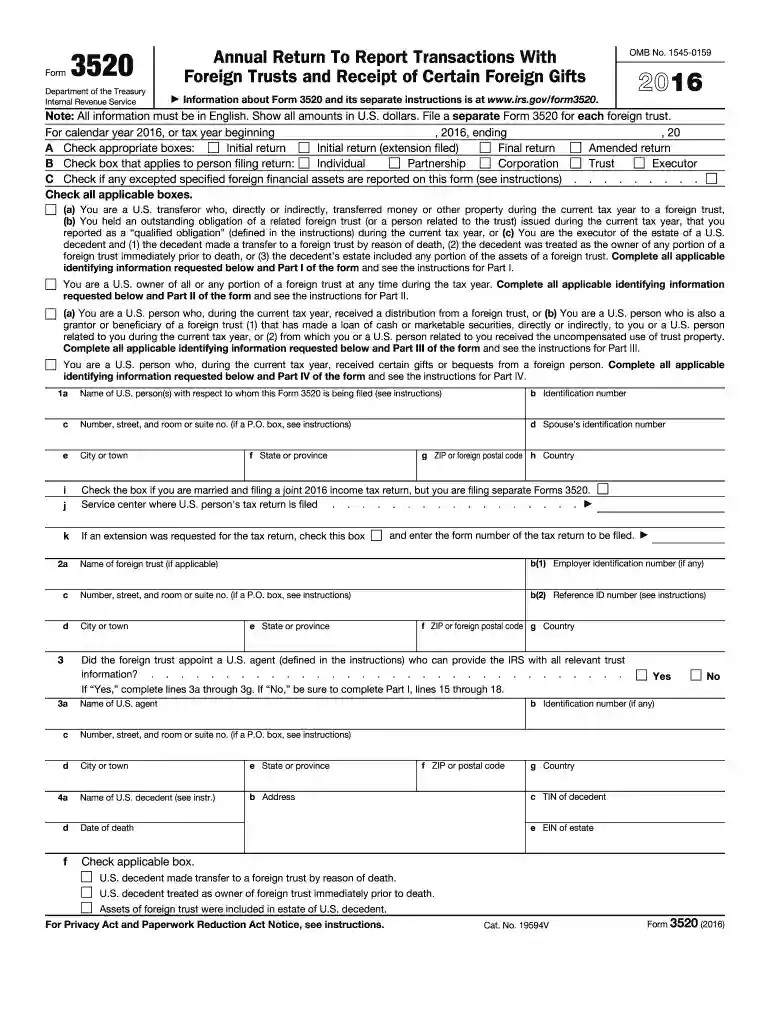
Form 3520 is an annual return required by the IRS for U.S. persons who engage in transactions with foreign trusts, or who receive certain foreign gifts. The 2016 version of this form ensures compliance with IRS regulations for that particular tax year. It records transfers to foreign trusts, distributions received, and gifts or bequests from foreign persons.
Understanding the purpose and use of Form 3520 helps ensure timely and accurate reporting, fulfilling obligations under U.S. tax law.
To acquire Form 3520 for the year 2016, individuals have multiple options. The form is available directly from the IRS website, where it can be downloaded as a PDF. Alternatively, taxpayers can request a copy by calling the IRS or visiting an IRS office.
Incorporating the right approach to obtain the form fits into the broader task of managing compliance with international transaction reporting.
Completing Form 3520 involves attention to detail and understanding specific IRS-related requirements. Here’s a general step-by-step process:
These steps guide through the form, emphasizing correct entries and full disclosure.
Form 3520 is predominantly utilized by U.S. persons involved in financial transactions with non-U.S. entities. This includes:
Understanding the target users aids in recognizing one's obligations regarding foreign financial interactions.
Familiarizing oneself with specific terms is essential:
Grasping these terms aids in interpreting the form's language and requirements.
The IRS outlines specific guidelines to ensure compliance with reporting standards. Key points include:
Adhering to these guidelines helps prevent compliance issues and potential penalties.
Important dates include:
Timely filing eludes late penalties and interest.
Failure to file Form 3520 can incur significant penalties:
Understanding the ramifications of non-compliance underscores the importance of timely and accurate filing.
We've got more versions of the 3520 instructions 2021 form. Select the right 3520 instructions 2021 version from the list and start editing it straight away!
| Versions | Form popularity | Fillable & printable |
|---|---|---|
| 2023 | 4.9 Satisfied (32 Votes) | |
| 2022 | 4.5 Satisfied (49 Votes) | |
| 2021 | 4.8 Satisfied (105 Votes) | |
| 2020 | 4.3 Satisfied (48 Votes) | |
| 2019 | 4.3 Satisfied (101 Votes) | |
| 2018 | 4.3 Satisfied (103 Votes) | |
| 2017 | 4.2 Satisfied (63 Votes) | |
| 2016 | 4.4 Satisfied (595 Votes) | |
| 2015 | 4.1 Satisfied (31 Votes) | |
| 2014 | 4 Satisfied (28 Votes) | |
| 2013 | 4 Satisfied (27 Votes) | |
| 2012 | 3.8 Satisfied (41 Votes) | |
| 2010 | 4 Satisfied (39 Votes) |
At DocHub, your data security is our priority. We follow HIPAA, SOC2, GDPR, and other standards, so you can work on your documents with confidence.
For calendar year 2016, or tax year beginning. , 2016, ending. , 20. A Check appropriate boxes: Initial return. Initial return (extension filed). Final return.Read more
The Product Registration Inspection Certificate along with the original billing invoice Owners Registration Form must be completed in full andRead more
by S Amin CPA 2017 The trustee of a foreign grantor trust is required to file Form 3520


