




01. Edit your form online
Type text, add images, blackout confidential details, add comments, highlights and more.

Type text, add images, blackout confidential details, add comments, highlights and more.

Draw your signature, type it, upload its image, or use your mobile device as a signature pad.

Send it via email, link, or fax. You can also download it, export it or print it out.
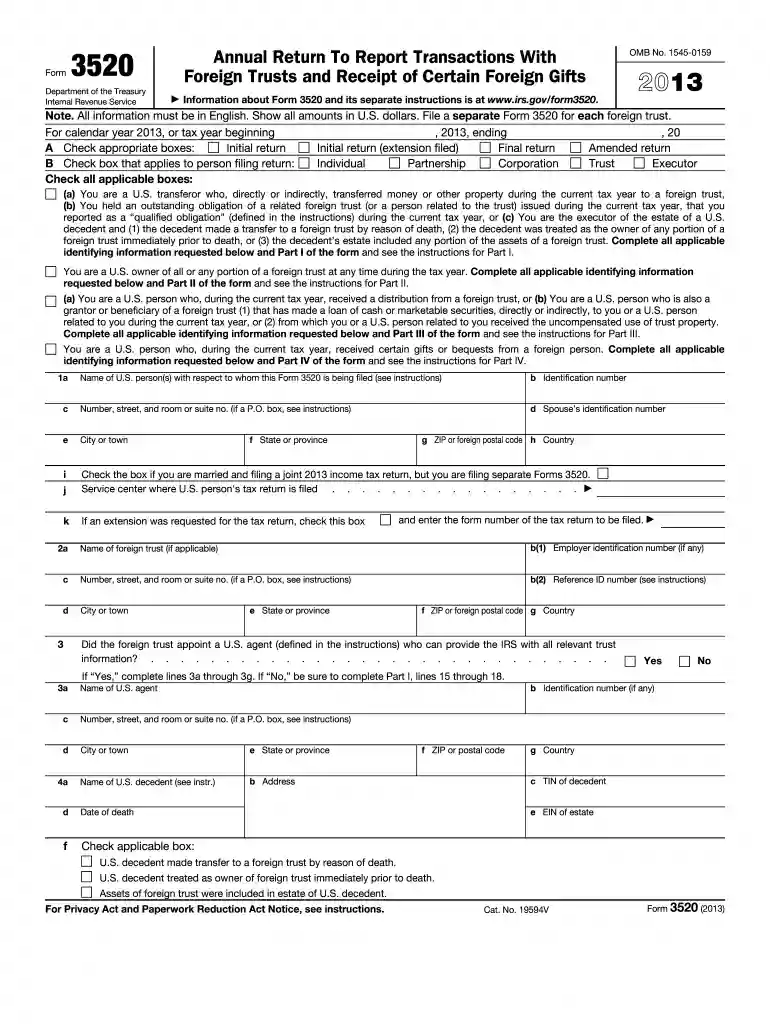
Form 3520 is an essential IRS document required for U.S. persons who engage in transactions with foreign trusts or receive certain foreign gifts. This form is primarily used to report transfers to and distributions from foreign trusts and to document extensive details about gifts or bequests received from non-U.S. persons. The information provided helps the IRS monitor these transactions and ensure compliance with tax obligations associated with foreign assets, fostering transparency and aiding in the prevention of tax evasion.
Filing Form 3520 coincides with your federal tax return deadline, typically April 15 for most filers. If residing outside the United States, an automatic two-month extension may apply, pushing the deadline to June 15. Filing an extension for your federal return also extends the Form 3520 deadline. Be mindful of these dates to avoid penalties.
Failure to file Form 3520 or providing inaccurate information can result in severe financial penalties. The IRS may impose fines amounting to 35% of the transfer or distribution amount not adequately reported. Additional penalties may apply for continued non-compliance, emphasizing the importance of accurate and timely submissions.
Form 3520 plays a critical role in maintaining compliance with U.S. tax laws related to foreign financial activities. Accurate reporting supports lawful participation in global transactions while adhering to the Internal Revenue Code provisions. Consulting a tax advisor or legal expert may be beneficial in navigating complex filings.
This form is primarily utilized by U.S. persons, including citizens, resident aliens, and domestic entities like corporations, who interact financially with foreign trusts or receive significant foreign gifts. These individuals and entities are legally obligated to report such international financial activities to the IRS for transparency and tax compliance.


Form 3520 is available in both digital and paper formats, allowing filers flexibility. Electronic filing is particularly convenient, offering speed and efficiency in submission. However, those preferring traditional methods can complete and mail a physical copy. Ensure security measures are adhered to, especially with electronic submissions, to guard sensitive information.
We've got more versions of the 2013 form 3520 form. Select the right 2013 form 3520 version from the list and start editing it straight away!
| Versions | Form popularity | Fillable & printable |
|---|---|---|
| 2023 | 4.9 Satisfied (32 Votes) | |
| 2022 | 4.5 Satisfied (49 Votes) | |
| 2021 | 4.8 Satisfied (105 Votes) | |
| 2020 | 4.3 Satisfied (48 Votes) | |
| 2019 | 4.3 Satisfied (101 Votes) | |
| 2018 | 4.3 Satisfied (103 Votes) | |
| 2017 | 4.2 Satisfied (63 Votes) | |
| 2016 | 4.4 Satisfied (595 Votes) | |
| 2015 | 4.1 Satisfied (31 Votes) | |
| 2014 | 4 Satisfied (28 Votes) | |
| 2013 | 4 Satisfied (27 Votes) | |
| 2012 | 3.8 Satisfied (41 Votes) | |
| 2010 | 4 Satisfied (39 Votes) |
At DocHub, your data security is our priority. We follow HIPAA, SOC2, GDPR, and other standards, so you can work on your documents with confidence.
File a separate Form 3520 for each foreign trust. For calendar year 2013, or tax year beginning. , 2013, ending. , 20. A Check appropriate boxes:.Read more
(iii) The Form 8938 filed by the specified person for the taxable year reports the filing of the Form 3520 and Form 3520-A. (3) Joint Form 5471 or Form 8865Read more


